Tamara Omairi
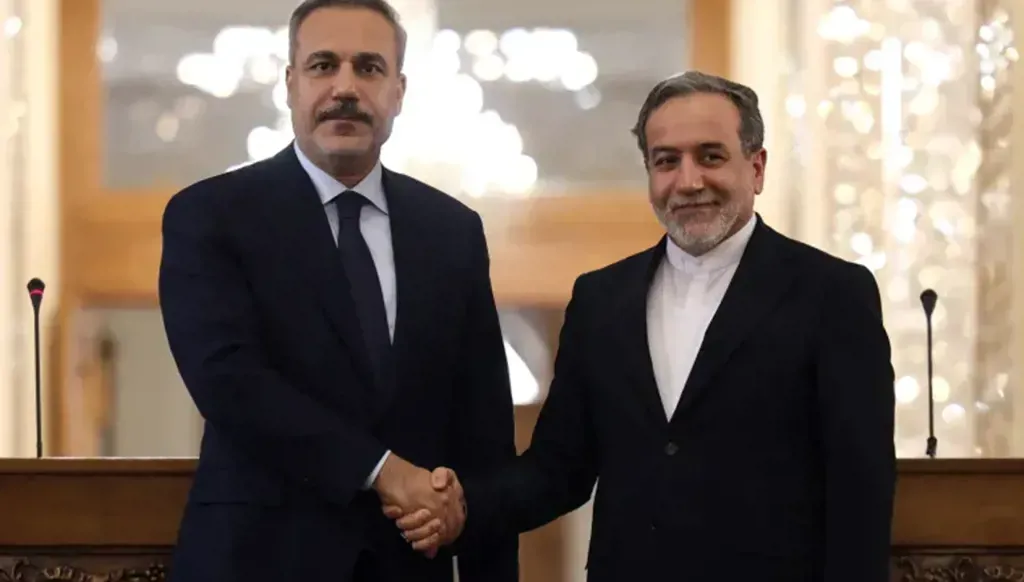
They fight each other by proxy in Syria; one is a NATO member, the other a declared enemy of the West, and yet Turkey and Iran have not altered their shared border since 1639. Dependent on Iranian gas and facing the same Kurdish threat, Ankara maintains a “controlled rivalry” with Tehran, where regional crises are carefully kept separate from economic exchanges.
I- A Border Older Than Both Regimes
Back in 1639, while Louis XIII was still reigning over France, the Ottoman Empire and Safavid Persia signed the Treaty of Qasr-e Shirin, drawing a 560-kilometer border between them. Nearly four centuries later, that very line remains virtually untouched. Empires fell, regimes crumbled, and massive political earthquakes shook both nations, from Mustafa Kemal’s founding of a secular Turkish republic in 1923 to the sweeping drama of the Iranian Islamic Revolution in 1979. Ankara and Tehran have reinvented themselves, sometimes radically, but their shared border has stood completely still.
This stability is no accident
Bilateral dialogue is partly conducted through institutional mechanisms, including the High-Level Cooperation Council established in 2014. This council regularly brings together the presidents and ministers of both countries. Eight meetings have already taken place. This framework allows for the setting aside of regional crises, such as those in Syria and Iraq, to focus on managing day-to-day issues.
The two states have also signed some fifty bilateral agreements. Road crossings have proliferated in recent years, increasing from two to several border posts. Consequently, on both sides, customs officials and government agencies must cooperate daily to facilitate trade. This process is part of the doctrine of strategic depth, through which Ankara seeks to transform the border from a secure buffer zone into an economic transit area.
For both Ankara and Tehran, challenging this border demarcation would be extremely costly. Good neighborliness is therefore not an ideological choice; it is a geographical necessity.
II- Gas and the Kurdish Fear: The Cement of the Partnership
Between Ankara and Tehran, regional rivalry is constant, but it remains under control. Behind official pronouncements, material and security realities force the two neighbors to cooperate. This cold realism dictates their daily interactions.
Gas: A Mutual Dependency
Energy is the first pillar of this partnership. Turkey depends on Iran for approximately 15 to 16% of its natural gas imports. For Ankara, a winter gas outage paralyzes the national economy. Iran, for its part, suffers from severe international isolation. Tehran therefore uses the Turkish border to circumvent Western sanctions. The two countries set aside their deep disagreements over Syria and Iraq to protect these vital resources.
The Kurdish Question: A Shared Fear
The Kurdish question cements their security cooperation. For both Ankara and
Tehran, the prospect of an independent Kurdistan has always been a red line, a direct, existential threat to their respective borders.This shared anxiety is what forced the two historic rivals to the negotiating table in the early 1990s, yielding a landmark security pact in 1992 and a follow-up protocol in 1993.Under these deals, both capitals pledged to actively stop armed Kurdish separatists from using their territories as launchpads, specifically targeting the Kurdistan Workers' Party (PKK) and its Iranian equivalent, the PJAK (free life party of Kurdistan)
Yet, this shared struggle does not erase mutual suspicion. Ankara regularly accuses Tehran of using the PKK as leverage ; a trust issue dating back to at least 1997, when the Turkish military openly accused Iran of housing PKK training camps on its soil. Tehran, for its part, fears Turkish backing for Iranian Kurdish dissidents, especially PJAK.
This deep-seated mistrust stems from how differently each nation treats its Kurdish population. Turkey has pursued strict assimilation, actively suppressing Kurdish cultural identity within its borders, whereas Iran has tolerated Kurdish cultural expression but ruthlessly crushed any hint of political autonomy or self-rule.
In the end, they don't cooperate because they trust each other. They cooperate because they have no choice.
III- Syria, the Theater of Their RivalrySince 2011, Syria has served as the central arena for the geopolitical rivalry between Turkey and Iran. Their strategic objectives in the conflict directly contradicted one another: Ankara actively backed Sunni rebel groups in an effort to oust Damascus, eventually establishing control over northern Syrian territories such as Afrin and Idlib. Conversely, Tehran mobilized extensive resources, primarily through the Islamic Revolutionary Guard Corps' Quds Force, to secure the survival of Bashar al-Assad's government. This clash was driven by fundamental strategic differences, as Iran viewed the Alawite regime as an indispensable pillar of its regional power projection, whereas Turkey perceived it as an illegitimate dictatorship suppressing a popular uprising.
A Proxy War
On the ground, both countries avoid any direct military confrontation. They delegate the fighting to proxy actors. Iran uses the Lebanese Hezbollah and various Shiite militias. Turkey, for its part, relies on Syrian rebel groups. This use of proxies makes it possible to continue the fight without ever triggering an open bilateral war.
Dialogue Maintained Despite Everything
Yet, this tectonic clash has not broken off dialogue. The two capitals strictly compartmentalize their disagreements. Even when their interests clash in Damascus, they still speak to each other at regular summits. They maintain their 50 bilateral agreements to protect their gas and goods trade.
This ability to negotiate despite the war demonstrates a pragmatism dictated by survival. But this crisis diplomacy encounters a major obstacle: Turkey's Western and Atlantic ties, which weigh heavily on mutual trust.
IV- Ankara as Mediator, but Under NATO's Watchful Eye
Turkey actively uses its geographical position to establish itself as an indispensable regional mediator. Ankara has turned this into a diplomatic routine. Back in 2010, Ankara teamed up with Brazil to broker a gutsy, tripartite uranium-swap deal with Tehran , a bold bid to offer Iran a viable alternative to suffocating Western sanctions. More recently, when widespread popular protests shook Iranian cities between 2025 and 2026, Turkey carefully chose quiet diplomacy over public condemnation. By framing the unrest as a strictly internal matter and flatly rejecting any foreign military intervention, Ankara shielded its vital relationship with its neighbor. It is this same calculated neutrality that drives President Erdoğan to regularly pitch Istanbul as the ultimate neutral ground for Washington and Tehran to finally sit down and talk.
But this diplomatic activism runs up against a major structural obstacle: Turkey's membership in NATO since 1952. For Tehran, this Western military alliance constitutes a security architecture that is inherently hostile. The specific case of the Kürecik radar, installed on Turkish soil, crystallizes all the tensions: Iran sees it as a device directly used by the United States to monitor and intercept its own missiles. This military installation undermines Ankara's credibility when it attempts to present itself as a neutral and independent intermediary in the eyes of the Iranian authorities.
Therefore, Turkish diplomacy must maintain a constant and delicate balance: preserving its vital Western alliances without severing dialogue with its Iranian neighbor. This geopolitical constraint prevents their technical cooperation from evolving into a genuine strategic alliance.
While Ankara and Tehran remain compelled to reach an agreement to stabilize their shared border, they continue to monitor each other closely. Ultimately, Turkey's Atlantic stance remains an insurmountable barrier to any profound understanding.
Conclusion
Ultimately, the relationship between Ankara and Tehran remains a "rivalry under control." Here, pragmatism is not a matter of political or ideological affinity, but a pure necessity for the survival of both powers.
Three unshakeable pillars underpin this balance, which has endured for centuries. First, there is a physical border that has remained unchanged since 1639. Second, there is Turkey's dependence on Iranian gas (to the tune of 15 to 16%), and finally, the mutual fear of Kurdish separatism on their doorstep. These vital material and security interests compel the two capitals to compartmentalize their disagreements. They carefully isolate regional crises, such as in Syria, in order to continue trading and communicating through their institutional channels
.
Everything now hinges on two unknowns: Ankara's room for maneuver vis-à-vis the West, and the Iranian regime's capacity to withstand internal and international pressure.







 واتساب
 يوتيوب
 انستغرام
 نبض
نبض
 ثريدز
ثريدز


 مسنجر
مسنجر
 بريد إلكتروني
 الطباعة