Lebanon’s winter tourism: A seasonal boost, not a recovery



شارك على
 مسنجر
مسنجر
 واتساب
 ثريدز
ثريدز
 بريد إلكتروني
 الطباعة
شارك على


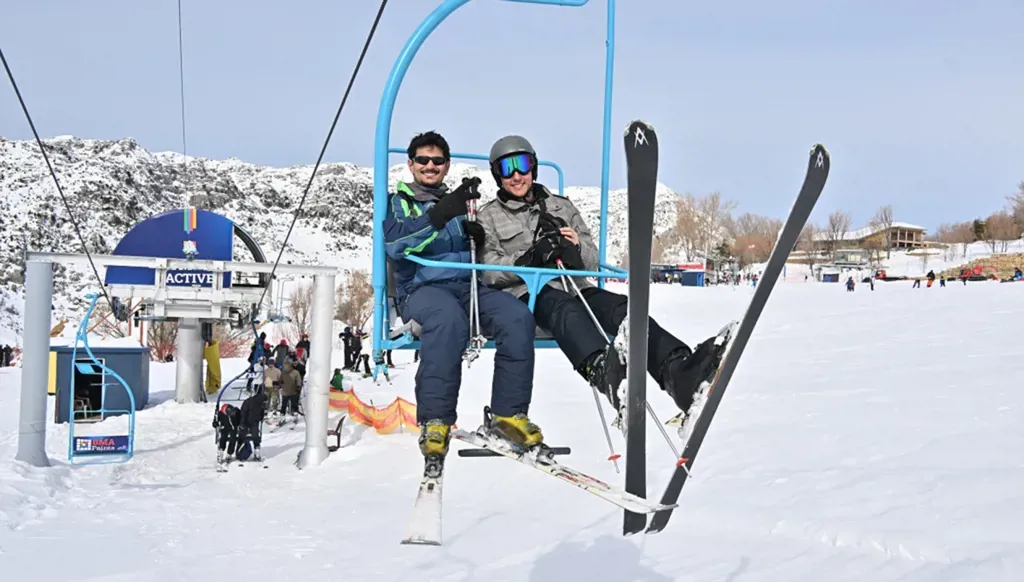


Under a sky clouded by political and economic anxiety, winter tourism in Lebanon is trying to carve out a path as a seasonal window of hope, reflecting localized economic vitality rather than a genuine recovery. Despite possessing rare attractions within its Arab surroundings, most notably alpine skiing, winter tourism remains confined by mountain geography and activities and is unable on its own to become a true economic driver.
This winter’s scene, according to Pierre Achkar, head of the Syndicate of Tourism Institutions, “appears relatively promising, but limited in substance and in its ability to generate sustainable revenues, even though the initial results carry positive signals. January and February recorded good booking activity, with near-full occupancy on January weekends, and expectations that February will be more active due to school holidays and festive occasions. However, bookings show short stays of no more than three days, alongside longer stays ranging between five and ten days, particularly from Egyptian, Kuwaiti, and Emirati visitors".
According to Achkar, reassurance from the President of the Republic that there would be no war on Lebanon marked a real turning point in the tourism mood. It “dispelled a wave of pessimistic media analyses that had been casting shadows over the political and military scene, broke the state of anticipation, and provided a relative boost of confidence for both tourists and expatriates alike. The impact of this reassurance became evident during Christmas and New Year, when tourism establishments recorded better performance compared with previous periods that usually saw sharp declines before or after the holidays".
The contribution of the winter season to overall national tourism revenues, according to estimates by sector professionals, amounts to around 30% to 50% of summer season revenues. While this figure may appear striking at first glance, it reflects less the health of the sector than the limitations of its operational capacity. Tourism, as Achkar describes it, is not a seasonal rush or a holiday activity, but a sustainable industry that operates year-round.
In tourism-oriented countries, the summer season extends for six months, as does the winter season. In Lebanon, by contrast, each season is compressed into just three months, meaning the sector effectively operates for only half the year, and at reduced capacity.
When it comes to annual revenues, Achkar prefers to steer clear of absolute figures. In Lebanon, numbers have “turned into conflicting points of view, in the absence of a unified and reliable official reference.” He therefore relies on occupancy rates as a more realistic indicator of performance.
These rates reveal the core paradox of winter tourism: ski areas record near a 100% occupancy for three days over the weekend, while the remaining four days are almost empty. A healthy benchmark for a country that is genuinely present on the tourism map should range between 70% and 80% over three consecutive months, rather than being confined to weekends.
Despite this, Lebanon has a rare advantage within its Arab surroundings: alpine skiing. The sport is largely absent in Arab countries, giving Lebanon an exceptional opportunity to attract students, schools, and universities from the region. Tourists who come to learn skiing do not stay for two days, but for a week or ten days, as is common in Europe, activating a fully integrated economic cycle that includes hotels, restaurants, transport, and services. Yet this potential remains untapped within a clear national strategy.
Historically, winter tourism in Lebanon used to attract European retirees, particularly those over the age of 65, seeking lower-cost winter destinations and cultural visits to archaeological sites such as Baalbek and Tyre, two major ancient cities in Lebanon. Today, Achkar says, “this group is almost absent. Germans, French, and Italians who used to visit Lebanon for culture and history have dwindled to dozens rather than thousands, while tourism needs tens of thousands of visitors each month to be economically viable".
As for figures, it is not possible to determine the exact number of winter tourists due to the absence of a statistical system that distinguishes between tourists and visitors traveling for work. Everyone entering through the airport is counted as a single figure, from foreign workers to employees of international organizations, whose number is estimated at around 15,000. They are counted as arrivals with every entry and exit, without being actual tourists.
At the peak of winter, particularly in January and February, daily arrivals do not exceed 8,000 people, compared with between 18,000 and 20,000 per day in summer. It is also impossible to determine how many of these visitors come specifically for skiing, making revenue estimates problematic.
According to cross-sector estimates, winter tourism accounts for no more than about 10% of total tourism revenues in Lebanon. Tourism sources confirm that activity at ski resorts is predominantly local in character, with Lebanese visitors forming the largest share, especially those using four-wheel-drive vehicles. Arabs account for no more than 10% of overall activity, while Europeans represent an even smaller share.
العلامات الدالة
الأكثر قراءة