The Gaza "Peace Council" faces its first test

Opinion 25-02-2026 | 13:14

The Gaza "Peace Council" faces its first test

Amid $17 billion promises and fragile ceasefires, the region watches to see if reconstruction can outpace politics and deliver real change.
The Gaza "Peace Council" faces its first test
(AFP)
Smaller Bigger

The launch of what has been called the "Peace Council" under the auspices of U.S. President Donald Trump, positions itself as a new framework for managing the Gaza file. It may reach much further. The donor's conference is an attempt to re-engineer the political, security, and economic landscape of the region under an international umbrella directly led by the United States.


Israel views the council as an opportunity to break what it sees as a vicious circle of useless initiatives. It described Trump's plan as “the first to address the roots,” reflecting a different prioritization: security first, then reconstruction, then politics. However, this order itself presents a deep problem; it is practically difficult to separate reconstruction from the political context, just as it is difficult to secure security without a clear and acceptable political horizon for the concerned parties. Security without a political solution becomes a temporary truce, and rebuilding without a political reference may simply reproduce the causes of explosion.


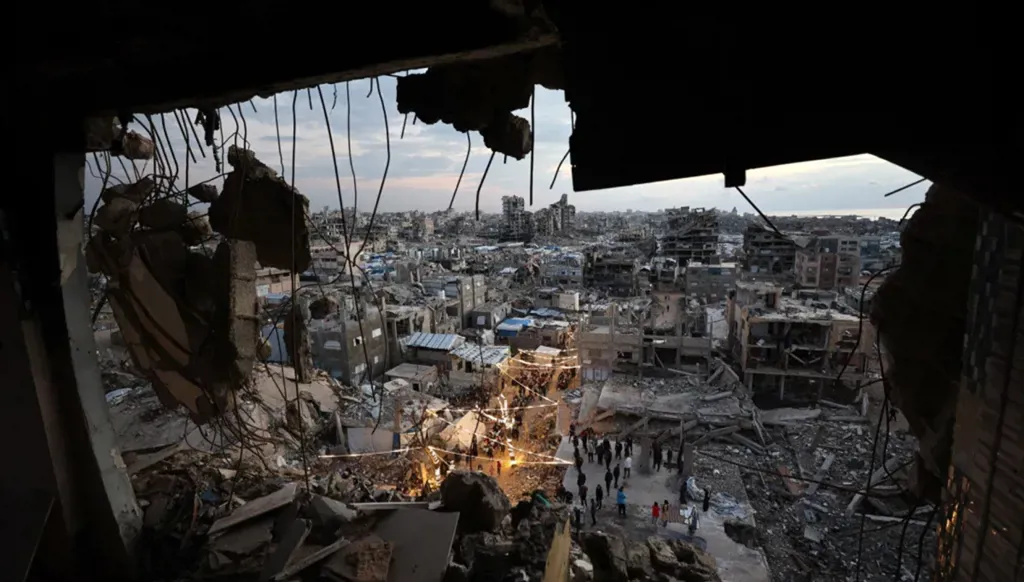
The figures that emerged from the meeting are politically striking. It was announced that $17 billion had been allocated for the reconstruction of Gaza, including $10 billion pledged by Washington through the council, alongside contributions from Arab and Asian countries. However, United Nations estimates suggest that the cost of rebuilding the sector could reach around $70 billion, after destruction affected most of the infrastructure. The gap between these two figures not only highlights a funding shortfall but also reflects a deeper challenge: Is the council the beginning of a long, multi-stage process, or a quick political initiative aiming for symbolic achievement?


More important than the size of the funds is the mechanism for their management. Who will supervise the expenditure? Who will ensure transparency? And who will prevent reconstruction projects from turning into a new arena of political and security competition? On the ground, despite the ceasefire taking effect, the situation remains fragile. Continued tensions and reports of Hamas strengthening its administrative and financial influence indicate that the actual authority within the sector has yet to be resolved. In such an environment, the fundamental question becomes: who manages the transitional phase, and who holds the final decision?


The council did not limit itself to discussing reconstruction; the idea of an “international stabilization force” and the establishment of multiple transitional structures for managing Gaza—including an executive council, a national committee, and a regulatory framework—was proposed. This institutional engineering may seem ambitious but raises sensitive questions about sovereignty and Palestinian representation, especially given the absence of a clear official Palestinian presence at the meeting. Any transitional process that does not include effective and legitimate Palestinian representation will remain subject to skepticism, regardless of the level of international support.


Regionally, the involvement of some Arab countries in financing is somewhat surprising. While the financial contribution grants a seat at the decision-making table, they also entails political and ethical responsibility for the process’s outcomes. If the plan falters or lacks transparency, participation could become a domestic liability. Some European countries limited themselves to an observer role for this reason, while other international powers stressed the importance of not bypassing the United Nations, reflecting caution against creating a parallel platform that could weaken the multilateral international system.


In essence, the “Peace Council” is not merely a financing mechanism but an attempt to redefine the equation of Gaza’s management: who leads, who monitors, and who decides. Its success will not be measured by closing statements or the size of pledges, but by its ability to produce tangible results quickly—schools rebuilt, hospitals operating, electricity restored to homes. The residents of Gaza will not wait long for legal or institutional discussions; the gap between announcement and implementation can be politically fatal.


The question that will determine the fate of the council is whether it will remain a financial oversight framework or evolve into a supreme political authority for managing the entire transitional phase. If the goal is truly to break the “crisis management” cycle, it must address the political roots of the conflict, not just rearrange priorities. Previous experiences in the region have shown that reconstruction can repair infrastructure, but it cannot resolve the political dilemma if left unaddressed.


Between great ambition and fragile ground reality, the “Peace Council” faces an early test. It may either become the beginning of a new path that redefines conflict management with clarity, transparency, and genuine partnership, or it may turn into another chapter in a long history of initiatives that collided with a reality far more complex than intentions. In a region that cannot bear an additional source of tension, the ultimate judgment will be based on what happens on the ground, not on what is said behind closed doors.


Disclaimer: The opinions expressed by the writers  are their own and do not necessarily represent the views of Annahar.

العلامات الدالة

الأكثر قراءة

النهار تتحقق 3/2/2026 10:43:00 AM
نبأ منسوب إلى وكالة "رويترز"، وتصريحات مزعومة للرئيس الروسي. و"النّهار" تقصت صحّتها. 
النهار تتحقق 3/3/2026 12:45:00 PM
بصفة "عاجل"، ينتشر فيديو لرئيس الجمهورية اللبنانية، متوجهاً فيه الى حزب الله.
ايران 3/3/2026 6:49:00 PM
تقارير إيرانية تنفي مقتل مجتبى خامنئي وتؤكد أنه بصحة جيدة