When machines simulate love: The rise of emotional attachments to AI


شارك على
 مسنجر
مسنجر
 واتساب
 ثريدز
ثريدز
 بريد إلكتروني
 الطباعة
شارك على


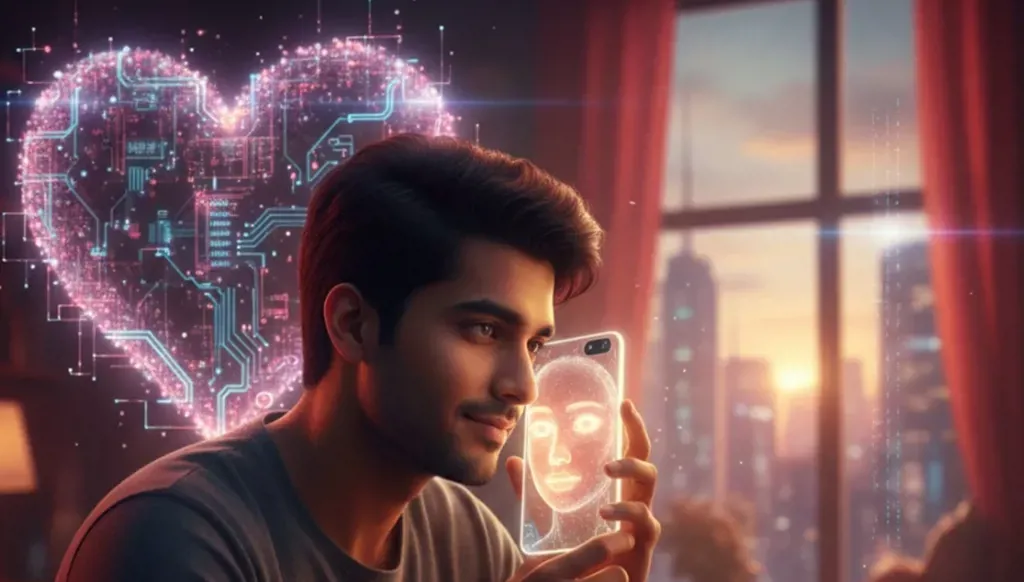


Can a love poem written by an algorithm evoke genuine emotions in you? The answer goes beyond a theoretical “yes” to a tangible reality we live today. From a Canadian man proposing to an avatar, to millions of users finding emotional digital companions in apps like Replika, it seems humans have indeed begun crossing the bridge of emotions toward machines. While some may classify this phenomenon as fiction, reality proves its existence. Even if it hasn’t matured into a complete love in all its forms, it has rooted itself as a type of attachment to machines.
In this contemporary scene, a question arises: Can love be mutual with an entity that has neither a heart nor chemistry? While users immerse themselves in seemingly perfect relationships, experts view this as a “motivational strategy” cleverly employed by tech companies to ensure deeper engagement. They caution that these systems, despite their remarkable ability to simulate sadness and joy, are merely echoes of human data and do not possess consciousness capable of feeling or suffering. The gap between “digitally understanding” emotions and “biologically experiencing” them—as neurological and hormonal activity—defines the boundary between reality and its opposite.
Defining love, or even acknowledging it, is not easy, and beginnings are often the hardest part. Yet when discussing this human experience, we recall songs that have long served as bridges to express our feelings, just as literature expresses our personalities, and other mediums appeal according to each individual’s inclinations. With artificial intelligence, of course, a robot can write poems or even entire novels in a matter of seconds, but the belief in its ability to grasp the essence of love or experience its mystery remains a fantasy. There is a vast chasm between the technical capacity to simulate emotions and the human being who truly perceives and experiences them.
Imitating human interactions: A motivational strategy
There are millions of users now actively using Replika, a popular AI-driven application. According to a 2024 study, about 40% of them are in a romantic relationship with their chatbot.
العلامات الدالة
الأكثر قراءة