Lebanon caught in the fallout of Hezbollah’s Syria activities


شارك على
 مسنجر
مسنجر
 واتساب
 ثريدز
ثريدز
 بريد إلكتروني
 الطباعة
شارك على


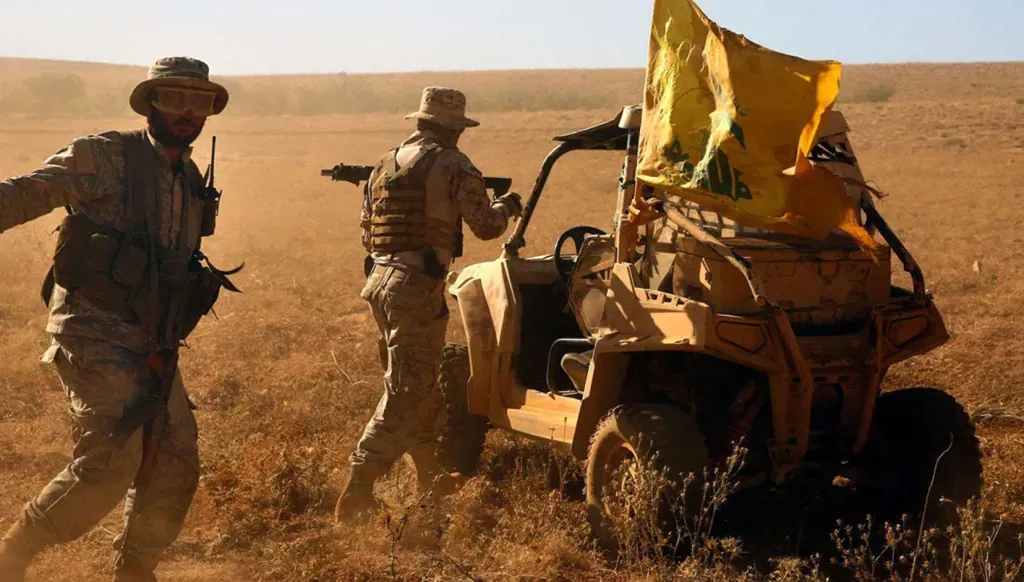


The Syrian authorities’ announcement on the 26th of last month revealed an attempt to smuggle “weapons including missiles and shells toward Lebanese territory,” in what were widely seen as clear signals accusing Hezbollah of being behind the attempt. A few days earlier, Syrian forces had announced the arrest of two members of a cell in the Mezzeh district, which they said was linked to Hezbollah. They reported seizing Grad rockets and launch platforms from the group.
These developments did not prompt any official security or political comments in Lebanon, despite intensive diplomatic follow-up. Only the party itself denied any connection to the cell, saying its name had been “dragged in arbitrarily” and rejecting any claim that it has “activity, links, or ties with any party in Syria.”
Political sources do not fear a deterioration in Lebanese Syrian relations over the issue, given several considerations, foremost among them Lebanon’s efforts to ensure that weapons are exclusively in the hands of the state, as well as the need for joint efforts in both countries, where the security situation remains fragile, to put an end to such activities.
If these incidents are confirmed, the same sources believe they may indicate an attempt by Iran, through the party, to rebuild its networks by supporting allied factions or sectarian groups in Syria. At the same time, the Syrian government currently enjoys greater credibility with regional and international actors as it confronts internal challenges and works to prevent Iran from regaining a foothold in Syria or undermining the country’s current recovery path.
Hezbollah’s continued cross border activity between Lebanon and Syria is placing pressure on Lebanon and its army, further highlighting what critics describe as its negative role. It is also reinforcing international calls for its disarmament, not only on the grounds that it poses a threat to Israel’s security, whatever remains of its capabilities, but also to Syria’s security and stability. The Syrian government, for its part, appears determined if tested on its readiness on the ground.
Syria’s security and stability have become a new red line that will not be tolerated if crossed. Drawing attention to an alleged role for the party in smuggling weapons from Syria into Lebanon or in supporting cells inside Syria underscores what critics describe as the continued disruptive influence of Iran at the regional level.
Iranian officials insist that Tehran will not negotiate over its ballistic missile program or its support for the so called “axis of resistance,” which it considers essential pillars of its defense and deterrence strategy.
Meanwhile, US President Donald Trump announced on the seventh of this month that he might accept an agreement limited solely to the nuclear issue. This raised concerns in Israel, prompting its prime minister to travel to Washington to insist that ballistic missiles also be addressed.
Diplomatic sources say that any negotiation covering Iran’s regional proxies is unlikely, since from the American, Israeli, and even broader regional perspective, Iran’s role in the region remains the core problem.
The US position opposing the return of Nouri al-Maliki as Iraq’s prime minister was seen as highly indicative, amid strong pressure and threats aimed at preventing the consolidation of Iranian influence at the level of power in Iraq. The continued imposition of US sanctions on Hezbollah, efforts to restrict its funding, and increasing pressure on the Lebanese state to ensure that arms are held exclusively by the state should be understood in this context.
In reality, some degree of Iranian political influence may be tolerated, but there is unlikely to be any leniency toward cross regional security influence stretching from Syria to Israel, Iraq, Lebanon, and Yemen. These sources point to remarks by Ali Larijani, Secretary of Iran’s Supreme National Security Council, during a visit to Amman on February 10, when he said that Iran would consider expanding negotiations with the United States to include “other areas” if the current US Iranian talks succeed.
He did not specify which areas he meant, or whether he was referring to ballistic missiles, limiting support for Iran’s regional proxies, one of the two, or commitments not to use them against Israel.
At the same time, Iranian statements continue to reject negotiations over these issues and to reaffirm support for “the resistance” in the region. However, it appears that Iran may ultimately be unable to bear the cost of backing Maliki in Iraq or maintaining the party’s military arsenal in Lebanon.
Disclaimer: The opinions expressed by the writers are their own and do not necessarily represent the views of Annahar
العلامات الدالة
الأكثر قراءة