Condoleezza Rice and the Colonel: A meeting of music, mystery, and power


شارك على
 مسنجر
مسنجر
 واتساب
 ثريدز
ثريدز
 بريد إلكتروني
 الطباعة
شارك على




Condoleezza Rice once dreamed of becoming a musician, but fate led her down a different path. She became the first Black woman to serve as National Security Advisor to President George W. Bush from 2001 to 2005, and later the second woman, after Madeleine Albright, to serve as U.S. Secretary of State from 2005 to 2009.
Rice played the piano at official events in the White House and once joked, “I would have been a failed pianist. Fortunately, I chose politics instead.”
In her 2011 memoir, titled No Higher Honor: A Memoir of My Years in Washington, in which she recounted her experience in both positions, she described her meeting with Libyan leader Colonel Muammar Gaddafi as one of the strangest encounters of her diplomatic career. She noted that she did not feel comfortable with the way he treated her, but she maintained diplomatic professionalism.
Abdul Rahman Shalgam, Libya’s former foreign minister, revealed in his 2023 memoir My Years details about Rice’s relationship with Colonel Gaddafi and her brief visit to Tripoli on September 5, 2008. She became the highest-ranking American official to visit Libya in more than half a century.
The meeting took place as Libya was returning to the international stage after years of isolation, following its decision to abandon its nuclear program, settle the Lockerbie case, and normalize relations with the United States.
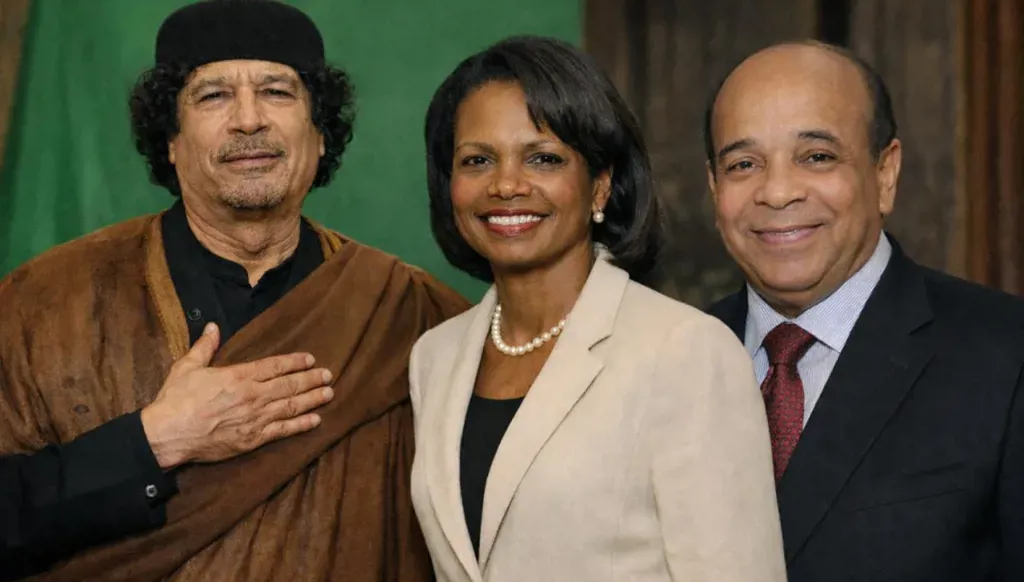
Shalgam recounts that when Gaddafi received her at Bab al-Azizia, he did not shake her hand. Instead, he placed his hand on his chest in greeting. He described the gesture as theatrical and intended for television, carrying a message to the Libyan people: “I do not shake hands with those who attacked me and attacked Libyans, killed them, and imposed sanctions on them.”
Despite this, Gaddafi did not hide his comfort with Americans of African descent, especially politicians. He saw them as brothers, or at least friends. He strongly believed that their African roots would draw them back to their origins, as he pursued his campaign to unify the African continent and strengthen its political presence on the international stage.
On several occasions, Gaddafi told his foreign minister Shalgam, “We must strengthen our relationship with Condoleezza Rice. In the end, she is an African American political star and plays a major role in American political decision making.”
At the start of the meeting, which was attended by Shalgam and Mutassim Gaddafi, Libya’s National Security Advisor at the time, the discussion was general. Rice expressed Washington’s satisfaction with the progress in relations between the two countries and the U.S. administration’s readiness to develop bilateral ties in various fields. Gaddafi then requested a private meeting attended only by an American interpreter of Egyptian origin.
According to what the interpreter later told Shalgam, when he was Libya’s permanent representative to the United Nations, Gaddafi expressed to Rice his desire to establish a special, strong, and direct relationship with President George W. Bush. He assured her that he could achieve a great deal in Africa with Washington’s support and that he was counting on her personally to serve as the link between him and the American president.
Gaddafi presented Rice with a gift, an oud, knowing her passion for music, and also gifted her a selected album of her personal photographs painted with oil colors, depicting various aspects of her facial features.
According to Shalgam, Gaddafi sought through this gesture to create what he called a “human chemistry” between them. He added that “Condi” left the meeting with a positive impression and with the sense that Gaddafi was a different, more human figure than the one portrayed for years by the American media.
Much was said about the Gaddafi–Rice meeting, including claims that he wrote romantic poetry about her and expressed tender feelings toward her. Shalgam dismissed all of this as baseless nonsense. He stressed that Gaddafi’s real aim was to leverage her African heritage so she might support him within the U.S. administration, which he saw as a power capable of helping him achieve his dream of establishing the African Union and shielding him from any sudden American hostility, especially after witnessing firsthand what Washington had done to Former Iraqi President Saddam Hussein and Iraq.
Gaddafi reportedly saw Rice as a “Black Henry Kissinger,” but Shalgam believed that the Colonel greatly exaggerated her power and influence over President George W. Bush.
Shalgam also recounts hearing an unconfirmed report that Gaddafi asked “Condi” for her private phone number, but she sidestepped the request and declined to provide it.
Perhaps the answer lies in Rice’s own account, in which she described her meeting with Gaddafi as one of the strangest experiences of her diplomatic career.
The story of “Condi” and the Colonel remains just one episode in a sea of stories and events recounted in the memoirs of the diplomat, journalist, and intellectual Abdul Rahman Shalgam. It bears witness to an era filled with both curious anecdotes and deep crises, an era that has passed with no return, yet whose consequences still cast a shadow over Libya’s present and future.
Disclaimer: The opinions expressed by the writers are their own and do not necessarily represent the views of Annahar
العلامات الدالة
الأكثر قراءة