Syria, Egypt sign energy memorandums amid power crisis and political recalibration


شارك على
 مسنجر
مسنجر
 واتساب
 ثريدز
ثريدز
 بريد إلكتروني
 الطباعة
شارك على


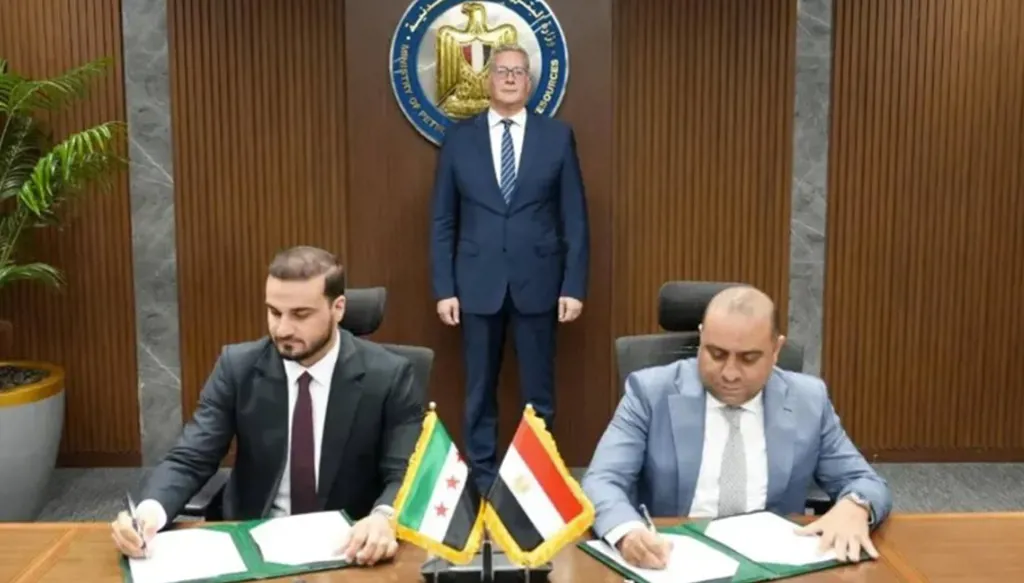


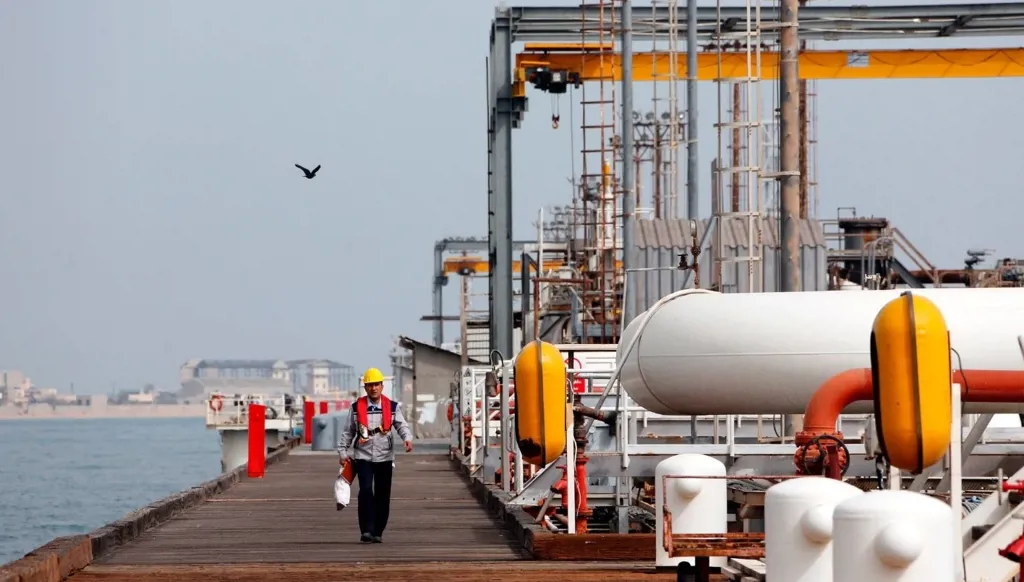
The Syrian Ministry of Energy and the Egyptian Ministry of Petroleum and Mineral Resources signed two memorandums of understanding in Cairo on Monday. The first covers cooperation on supplying natural gas to support electricity production in Syria by utilizing available infrastructure and technical capabilities. The second focuses on cooperation in oil derivatives to meet the needs of Syria’s energy sector, while also exploring the exchange of expertise and the rehabilitation of parts of the oil and gas infrastructure.
According to official communiqués, the memorandums are technical and open-ended, with no announced quantities, timelines or financing mechanisms. Their significance, however, lies less in implementation details than in their political context. The agreements come after a year of a strained relation between Cairo and the new authorities in Damascus, amid the absence of direct political channels or declared partnerships. Choosing the energy file appears to be a low-cost political entry point to reopen communication without pre-set commitments or alignments.
The memorandums were signed amid a severe electricity crisis in Syria, with production operating at minimum levels and outages threatening social stability before translating into economic losses. The move therefore seems closer to buying time and preventing a complete breakdown than to rebuilding the energy sector, aiming to preserve minimum state functionality in a service that has become a direct benchmark of stability.
The current understanding also differs fundamentally from proposals raised in 2021, when gas supplies to Lebanon via the Arab Gas Pipeline were discussed, with Syria receiving a share of electricity and gas under arrangements constrained by Caesar Act provisions. While the heavier legal restrictions are no longer in place, the difference is not purely legal. At the time, political considerations made Cairo more cautious in dealing with Damascus, particularly given sensitive security issues.
This positions Egypt as a distinct option in Syria’s energy file - not merely an additional supplier, but a platform capable of facilitating faster arrangements due to its ready infrastructure, operational expertise and regional network. In this context, the Egyptian track is seen as an added assurance within a broader margin of maneuver, rather than an alternative bet or a standalone solution, while the Azerbaijani route remains a complementary option rather than one expected to shoulder the full burden alone.
From this perspective, openness toward Egypt is neither a full political shift nor an exclusive alternative to Azerbaijani gas, but part of a basket of options shaped by experience. Diversifying pathways is no longer a luxury, but a transition away from reliance on a single source, after the limits of any one bet have become clear. Still, this practical dimension cannot be fully understood without placing it in a wider political context that extends beyond energy into Syria’s broader political trajectory.
The memorandums were signed at a moment when questions surrounding the unity of Syrian territory have returned to the forefront as an open political issue. Fragmentation is no longer a theoretical outcome of state weakness, but an option increasingly reflected in the discourse and actions of various forces, building on a de facto division that has never fully closed.
In this light, Egypt’s move is understood as a fortifying step that goes beyond managing an energy sector. The aim is to stabilize the framework within which Syria is governed - as a single negotiable state, not a mosaic of entities vulnerable to entrenchment. This interpretation gains weight amid a regional environment where conflict-management models based on partial entities and limited recognition are advancing, from the southern Red Sea to Yemen. Within such a climate, Syria risks becoming another testing ground, especially given clear Israeli interest in pushing paths that could transform existing divisions into formal partition.
Accordingly, the Syrian-Egyptian rapprochement through energy is not viewed as a temporary response, but as part of a broader effort to prevent a political slide that would redefine Syria outside the logic of a unified state.
Ultimately, this is an energy memorandum in a political format: a testing framework without figures or schedules, signaling a broader rapprochement between Cairo and Damascus more than offering an immediate solution to the electricity crisis. Its value lies in opening a low-cost Arab channel at a regional moment ripe for fragmenting state structures, while its sustainability will be determined by financing and power balances rather than by statements.
العلامات الدالة
الأكثر قراءة