Inside Trump’s war on the media: Lessons from the Iran conflict

Opinion 18-03-2026 | 12:14

Inside Trump’s war on the media: Lessons from the Iran conflict

From regulatory pressure to moral and political threats, the administration’s tactics show how wartime crises can reshape the boundaries of press freedom. 
Inside Trump’s war on the media: Lessons from the Iran conflict
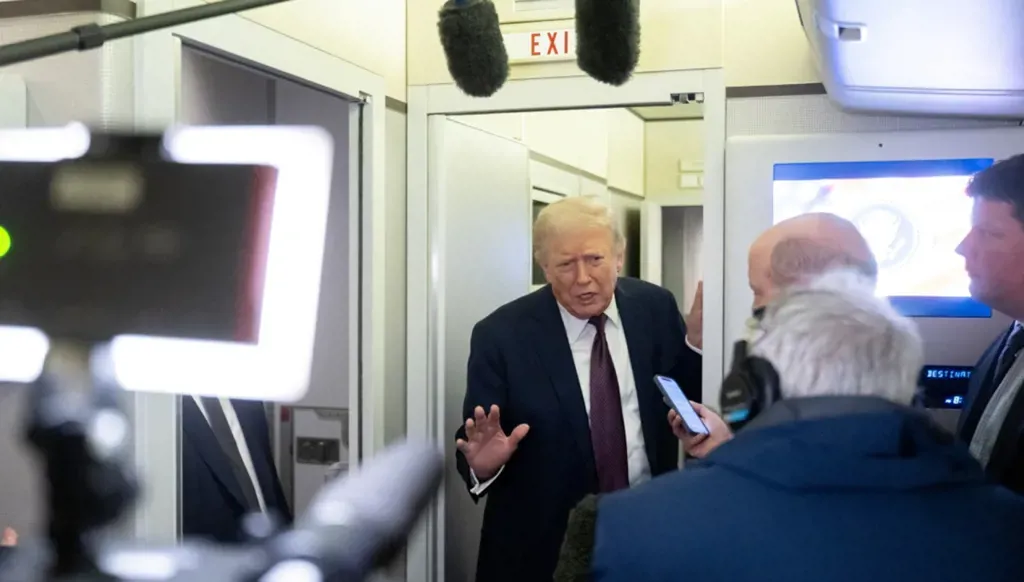
Trump speaks to reporters on board the plane about the war in Iran on March 15, 2026. (AFP)
Smaller Bigger


From the very first moment President Donald Trump entered the White House, it was clear that his relationship with the media would not be traditional. What wasn’t initially clear was that this relationship wouldn’t remain confined to political tension or harsh rhetoric, but would gradually evolve into an integrated model for reshaping the media landscape—a model that unfolded in stages and reached its peak with the outbreak of the war in Iran at the end of February.


What happened during these few months cannot be seen as isolated events, but rather as a series of interconnected steps—moving from doubt, to pressure, and then to an attempt to directly control the media narrative favored by Trump and his administration.


In the first phase, which began in the administration’s early days, the focus was on delegitimizing the media morally. This was not new in Trump’s rhetoric, but this time it came within the context of full executive authority. The media was portrayed not merely as a political adversary, but as an untrustworthy, biased, and misleading force. This phase was necessary to establish what can be called a “climate of doubt,” making the public more receptive to any subsequent actions against media institutions.


The second phase arrived quickly and was more consequential: the shift from rhetoric to tools. This is where regulatory institutions, led by the Federal Communications Commission (FCC), came into play. These tools were not used to impose direct censorship, but in a more subtle and complex manner—by reinterpreting rules, opening investigations, and suggesting potential license reviews. These measures were not necessarily intended for immediate punishment, but to create a state of uncertainty within media organizations. The message was clear: the rules are not fixed, and the space within which the press operates can shrink.


In this phase, what is known in media studies as the “chilling effect” began to take shape, meaning media institutions started altering their behavior out of fear of potential consequences. In editorial rooms, the question was no longer just “What is the truth?” but also “What could be the repercussions of publishing it?”


But the decisive shift came with the outbreak of the war in Iran. At this point, the administration entered the third phase, moving from indirect pressure to actively attempting to control the media narrative during wartime. The messages were no longer suggestive or legalistic; they became direct and explicit: coverage must align with the administration’s vision, or media institutions could face regulatory or political consequences.


In this phase, the nature of the relationship fundamentally changed. The media was no longer merely a criticized entity; it became part of the national security equation, as perceived by the administration. With this shift, a more potent tool emerged: linking media coverage to the concept of nationalism. Institutions that did not adopt the official discourse were implicitly—or sometimes explicitly—cast into a position of doubt, as if they were undermining the American stance or giving space to its adversaries.


This connection is the most dangerous aspect of the equation because it shifts pressure from the political realm to the moral one. Journalists face not just the threat of professional accountability, but the stigma of disloyalty. In wartime, such an accusation alone is enough to influence the behavior of media institutions without any need for direct official action.


Most importantly, this strategy does not depend on full implementation, but on the power of the threat itself. Even the mere suggestion of revoking licenses, opening investigations, or restricting access to information is enough to provoke real changes in media behavior. Here, the true objective is realized: not total control over the media, but steering it toward self-censorship.


When we consider these three phases together—delegitimization, the use of regulatory tools, and controlling the narrative during wartime—it becomes clear that we are witnessing a gradual model for reshaping the relationship between authority and the media. This model relies less on direct oppression and more on redefining the boundaries within which the media can operate.


From January until today, the Trump administration approached the media in three connected phases: regulatory, then disciplinary, and finally wartime mobilization. What made the period of the Iran war different was that it revealed the most explicit face of this approach. It was no longer merely an adversarial relationship with the press, but an attempt to impose an official definition of what wartime coverage should be. This represents a highly dangerous development, as it shifts the relationship between power and the media from traditional political tension to a logic of national obedience under threat.


But this model, despite its short-term effectiveness, carries a dangerous paradox. A state that seeks to unify its narrative in wartime may achieve clarity in discourse, but in doing so, it sacrifices one of its most vital strengths—the plurality of voices and the capacity for self-criticism. History shows that wars conducted within closed media environments may seem more disciplined at first, yet they are far more prone to strategic errors over the long term.


What this experience reveals is not merely about Trump’s management style, but raises a broader question: to what extent can democracies reshape their relationship with the media under crisis pressures without compromising their very essence?


This question, more than anything else, is what elevates today’s events beyond the confines of the current political moment, turning them into a deeper test of the very nature of the system.

Trump himself became increasingly direct in linking nationalism to the media narrative he sought. The President and his team stepped up pressure on journalists to report the war in line with the administration’s story, while attacking media institutions for allegedly distorting the facts. Reports described scenes aboard Air Force One where Trump rebuked an ABC reporter, calling the network “corrupt,” while Secretary of Defense Pete Hegseth singled out CNN, advocating for “national journalism” with restrictions on press access within the Pentagon. This is significant because the threat became not just regulatory, but also moral and political—those who did not echo the administration’s narrative were framed as unpatriotic.


Disclaimer: The opinions expressed by the writers are their own and do not necessarily represent the views of Annahar.

العلامات الدالة

الأكثر قراءة

العالم العربي 3/18/2026 6:11:00 PM
الجمعة أول أيام عيد الفطر في دول عربية وإسلامية بعد تعذّر رؤية الهلال
اقتصاد وأعمال 3/17/2026 5:20:00 AM
لا نيّة حالياً للتراجع عن الضريبة البالغة 300 ألف ليرة على صفيحة البنزين، باعتبار أن التراجع عنها سيؤدّي إلى صعوبة في تأمين الإيرادات اللازمة لرواتب القطاع العام