The assassination of Iran's Supreme Leader Ali Khamenei and the American-Israeli war on Iran mark a historical turning point in the trajectory of the Islamic Republic. Recent developments have exposed the fragility of the regime's balance among religious authority, security institutions, and political, economic, and social powers. In this context, the center of decision-making quickly shifted to the Revolutionary Guards, with the election of Mojtaba Khamenei as his father's successor—a move that exhibits clear political and security coup characteristics, particularly as it departs from one of the most essential pillars of the Islamic Revolution led by Imam Khomeini: the rejection of the principle of inheritance within the system's structure, regardless of its justifications or degree. This, in theory, opens the door to questioning the legitimacy of this step in the eyes of certain political and religious currents within the Islamic Republic.
This transformation places the regime before a real test of its internal legitimacy and raises the central question of how to manage ethnic and sectarian diversity in Iran, with the potential for future debates over decentralized or even federal structures—particularly if Persian-centered policies continue to marginalize other ethnic groups. The electoral process within the Assembly of Experts also sparked broad questions about the degree of adherence to traditional constitutional mechanisms, reflecting the exceptional influence of the war on the country’s political decision-making.
In this context, Iran appears to be entering a transitional phase that differs from the form in which the Islamic Republic has been known for the past four decades, with the traditional balance among institutions weakening in favor of the emergence of a more unified security decision‑making center.
Transfer of Power: From the complex religious system to the security state
Historically, the Iranian system rested on a delicate balance among the Leader’s office, the presidency, the religious seminaries, the traditional army, the Revolutionary Guards, the Basij forces, and the economic bazaar networks. This equilibrium enabled the Islamic Republic to maintain relative stability despite the repeated crises it has faced since the revolution.
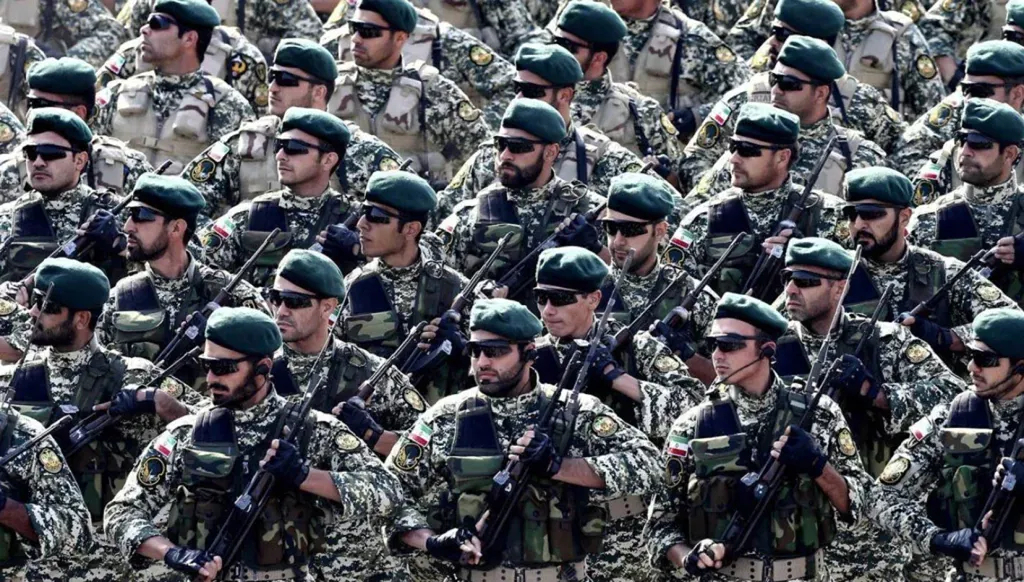
However, recent shifts indicate a clear rise of the security institution—the Revolutionary Guards—as the actual center of decision-making, while the traditional army appears less influential at this stage. With this dominance of security forces, the system is gradually transforming from a complex religious-state model into a centralized security state with symbolic religious cover, complicating its internal relations with other authoritative components and introducing a significant degree of fragility within the ruling structure.
It is important to distinguish between the traditional Iranian army, a historically national military institution, and the revolutionary military institution embodied by the Revolutionary Guards. The ongoing shift does not reflect a rise of the regular army to power, as seen in traditional military coups, but rather highlights the increasing influence of an ideological revolutionary institution originally created to safeguard the system after the revolution.
Some observers believe that Iran has indeed entered a new political phase, transitioning from a multi-centered revolutionary system model to a more centralized security-state model, while retaining a religious cover that grants it symbolic legitimacy without this cover being the real source of power.
Exporting the revolution and building regional influence
To understand the dimensions of this internal shift, it is necessary to revisit the regional project that Iran has pursued since the establishment of the Islamic Republic in 1979. Since then, Tehran’s role in the Middle East has extended beyond traditional foreign policy, encompassing a broader vision rooted in the idea of exporting the revolution and building a transnational network of influence.
In its early years, the Iranian revolution presented a comprehensive Islamic discourse centered on the principles of independence, justice, and resistance to external domination, enabling it to attract broad political sympathy across several Islamic societies. Over time, this discourse evolved into a more organized policy aimed at implementing the constitutional principle of exporting the revolution and, consequently, building a regional network of influence through political alliances and local armed or semi‑armed groups in neighboring countries. This strategy allowed Tehran to offset certain geographic and economic limitations and transform its regional presence into an indirect instrument of deterrence.
Within a few decades, Iran succeeded in establishing an influential presence across several Middle Eastern arenas, capitalizing on political voids created by wars and internal divisions, in which it played a decisive role. However, this influence also faced structural limits as sectarian conflicts in the region escalated, constraining its capacity to present itself as a comprehensive Islamic project.
Religious diversity: From an instrument of influence to a strategic burden
Iranian expansion in conflict arenas was accompanied by the rise of a sectarian dimension, generating tensions with large segments of Sunni communities, which constitute the significant majority of the Arab population—exceeding 460 million people—both in the Arab East and the Arab Maghreb. This tension highlighted the limits of Iran’s ability to present itself as a comprehensive Islamic project, as its influence is often perceived as sectarian rather than part of a broader political agenda.
This shift contributed to reducing Iran’s margin of expansion outside its directly allied environments at a time when regional and international forces found in these tensions an additional gateway to confront Iranian influence.
Thus, sectarian diversity, which at one stage was used as a tool to build regional influence, can under other circumstances become a strategic burden on the state itself. This underscores the renewed need for a careful and perceptive political approach to managing the repercussions of Iranian interventions in environments whose social, religious, and political structures differ from its own.
Ethnic diversity within Iran: A stability factor or a strategic challenge?
Iran is home to multiple ethnic groups, most notably Persians, Azeris, Kurds, Arabs, Baloch, and Turkmens, alongside wide religious and sectarian diversity. This diversity is particularly significant due to the geographic distribution of these groups in border regions, their rapid demographic growth, and their demands for recognition of their national, linguistic, and cultural identities, making internal tensions potentially extend into regional dynamics.
In light of the rise of the centralized security state and the emphasis on Persian national identity, the risks of managing this diversity may increase, particularly if central policies continue to marginalize these ethnic groups. In this context, longstanding debates about the relationship between the center and the peripheries—including the potential for political decentralization or federalism—may resurface.
The real challenge extends beyond managing the transitional phase of power after Khamenei to achieving a stable balance between state centralization and the multiple ethnic components’ need for more just political and economic participation within the state structure.
When the sorcerer's spell backfires
International experience shows that tools of external influence can, at a certain point, become sources of internal pressure within a state. In the Iranian case, the rise of the security state and the erosion of traditional institutional balance may reignite internal ethnic debates.
In this context, demands for federalism or autonomy could become tools of political pressure on the central regime in the future, particularly if economic crises and regional tensions persist.
The irony is that the very tools used to expand regional influence are gradually turning into internal challenges, as they were not managed with the intelligence and political savvy needed to account for the growing populations of multiple ethnic groups and the rising demands for recognition of their national and cultural identities.
The strategic test for the Iranian regime
The Iranian state possesses strong central institutions and long experience in managing crises, but today it faces an unprecedented test: managing the transitional phase of power after the assassination of Ali Khamenei, adapting to a rapidly changing Middle East, and reconsidering the regional influence model it has built over past decades.
At the same time, the regime must address the identity concerns of rising ethnic groups within the state, a factor that may necessitate rethinking the nature of the relationship between the center and the peripheries in the future.
This historical moment may determine the trajectory of the Islamic Republic for decades, balancing between consolidating the central security-state model and the potential emergence of discussions about more decentralized political structures, aimed at avoiding the possibility of fragmenting Iran’s vast territory—approximately 1,650,000 square kilometers—and its ethnically diverse communities, which often extend geographically beyond Iran’s borders into neighboring countries.
The conflict that may intensify between the ideological revolutionary current seeking to monopolize power after the assassination of Ali Khamenei—and the Iranian state with its institutional and security pillars on one side—and the religious institution, which could become more fragile and marginalized once the dust of the war settles, will be a decisive factor in determining the future of Iran’s political regime and its territorial unity.
Disclaimer: The opinions expressed by the writers are their own and do not necessarily represent the views of Annahar.



 مسنجر
مسنجر
 واتساب
 ثريدز
ثريدز
 بريد إلكتروني
 الطباعة