A new initiative for union in Sweida as Druze see the writing on the wall


شارك على
 مسنجر
مسنجر
 واتساب
 ثريدز
ثريدز
 بريد إلكتروني
 الطباعة
شارك على


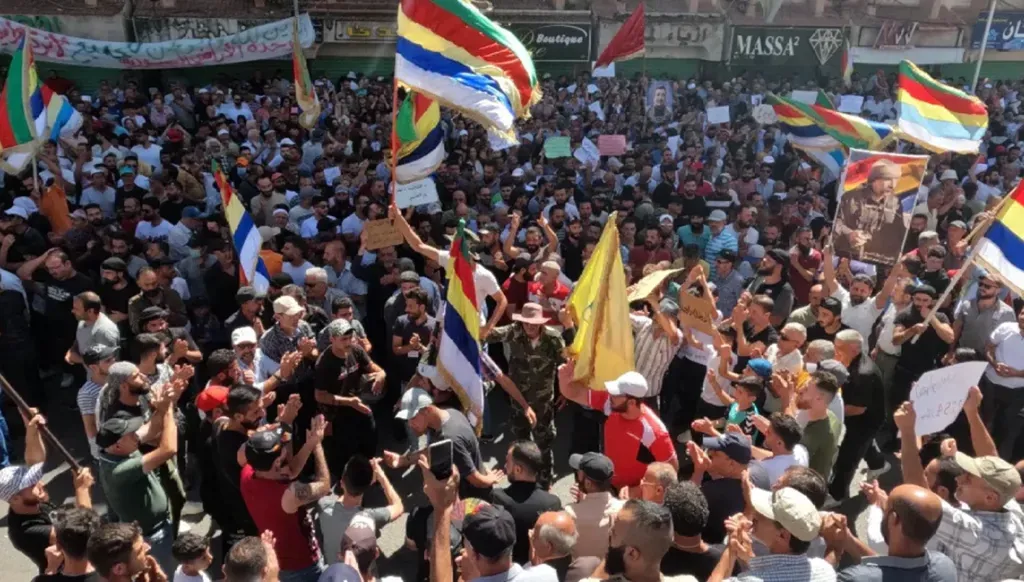


The political deadlock in Sweida continues with little on the horizon. Sheikh Hikmat Al-Hijri, one of three Sheikh's who represent Syria's Druze community, remains insistent on his secessionist proposal, while Damascus authorities reach the final stages of an offensive in the northeastern part of the country. On the whole, the Sweida issue has yet to find resolution, and there is a general feeling among analysts that a solution will only come through an Israeli-Syrian agreement, as Israel has taken a larger role to support Syrian Druze in the last year.
However, this deadlock has not prevented the Druze of Sweida from taking their own steps to resolution. A new initiative, launched by academic and cultural elites, and political and social activists, includes a roadmap toward political settlement. The initiative, named "The Third Stream," outlined a series of principles, affirming that Sweida was "an inseparable part of a unified Syria," and that administrative decentralization might be an effective solution. It also rejected secessionist aspirations and regional alignments, emphasizing that Syrian authorities bear responsibility for what has occurred.
Broad Lines of the Initiative
Annahar communicated with Fadi Al-Atrash, a social activist from Sweida and one of the signatories of the initiative, to explore the details of the proposal. Al-Atrash described the initiative as a "realistic and logical vision" aimed at overcoming the "state of stalemate," following the spread of illogical propositions, such as establishing a Druze state or joining Israel.
These propositions lacked realism, as the establishment of a Druze state is not politically, locally, internationally, economically, or demographically viable. Without open borders, it was not a logical proposal. Similarly, the geographical joining of Sweida to Israel is on its face infeasible, given that the Quneitra and Daraa governorates separate the Druze region from the Israeli state by more than a hundred kilometers.
The initiative’s emphasis on the Syrian identity of Sweida and the Druze was remarkable amidst the secessionist rhetoric prevalent in Al-Hijri’s speeches. Al-Atrash stresses "adherence to the known values," which entails "protecting the national heritage" and firmly rejecting secession. The social activist draws on the history of Sultan Pasha Al-Atrash, Shakib Arslan, and Kamal Jumblatt to affirm the Syrian Arab identity and the rejection of secession.
Popular acceptance
The political proposition is important and realistic, but it requires two factors to become more practicable: international support to pressure the concerned parties toward agreement and popular acceptance within the Druze circles in Sweida. Al-Atrash states that the initiative is "widely accepted," having gained significant traction and prompting reconsideration of the civil solution, although he acknowledges that it "will not please" those who wish to maintain the state of stalemate.
Also looking for a settlement are the Jordanians and Americans, both of whom engaged in the roadmap agreed upon with Damascus months ago. Al-Atrash notes that there is "no communication" with the Syrian government or any Arab or international entity, but he hopes that Arab countries will support the initiative.
In conclusion, this initiative essentially constitutes a proposition opposing Al-Hijri’s secessionist proposals and closely aligns with the tripartite roadmap agreed upon between Damascus, Amman, and Washington months ago, carrying nearly the same clauses. Attention is now on this shift emerging in Sweida, as the elites begin to recognize the impossibility of secessionist projects and the necessity of moving toward political settlement with Damascus.
العلامات الدالة
الأكثر قراءة