Israel’s shadow war in Iran: From secret operations to public support of protests


شارك على
 مسنجر
مسنجر
 واتساب
 ثريدز
ثريدز
 بريد إلكتروني
 الطباعة
شارك على




Since the 1979 Islamic Revolution in Iran, Israel has made significant efforts to influence Iranian public opinion. However, it is important to distinguish between documented Israeli operations and controversial claims. While evidence exists regarding targeted assassinations and military operations, the question of a direct Israeli role in fueling internal protests against Tehran’s regime is far more complex, and far less clear, than the official Iranian narrative suggests.
Post-Revolution: A missed opportunity
In an article titled “An Assassination That Could Have Changed the Course of History,” the Israeli newspaper Jerusalem Post recounts that Shapour Bakhtiar, the last prime minister under Shah Mohammad Reza Pahlavi, asked Mossad in January 1979 to assassinate Ayatollah Khomeini, who was then exiled in Paris. The Israeli political leadership declined the request, believing that Iranians would handle him themselves.
The newspaper adds: “This was a strategic mistake, as it enabled the Islamic Revolution to triumph.”
After the revolution, Iran severed official ties with Israel, granting the former Israeli embassy premises to the Palestine Liberation Organization. However, during the first Gulf War with Iraq (1980–1988), Israel adopted a pragmatic approach, secretly becoming one of Iran’s main arms suppliers. The same Israeli newspaper reports in an article titled "Israel-Iran Alliance: Tel Aviv’s Arms Sales to Iran During its War with Iraq" that Tel Aviv - driven by geopolitical considerations - wanted the Soviet-backed Iraq to be defeated, reshaping the balance of power and regional influence.
The newspaper cites Trita Parsi, founder and president of the National Iranian American Council and author of "Treacherous Alliance: The Secret Dealings of Israel, Iran, and the United States," who argues that “Israel saw it as necessary for its regional security to form alliances with non-Arab states on the periphery of the Middle East, in order to balance the immediate neighborhood of Arab states.”
Additionally, Iran provided intelligence to Israel to help carry out Operation Opera in 1981, targeting Iraq’s Osiraq nuclear reactor, in exchange for Israeli intelligence.
Cold War on the nuclear program
In the 1980s and 1990s, Iran’s nuclear program became a focus of systematic Israeli intelligence operations. Mossad tracked Iran’s efforts to acquire nuclear technology from Europe, Asia, and former Soviet states, using shell companies and sting operations to uncover and sabotage these deals. The agency also monitored Iran’s ties with Pakistan, which was assisting Tehran on the same nuclear program.
Mossad operations at the time were not aimed at inciting internal protests but focused on sabotaging Iran’s nuclear infrastructure. As part of this effort, several leading Iranian nuclear scientists were assassinated. Between 2007 and 2012, Mossad targeted figures such as Massoud Ali Mohammadi, Fereydoon Abbasi (2010), and Ahmadi Roshan (2012), among others. During this period, Iran arrested roughly 15 individuals allegedly trained by Mossad and accused of participating in the killings.
The Green Movement
The Green Movement occupies the largest space in Iranian narratives about "foreign intervention in the country". After highly disputed presidential elections in June 2009, massive protests broke out across the country.
The data suggests that the Green Movement was fundamentally a domestic movement, sparked by the controversial election results and led by Mir Hossein Mousavi and Mehdi Karroubi. It persisted for six consecutive months, driven largely by local organization.
In a study titled "Iranian Democratization Part I: A Historical Case Study of the Iranian Green Movement" at the University of South Florida, researcher Victor Sandquist concluded that "there is no credible evidence that the protests were externally orchestrated; they were a response to genuine local grievances: corruption, political repression, and human rights violations."
Nevertheless, the Iranian government promoted the narrative of a “foreign conspiracy,” accusing the United States, Britain, and Israel of “engineering” the protests. Detainees were reportedly forced to confess under torture to support this claim, a narrative repeatedly used to justify persecution, torture, and executions.
Agents for Israel
Israel’s direct role in influencing the Iranian street at the time may have been limited, but it later leveraged armed opposition groups as proxies. The most notable of these was the Mujahedin-e Khalq (MEK), founded in 1965. Originally an ally of the Islamic Revolution, the group eventually turned against it.
In August 2025, The Times of Israel reported direct cooperation between Mossad and the Mujahedin-e Khalq (MEK), involving the sharing of intelligence on Iran’s nuclear scientists in exchange for financial, military, and training support from Mossad. According to the same report, the group acted as a “proxy” to carry out sabotage and intelligence operations. Iranian authorities stated that in June 2025, they arrested two MEK members accused of manufacturing rocket launchers and subsequently executed them.
Alongside the Mujahedin-e Khalq, the Baluchi Sunni group Jundallah, founded by Abdul Malik Rigi in 2003, received confirmed U.S. support in 2007 and 2008, though there is no documented evidence of Israeli backing.
The Hijab Uprising
Following the death of Mahsa Amini in September 2022 at the hands of Iran’s morality police, an unprecedented wave of spontaneous protests swept across the country, demanding women’s rights and personal freedoms. The movement was fundamentally local, with no credible evidence of foreign orchestration, although human rights groups received diplomatic support from Western governments. There is no evidence of Israeli intelligence involvement.
The 12-Day War
On June 12 and 13, 2025, Israel launched the "Rising Lion" military operation against Iran, targeting its nuclear program and Tehran’s missile capabilities. Over 200 aircraft carried out more than 100 air raids. In the first wave of attacks, nine nuclear scientists and fifteen senior military commanders were killed.
There is no doubt that Israel’s military success relied on intensive covert intelligence operations. According to an Israeli report, Mossad smuggled weapons and drones into Iran using trucks, shipping containers, and even suitcases. It established a base inside Iran to launch explosive drones, deployed laser-guided weapons near air defense systems, and Israeli commando units operated within Tehran and deeper into Iranian territory.
The Iranian regime descended into a climate of suspicion and fear, arresting over 1,000 people almost immediately, intensifying government surveillance, and urging citizens to spy on one another, leading to a sharp rise in espionage-related arrests.
January 2026 protests and declared Israeli role
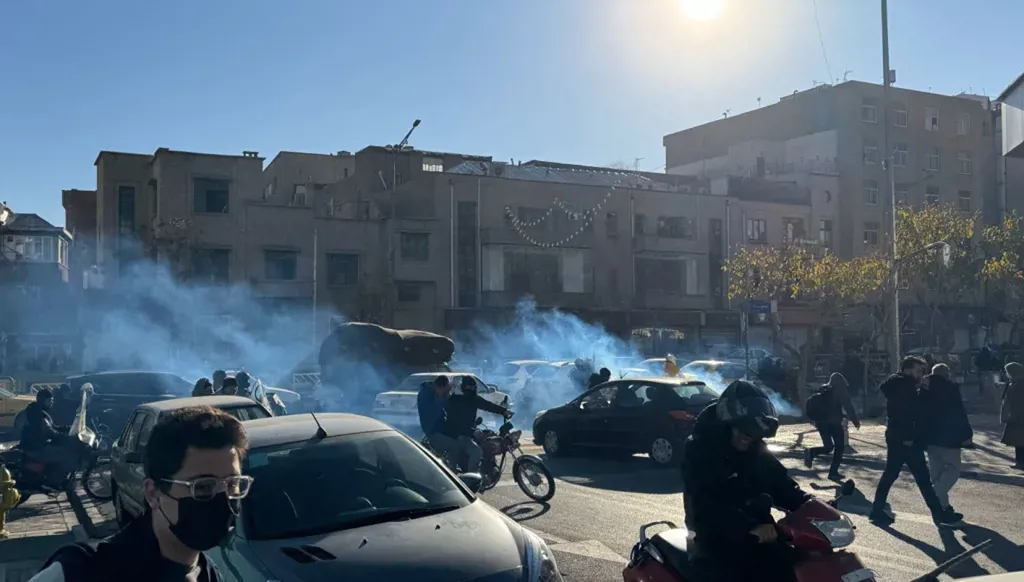
In late December 2025, a new wave of protests erupted in Iran following the collapse of the Iranian rial against the US dollar, rising inflation and youth unemployment, widespread government corruption, and unequal distribution of resources. These economic grievances were compounded by systematic authoritarian rule, the suppression of opposition, and public backlash after twelve days of war with Israel, which further weakened the regime’s overall image.
The protests began as a response to economic hardships but soon evolved into an anti-regime movement, with calls for regime change. They spread to dozens of cities, resulting in dozens of deaths and hundreds of injuries.
Unlike previous protests, Israel’s involvement in these demonstrations was “openly announced.” For the first time, Mossad publicly expressed support for the Iranian protests, tweeting in Persian on December 30, 2025: “Take to the streets together. The time has come. We are with you. Not from afar or just in words. We are also with you on the ground.”
العلامات الدالة
الأكثر قراءة