When media becomes a weapon: Lebanon’s battle between journalism and chaos

Opinion 03-04-2026 | 11:32

When media becomes a weapon: Lebanon’s battle between journalism and chaos

From social platforms to TV screens, partisan voices exploit lawless airwaves, turning information into division and testing the limits of ethics, responsibility, and national stability.
When media becomes a weapon: Lebanon’s battle between journalism and chaos
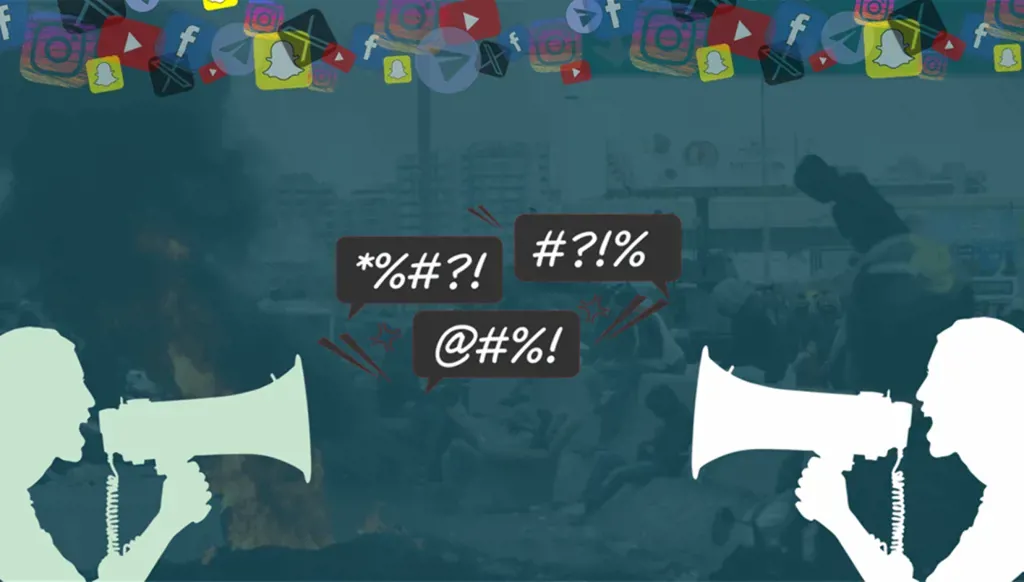
Illustrative image.
Smaller Bigger


Fadi Bou Dayya has often stirred controversy with his provocative interventions in the media and on social platforms, much like many in the opposing Lebanese camps. This partisan activist, who aligns himself with the media world and adopts a harsh tone not devoid of threats, went too far this time by promoting the legitimacy of Iran launching missiles at the American University of Beirut. He implied that the university's students are no better than the Iranian students killed by American planes at a school in southern Iran at the beginning of the war. Even the resistance axis, which had considered Bou Dayya a resistant journalist and supported his discourse, could not tolerate his words this time, prompting his associates in the media and his close affiliates to disavow him and his statements.


This incident, which reflects a recurring daily pattern and is not exclusive to Bou Dayya, urgently highlights a serious problem that increasingly threatens civil peace: the rampant speech on traditional media and social media without accountability or oversight. Agitators from all sides—whether "sovereignists and resistance supporters," or those associated with either side or close to them—unleash on screens hatred, dangerous ideas, threats, and destructive sectarian and communal delirium, at a time when the country stands on the brink.


Since the bold display of sectarian and communal fanaticism has become a symbol of affiliation in Lebanon and an almost racialized identity, concepts have become confused, terminology lost, and values turned upside down. Amidst the chaos engulfing the entire country and the looming danger, aimless and violent sectarian wars rage on screens and across the airwaves. The reciprocal media violence has exceeded all limits, targeting personal insults, illnesses, disabilities, parents, siblings, families, sanctities, prophets, and saints, all without any legal or ethical deterrence.


The issue raises a fundamental question: Who is a journalist? And, by extension, is everyone who appears on a screen—regardless of its size or format—a journalist? Who gave them the right to call themselves journalists, or allowed a fraudulent website to distribute professional titles to anyone?


If the state—with its Ministry of Information, judiciary, and aging National Media Council—is unable to regulate the media landscape, just as it fails to control anything else in the country, no one should expect this raging wave to subside. The storm may calm briefly, only for someone from here or there to emerge, inciting division and openly calling for civil war, while their host feigns surprise and amusement at what is being said—smiling smugly—when in fact they specifically invited them to make these statements and had incited them.


This is the shame of the media: what we watch and hear in terms of unruliness is more dangerous than the unruliness of arms. It is the shame of institutions, the shame of pretenders, and the shame of a silent state. This is not media freedom at all; true freedom is not the opposite of ethics and national responsibility, especially in times of war and at critical junctures.


Revisiting the concepts, a journalist is someone who informs and educates the public through a recognized and reputable communication medium, explaining, analyzing, and connecting facts to reach logical conclusions. Journalism is a profession with its own principles, ethics, and regulations, and it is certainly not a field for those without proper training, nor for impersonators who have encroached upon it without academic, professional, or ethical preparation—exploiting the absence of regulatory laws and the weakness of official authority in the face of the forces of the status quo and the media’s dominance over the country’s public space.


The profession of journalism requires seeking out information, verifying it before publishing or broadcasting, maintaining objectivity, and—most importantly—committing to the national interest rather than factional agendas, especially in times of war and sedition. Yet the reality is that merchants, ambitious individuals, and fame-obsessed amateurs have intruded into this sensitive field, using their own money or that of others, creating new media practices that contradict true professional principles—so much so that these practices have nearly become dominant. The title of "journalist" is now often granted to anyone who appears on a television or phone screen, regardless of the content of their discourse, earning admiration from their sect or party and the insults of their opponents. As for those who call themselves analysts, writers, researchers, or strategists with pompous titles, their story is another altogether.


Thus, real journalism has retreated to the point where the public perceives the media as this “monstrosity” they are subjected to, with its so-called pioneers seen as a swarm of inciting, cancellation-driven personalities, roaming from one screen to another in pursuit of trends and sensationalism.


Publicly prosecuting some of these individuals could open the door to curbing this phenomenon, provided that political interests and their mediations do not interfere. Yet the ultimate solution remains distant as long as there are no clear legal frameworks to regulate the rampant chaos that has taken deep root.


Disclaimer: The opinions expressed by the writers are their own and do not necessarily represent the views of Annahar.

العلامات الدالة

الأكثر قراءة

العالم العربي 4/2/2026 12:41:00 AM
عشرات طائرات "A-10 Thunderbolt II" في طريقها إلى الشرق الأوسط… "Warthog" تعود إلى الواجهة
ايران 4/2/2026 3:29:00 PM
يُوصف الجسر بأنه "أطول جسر في الشرق الأوسط" وأحد أكثر الجسور تعقيداً من الناحية الهندسية في المنطقة.
اسرائيليات 4/2/2026 6:02:00 PM
ظاهرة لافتة في تل أبيب تمثّلت في تحليق كثيف لأسراب الغربان، بالتزامن مع استمرار الحرب والهجمات الصاروخية