


 Messenger
 Whatsapp
 Threads
 Email
Email
 Print
Print
 X
X
 Facebook
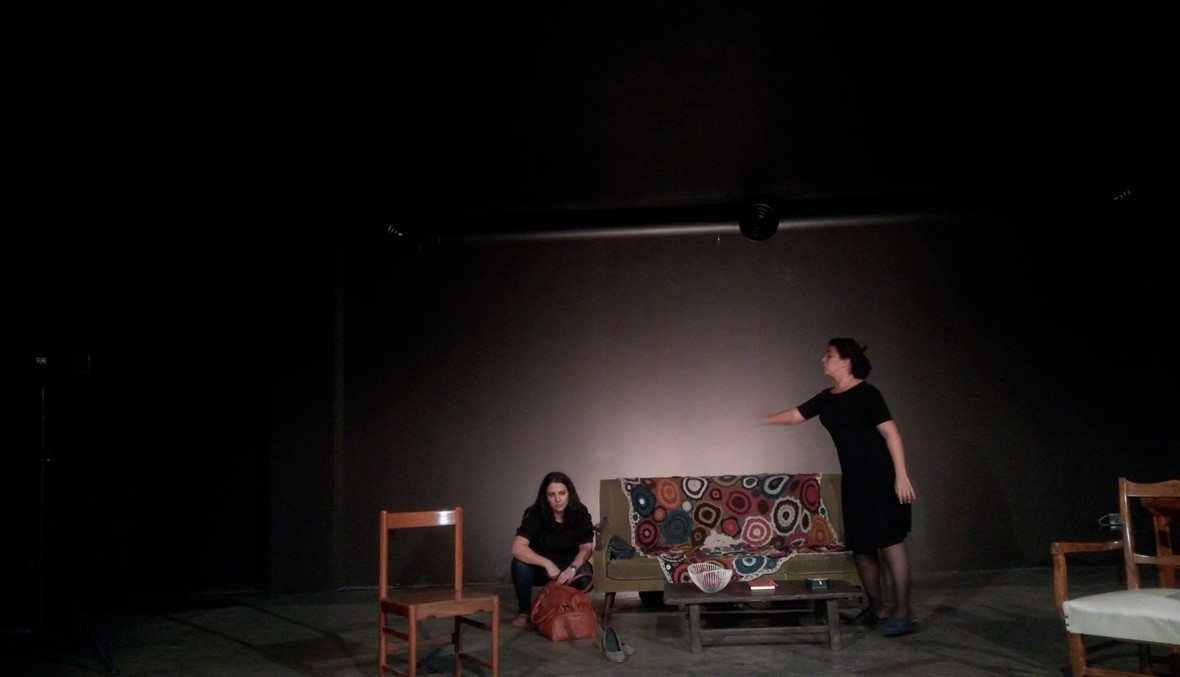


BEIRUT: With Nadia nagging, Rim begging her to stay in the house, and their brother Nabil seeming confused and irritated by their constant arguments the play “Al Bayt” opens with its first scene, on a highly remarkable experimental theater nights.
This kind of theater, where the actors are placed in the spotlight, rather than the lighting, props, and all the other art direction, without forgetting the importance of the latter as well, is rarely seen in Lebanon’s theatrical plays. (again, is unclear, write simple)
“Al Bayt,” a Lebanese script that was played in many countries before reaching Lebanon for the first time, is currently roaming around Lebanon. Annahar watched it at KED, on Karantina road.
As the story emerges in the play written by Arze Khodr and directed by Caroline Hatem, Rim’s (played by Jessy Khalil) temper gets worse, as she tells her sister Nadia (acted by Yara Abo Haidar) how bad childhood memories make it impossible for her to return to the home she has left 10 years ago.

The only reason the rebel sister supports her elderly strict and conservative sister through staying home is because of their mother’s death.
Smoothly, the script seemed to reach the audience, translating dark comedy into loud laughs and mixed feelings depending on the actor’s experiences and thoughts portrayed on stage.
Nabil, the brother, played by Tarek Yaacoub, is the indecisive character that doesn’t want to upset any of his sisters.
The light (designed by Rayan Nihawi) was mostly dim and warm, especially at times when Rim tries to convince Nabil of telling Nadia that they should sell the house and distribute shares. “Each of us will get $800,000 if we sell this old house I hate,” Rim stresses confidently.
Sound and music composition, designed by Rabih Gebeile, gave the impression of confusion and a thirst for freedom.

Rim telling Nadia the truth about selling the house. (Annahar Photo/ Zeina Nasser)
LOGICAL EMOTIONS
Actor Tarek Yaacoub told Annahar: “Nabil is like me in a way. I don't have as much money as him though.” The young actor confessed that through Nabil’s character, he understood his aunt. “My aunt was afraid of marriage,” he said
“The content is there, in the theatrical work,” he added.
Yaacoub didn’t say that the role was hard, but preferred mentioning that “practice makes perfect”.
Months before the play, the crew was practicing for 4 to 6 hours per day.
34-year-old Yaacoub said that he is working with two strong actresses. He has previously acted in short films and movies, one of which is Very Big Shot.
“You find something real in every sentence being said on stage,” he said.
Answering Annahar on whether it makes it difficult for the actor to be moving around many stages for one play, he said that the space affects the actor, but once one has the character, they would be able to draw the house again.
“It's built on logical emotions, and if it wasn't built on them, it would become a parody,” he said.

Nabil, acted by Tarek Yaacoub. (Annahar Photo/ Zeina Nasser)
STABLE PRESENCE
According to Yara Abou Haidar, who, as she mentioned, is a lot different than the character she acts, “the actor uses things from their personal things sometimes.”
For her, acting is an ongoing process, and the role she plays is like many people she knows in society.
“It's not wrong to experiment,” she said, adding that “Al Bayt” will be performed again in February, during the opening of renovated Monot Theater.”
A fully-booked night brings up the question of the status of Lebanese theater. For Abou Haidar, “the theater is alive and such topics are needed to entertain the audience.”
She sees that this type of art is essential to breathe.
“It's very hard to be actors in this country, though,” she said, adding: “We're not in a group. It's an everyday resistance to act in Lebanon.”
Mentioning that most actors/actresses have a second job besides acting, to be able to make a living, Abou Haidar happily said: “No one can remove your presence from stage. You are here, at that certain moment, moving, and that’s beautiful. “
INSPIRED BY DAMASCUS
Playwright Arze Khodr said in an interview that she was really entertained by the show and the actors.
Her main inspiration to write the play was Damascus’ old houses, she said. It was part of a playwriting workshop she was attending in Syria, and “Al Bayt” (The House) was written between 2007 and 2008.
“Sometimes an idea is inspired by nothing,” she said, adding that what happens in “The House,” which ends by the government wanting to destroy the house because a highway wants to take in its place, “could happen with siblings everywhere.”
The last draft of the play was written in 2008. After that, the play was performed in Germany in 2013 and 2015. There was also a staged reading of it in New York, London, France, and Tunisia.
The only two countries where it was fully staged are Germany and Lebanon.
“I feel the play is independent, and I feel as if I'm watching,” Khodr says.

Jessy Khalil (Rim) sees that the actor searches for certain traits in the character. “The character doesn't have to look like the actor though,” she mentioned.
“Rim’s character looks a lot like me in my daily life,” Khalil said, adding that “it's relative the way we can relate or identify to a different character.”
“Untraditional women are with Rim,” she mentioned.
“As actors, we are honored to act in such a play,” she said, adding that “the idea of direction and experimental theater places the actor in the center of the artistic work.”
“The play is the actors,” Khalil, who just finished her 10th play, said.