Inside Iran’s succession struggle: The race for Supreme Leader
As Tehran grapples with internal rivalries, the Revolutionary Guard, political elites, and religious authorities vie to choose Iran’s next Supreme Leader—while external threats from the U.S. and Israel add a dangerous edge to the succession.
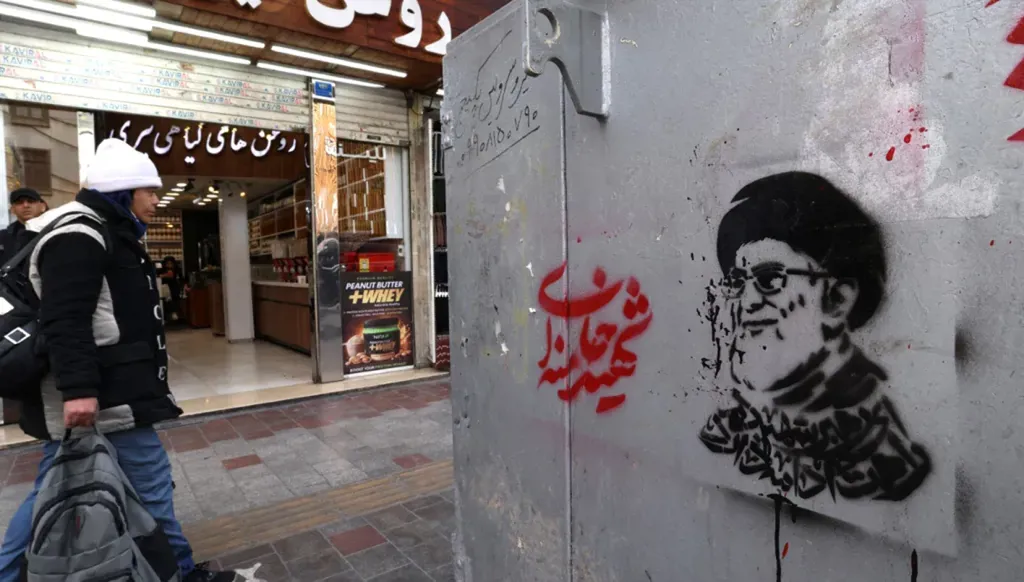
An Iranian walks past a graffiti image of Khamenei near Tajrish Square in Tehran. (AFP)
Eight days after the killing of Ayatollah Ali Khamenei in an attack by the United States and Israel on Tehran, the position of Supreme Leader in Iran remains vacant. The delay in choosing a successor for the man who ruled the country for more than three decades is not solely due to security concerns or external threats, but also reflects a silent struggle within the system's own structure.
Unlike in 1989, when the Assembly of Experts chose Ruhollah Khomeini’s successor in less than a day, the process of selecting the third Supreme Leader of the Islamic Republic today appears far more complex. It involves the calculations of the Revolutionary Guard, the positions of the heads of the branches of government, the views of the religious establishment, as well as the concerns of various political currents over the identity of the man who will assume this crucial position.
The question posed in Tehran is not just who will be the next leader, but what new balance of power will emerge from this pivotal moment in the history of the Islamic Republic?
Among the factors that have slowed the selection process are repeated threats by U.S. President Donald Trump to assassinate the next leader. Trump went further in his recent statements, insisting that the choice of the next leader should be coordinated with the United States. This stance has drawn ridicule from some Iranians, who jokingly remarked that Trump has effectively become the 89th member of the Assembly of Experts, the 88-member council constitutionally tasked with selecting the Supreme Leader.
However, external threats are not the only reason for the delay; there is also a hidden struggle among the country’s political power centers and influential institutions over the identity of the new leader and the direction of the next phase.
In general, the most prominent of these forces can be limited to four main circles:
1-Revolutionary Guard
The Revolutionary Guard is currently leading the military confrontation with the United States and Israel, and it is understandable that it does not wish to be a mere bystander in the process of selecting Iran’s third leader.
The current and former leaders of the Revolutionary Guard have become influential figures in Iranian political life. While Khomeini sought during his ten-year leadership to keep the Guard out of politics, Khamenei, over his thirty-six-year tenure, actively encouraged the institution’s involvement in the political arena. This fostered the Guard’s expanded influence across various decision-making centers, from the government and parliament to institutions directly linked to the Supreme Leader’s office.
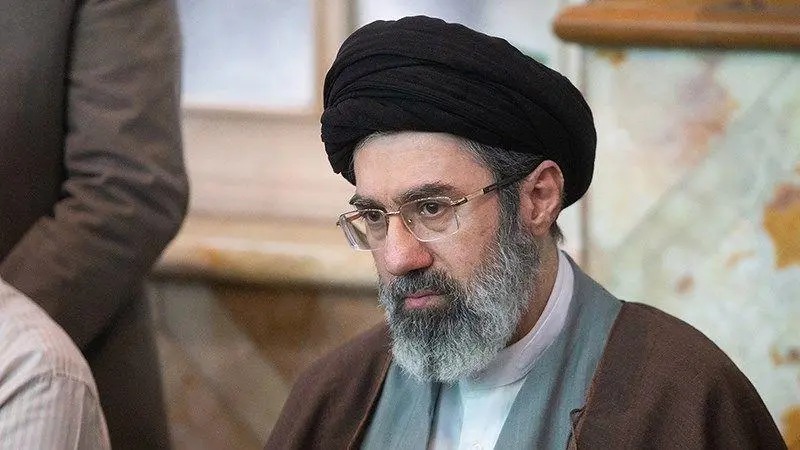
Thus, the Revolutionary Guard aims to advance its preferred candidate for the leadership. Leaks suggest that Mojtaba Khamenei is viewed as the closest choice to the Guard. In fact, some media outlets aligned with the Guard have unofficially reported in recent days that he has been selected as leader, with the official announcement delayed for security reasons. Reports also indicate that 69 of the 88 members of the Assembly of Experts have voted in his favor.
This issue becomes even more sensitive in light of last week’s attacks on buildings belonging to the Assembly of Experts in Tehran and Qom, which resulted in their destruction.
Mojtaba Khamenei. (Tasnim)
2-Heads of the three authorities
The leader’s death has increased the influence of the heads of the executive, legislative, and judicial branches. According to the Iranian constitution, the President, the head of the judiciary, and one member of the Guardian Council form a temporary leadership council responsible for managing the country’s affairs until a new leader is elected, with its decisions being binding.
This council’s responsibilities also include preparing the political and institutional conditions for electing the leader, making the heads of the three branches key players in the ongoing discussions over the proposed candidates.
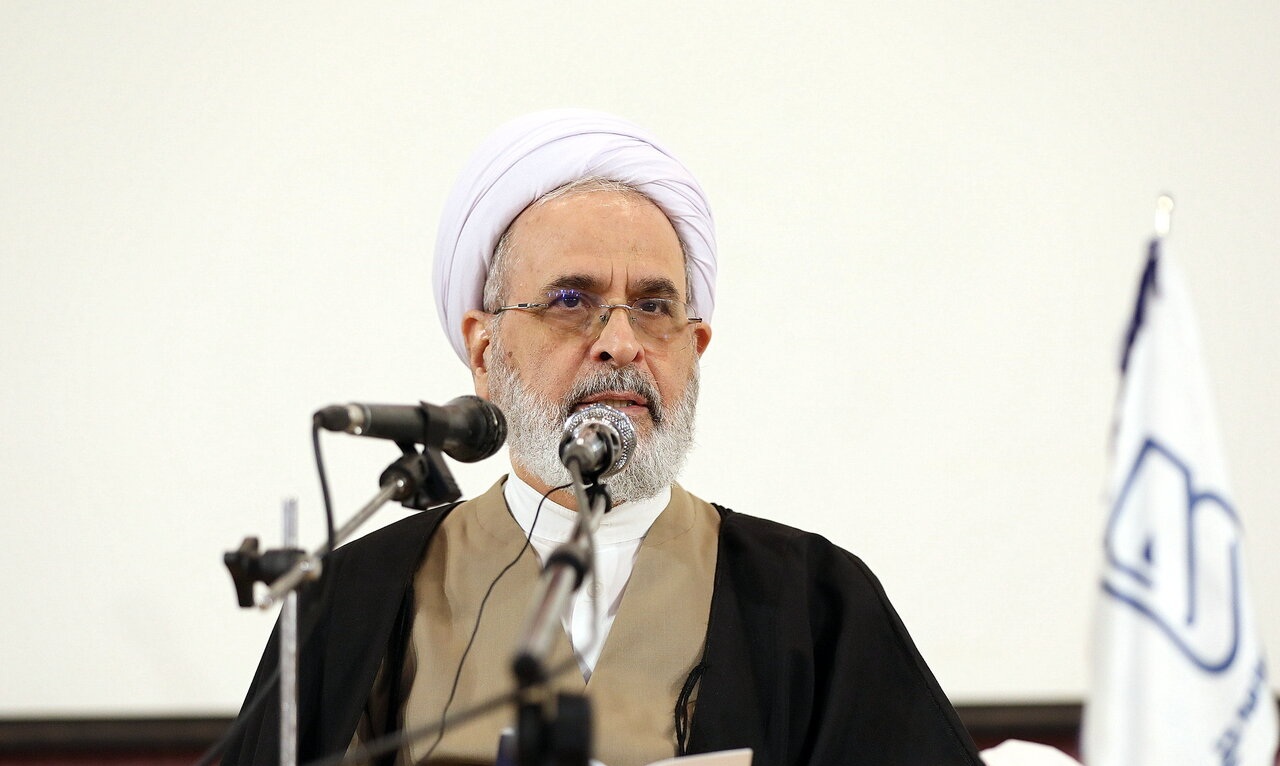
Indicators suggest that Chief Justice Gholam-Hossein Mohseni-Eje'i — who is himself a potential candidate — is working to enhance his chances of attaining this position, and if that proves unfeasible, he appears likely to support Ali-Reza A’arafi.
Conversely, Parliament Speaker Mohammad Baqer Qalibaf is known for his strong support of Mojtaba Khamenei’s nomination, while President Masoud Pezeshkian appears to favor other candidates such as Hassan Khomeini or Hassan Rouhani, though it remains unclear whether these names have been formally presented to the Assembly of Experts. Should neither succeed, Pezeshkian is likely to prefer Ali-Reza A’arafi over Mojtaba Khamenei.
Ali-Reza A'arafi. (X)
3-Sources of emulation and the religious institution
Iran has nearly ten grand sources of emulation and more than four hundred thousand clerics, making this religious establishment a significant moral and political force in sovereign decisions. In the process of selecting the leader, the positions of these sources of emulation cannot be ignored, as opposition from even one could undermine the new leader’s legitimacy and open the door to political and religious challenges.
For this reason, a secret committee within the Assembly of Experts, composed of five members, is tasked with consulting Shiite sources of emulation before finalizing the candidates’ names.
The sources typically stress that the leader must be a cleric capable of ijtihad, with a strong religious reputation and a clear commitment to upholding Sharia. Nevertheless, given the nature of Khamenei’s interactions with the sources over the past three decades, it is unlikely they would oppose any of the current proposed candidates. Khamenei dealt firmly with sources who opposed him in the past, such as Ayatollah Montazeri and Ayatollah Saniee, preventing them from becoming influential centers of opposition.
4-Political and social currents
The reformist current in Iran exhibits clear concern over the potential ascension of Mojtaba Khamenei to leadership, as he is widely perceived as a close ally of the conservative camp, hesitant toward the reformists' agenda. He is believed to have supported the governments of Mahmoud Ahmadinejad and Ebrahim Raisi, while opposing Hassan Rouhani's government.
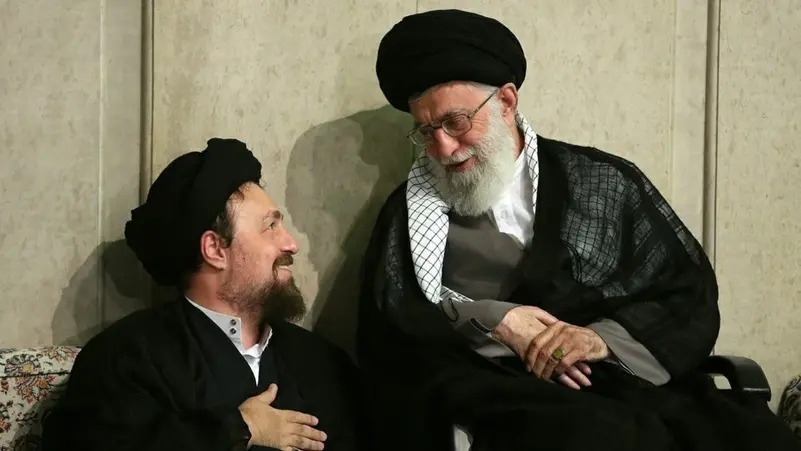
Therefore, the reformists—if they have any real influence in the selection process—favor names such as Mohammad Khatami, Hassan Rouhani, or Hassan Khomeini. However, indications suggest that Hassan Khomeini alone may be among the names proposed for voting within the Assembly of Experts.
Hassan Khomeini sitting next to the late leader Ali Khamenei. (X)
Some estimates suggest that one reason for the delay in announcing Mojtaba Khamenei’s election is the pressure exerted by reformists through two influential figures in the regime: Ali Larijani, Secretary of the Supreme National Security Council, and Ali Asghar Hejazi, Deputy Head of the Leader’s Office. These officials have warned that preserving the regime and its stability may require selecting a leader who does not provoke the United States and is capable of maintaining quieter channels of communication with the West.
Hejazi—who, according to some rumors, was killed in the second bombing of the Leader’s office on Friday morning—was among the closest to the leader. Yet, like Larijani, he did not align with the hardline current. It is worth recalling that both men faced severe attacks from hardliners in 2015 due to their support for the nuclear agreement.
In light of these complex dynamics, it appears that selecting the third leader of the Islamic Republic will not be merely a constitutional procedure carried out by the Assembly of Experts, but the outcome of covert negotiations and struggles among the regime’s various power centers.
Additionally, the harsh attack by hardliners on Pezeshkian, after he released a video message on Saturday apologizing to Arab states for the military attacks they endured, reflects the depth of tension within the Iranian political scene and underscores that governing the country through a temporary leadership council will not be a sustainable option for long.
For this reason, it is likely that the selection of the new leader will be resolved soon. Nevertheless, the possibility of him being targeted remains, amid open hostility with the United States and Israel and ongoing confrontations between the two sides.



 Messenger
 Whatsapp
 Threads
 Email
Email
 Print
Print
 X
X
 Facebook


 Mojtaba Khamenei. (Tasnim)
 Ali-Reza A'arafi. (X)
 Hassan Khomeini sitting next to the late leader Ali Khamenei. (X)