

U.S. forces surge in the Middle East as negotiations continue


 Messenger
 Whatsapp
 Threads
 Email
Email
 Print
Print
 X
X
 Facebook
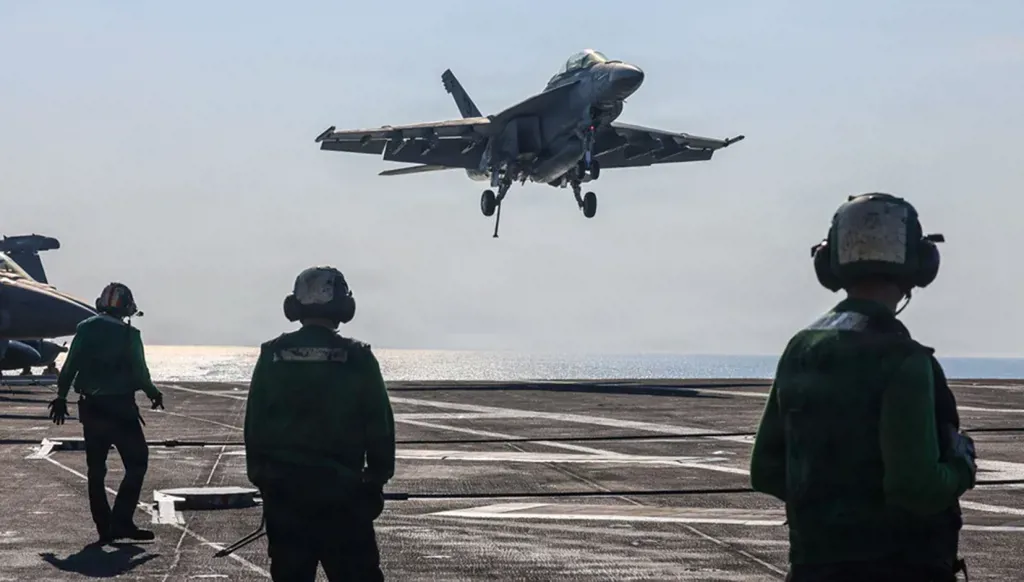


The region steps closer to the brink with news that President Donald Trump received a status of readiness from U.S. forces. There is now a possibility of action starting Saturday.
Although the timeframe for any military action could extend beyond the weekend, sources cited by CBS News say that officials confirmed Trump has not yet made a final decision. Discussions within the White House are evolving, with careful evaluation of the risks of escalation.
The Wall Street Journal reported that the United States has continued moving advanced fighters like the F-35 and F-22 to the Middle East, according to flight tracking data and a top American official. Another aircraft carrier, carrying attack aircraft and electronic warfare planes, is heading to the region. Command and control planes, essential for managing large-scale air campaigns, are also on their way. Vital air defense systems have been deployed in the region over the past few weeks.

This buildup gives the United States the option of launching a sustained aerial campaign lasting weeks against Iran, rather than a quick, single strike like Operation "Midnight Hammer," which Washington carried out in June against three Iranian nuclear sites, according to U.S. officials.
David Deptula, a retired three-star general in the U.S. Air Force who played a key role in the 1991 Desert Storm campaign against Iraq, said, "Frankly, the best that could come out of this is that the significant increase in deployed forces may serve as a sufficient indicator that Trump is serious about using force," which could prompt Iranian leaders to reach an agreement.
However, U.S. and foreign officials have grown more pessimistic about the likelihood of Iran agreeing to U.S. demands. They said Tehran might be willing to suspend uranium enrichment activities only briefly, possibly until Trump leaves office.
The U.S. Air Force recently relocated dozens of fighters and support aircraft to Muwaffaq Salti Airbase in Jordan and Prince Sultan Airbase in Saudi Arabia, according to flight tracking data. These aircraft include additional F-35, F-15, and F-16 fighters, as well as E-3 AWACS and E-11 airborne communication planes. More fighters are expected to arrive.
Meanwhile, the U.S. Navy currently has 13 ships in the Middle East and the eastern Mediterranean to support any potential operation, including the aircraft carrier USS Abraham Lincoln and nine destroyers capable of countering ballistic missiles, according to a naval official. Another aircraft carrier, USS Gerald R. Ford, along with four destroyers in its strike group, is on its way to the region.
In addition, the American strike force preparing off Iran includes fighters and destroyers:
KC-135 Stratotanker and KC-46A Pegasus – aerial refueling
Boeing RC-135V Rivet Joint – electronic surveillance
F/A-18E/F Super Hornet – maritime air raids
F-15E Strike Eagle – strike missions
E-2 Hawkeye – early warning and battle management
Lockheed C-5M Super Galaxy – transports carrying 122 tons
USS Spruance – destroyer for air defense and anti-submarine warfare
USS Tulsa, USS Canberra, and USS Santa Barbara – ‘Independence’-class combat ships for mine warfare

The Pentagon has also deployed additional ground-based air defense systems to multiple locations across the Middle East.
While this buildup appears extensive, it represents only a fraction of the capabilities the United States deployed during the Gulf War in 1991 or the 2003 Iraq invasion. In the first instance, Washington deployed six aircraft carriers in the Arabian Gulf and the Red Sea. The U.S. Air Force then deployed entire wings of warplanes—not just squadrons, as is currently the case—to conduct a six-week air campaign.
During the 2003 war, the U.S. Air Force positioned 863 aircraft in the Middle East. Operation "Desert Storm" in 1991 involved 1,300 aircraft from the U.S. Air Force, Navy, and Marine Corps, according to Air & Space Forces Magazine.
Today's circumstances are different. The U.S. Air Force is much smaller than it was, and there are no American or allied ground forces to support the operation. Additionally, there is no broad international coalition unless the Israeli Air Force participates in the campaign.
Unlike in 1991, Saudi Arabia and the UAE have restricted their airspaces from potential use in American strikes. Much of the U.S. warplane presence is currently concentrated in Jordan.
However, military technology has evolved, including advances in precision strike capabilities, stealth, and space-based systems.
Not all weapons the United States could use to strike Iran are currently in the Middle East, nor do they need to be. B-2 stealth bombers have long trained to carry out missions in the region directly from the United States, as they did in June against Iran's nuclear facilities, or from the U.S.-British joint base in Diego Garcia in the Indian Ocean. Other long-range American bombers are capable of performing the same task.