

Lebanon on the edge: Between regional war and domestic collapse


 Messenger
 Whatsapp
 Threads
 Email
Email
 Print
Print
 X
X
 Facebook
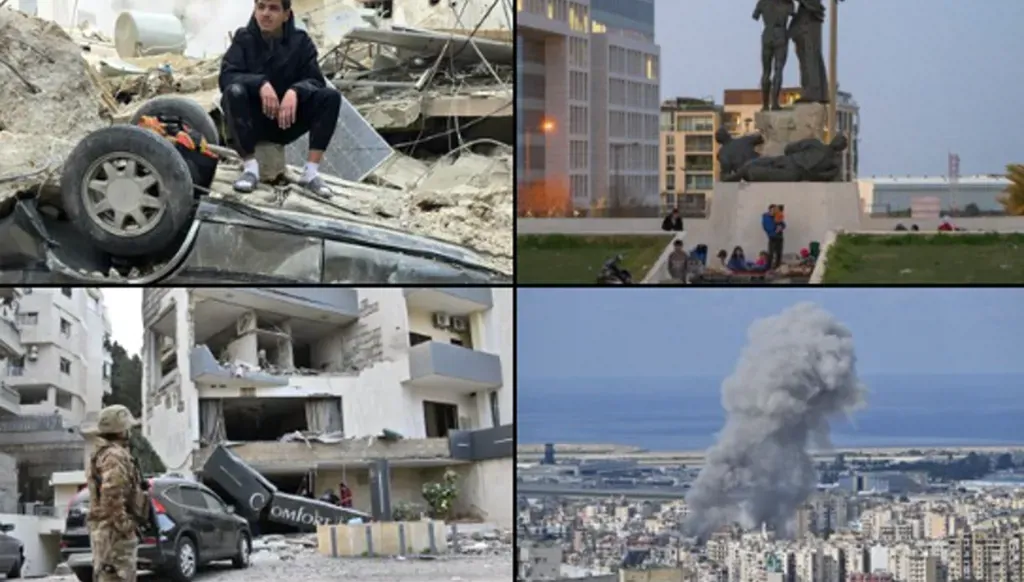


To the rhythm of the reciprocal bombardment between Israel and Hezbollah, Lebanon is entering its most dangerous phase in years. This time, however, the country faces a regional scene open to a direct confrontation between the United States and Israel on one side and Iran on the other. The conflict is no longer limited to skirmishes along the southern border; it has escalated into an open multi-front war and a severe internal test for the Lebanese state at a moment of extreme political and economic fragility.
The outbreak of the American-Israeli war on Iran marked a fundamental turning point. As the strikes extended into the Iranian heartland, the Lebanese front could no longer remain in a position of indirect support and effectively became part of the battle itself. Hezbollah escalated the launch of rockets and drones toward northern Israel, a move many interpreted as clear backing for Tehran, even as the party insisted that its actions were intended only to prevent the establishment of new ground realities and were not directly linked to the war on Iran. Meanwhile, Israel intensified its airstrikes on the southern suburbs and areas in the south and Bekaa Valley, targeting what it described as military infrastructure and weapons depots, and clearly signaled that it was prepared for a large-scale ground invasion if the escalation continued.
In this way, the old rules of engagement have eroded all at once. The field situation suggests that events are moving toward the edge of a full-scale war without an official declaration, while the level of mutual threat is rising to an unprecedented point. Israel’s threat of a ground invasion is no longer just political pressure; it has become a seriously considered military option, especially if rocket attacks expand and reach strategically sensitive depths. At the same time, the decision to link the Lebanese front to the war on Iran makes it difficult to separate the two arenas or to contain one without affecting the other.
The central question in Beirut and in other concerned capitals is: where is this war headed, and how long could it last? The data suggest three possible trajectories. The first is the continuation of intense reciprocal strikes over several weeks, in a framework of “war of attrition,” where each side attempts to improve its negotiating position while waiting for the course of the war on Iran itself to become clearer. This scenario keeps Lebanon under fire, but within a relatively limited scope.
The second trajectory involves a slide into full-scale war, either through a large Israeli ground operation in the south or as a result of a decisive strike that changes the rules of the game. In this case, the war could stretch on for months, imposing a huge human and economic cost, especially on Lebanon, whose infrastructure and financial system cannot withstand a blow of this magnitude. Recent years’ experiences are fresh in memory, but the difference today is that the state is weaker, the economy more exhausted, and the capacity for recovery almost nonexistent.
The third trajectory, which is less likely at present but cannot be ruled out, would involve a rapid ceasefire under international auspices, reestablishing new or adjusted rules of engagement. However, the success of this option depends on broader regional calculations, particularly the outcome of the American-Israeli war on Iran. If Washington and Tehran move toward containing the confrontation or opening negotiation channels, this would automatically ease tensions on the Lebanese front. But if the war there drags on, the flames will continue to burn here.
Internally, the consequences of the war are no less serious than its military dimensions. Displacement is increasing, and anxiety is spreading to Beirut and its suburbs, amid sharp political divisions and an almost total absence of the national solidarity that marked previous wars. Debate is intensifying over decisions of war and peace, the role of Hezbollah, and the limits of state authority, especially after the government’s recent decision to classify Hezbollah as an organization outside state control. Some see the confrontation as a preemptive defense within an open regional struggle, while others believe Lebanon is once again being dragged into a war beyond its capacity to withstand. Between these positions stands a government with weak authority and limited resources, trying to contain the security and humanitarian collapse without having real tools to change the course of events.
In the end, there are no decisive signs of an imminent military resolution, but some indications of the war suggest that the logic of total eradication is present in the calculations of certain actors. The greatest danger lies in the conflict spiraling toward a wider targeting of civilian sites or critical Lebanese infrastructure, which could place the country under a comprehensive siege with severe social and economic consequences.
Lebanon once again stands on the edge of the unknown. The coming weeks will be decisive: either a new regional balance is established under fire, or the country slides into a prolonged war that redraws the political and security maps of the region. Until then, the nation remains a prisoner of a struggle larger than itself, with its outcomes determined more by regional and international capitals than by Beirut.