

Exclusive weapons in Lebanon: Hezbollah vs. the State
As Iran, France, Egypt, the U.S., and Saudi Arabia weigh in, Hezbollah’s weapons strategy faces growing challenges—impacting the country’s stability.


 Messenger
 Whatsapp
 Threads
 Email
Email
 Print
Print
 X
X
 Facebook
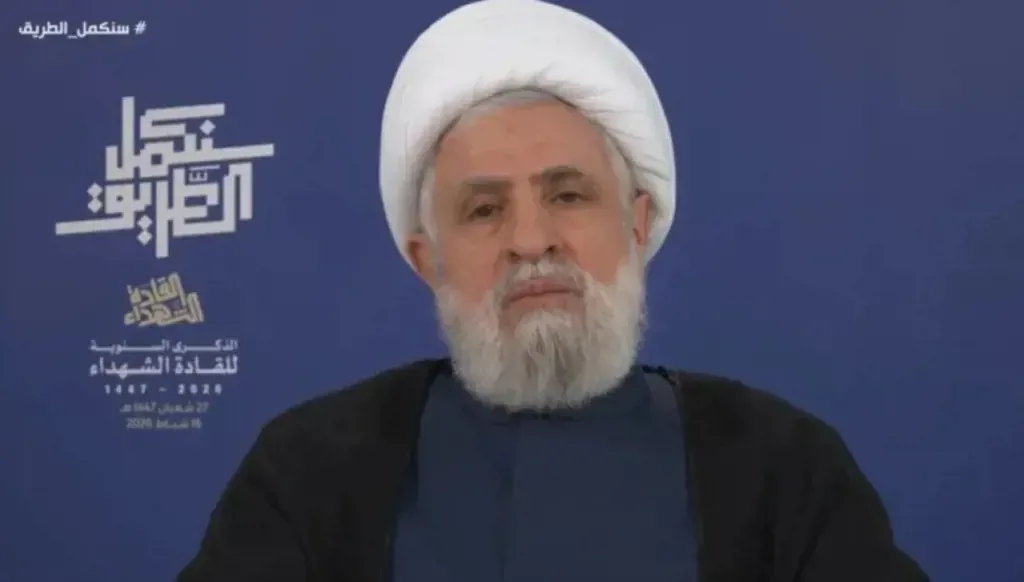


Hezbollah's Secretary-General, Sheikh Naim Qassem, timed his speech to coincide with the cabinet session discussing the exclusive weaponry issue north of the Litani, escalating tensions as usual. He even asserted that the cabinet should not debate any exclusivity of weapons, implying, in his own way, that the Lebanese army should be aligned with the resistance and support it for the benefits he perceives it brings.
With Sheikh Naim Qassem’s weekly escalation, he seemed to signal that the exclusivity of weapons in any area controlled by Hezbollah should no longer be discussed, the question remains: what is he betting on?
Does he bet on prolonged Iranian-American talks, taking advantage of the interim period? Does he bet on certain French and Egyptian calls for calm to keep the issue of weapons exclusivity limited?
Perhaps it is a bet on something specific, but Sheikh Naim Qassem’s words have little impact or resonance in the United States or Israel. This is evident from the increased escalation along the Beirut-Damascus road at Masnaa, in villages and towns in the Bekaa, and in the south, where Israel will not allow or accept these weapons to remain. Ultimately, Lebanon continues to pay a heavy price, reminiscent of the procrastination of the Palestinian authority in the 1970s, followed by decades of tutelage under Hafez and then Bashar al-Assad, leading to the current Iranian influence through Hezbollah. The pressing question remains: how far will the issue of exclusive weapons extend, and when will it finally reach a resolution?
In this context, the head of foreign relations for the Lebanese Forces, former Minister Richard Kouyoumjian, told Annahar that Hezbollah is relying solely on a strategy of “escaping forward.” He stressed that this has little to do with the American-Iranian negotiations and is instead an attempt to push through this stage with its positions. Where it leads and where it ultimately cashes out remains unclear—Hezbollah faces considerable confusion, while Iran is focused on its strategic interests rather than Hezbollah itself, if it is merely one of its instruments.
Kouyoumjian adds that Hezbollah’s actions are meant to send messages to its own environment, signaling that it remains strong and capable. At the same time, it seeks to extract more benefits—such as reconstruction funds and other support—from the state, which continues to bear the costly consequences of Hezbollah’s involvement and distractions during the recent war.
As for the Egyptian and French positions, does this provide Hezbollah with a sense of hope or leverage?
Kouyoumjian concludes that the French and Egyptian stance aligns with the American and Saudi position: there should be a single weapon, that of the Lebanese army, and no other. They may support the exclusivity of weapons, but the French and Egyptians posture seem to differ from the Americans and Saudis, seeking to contain their arms and manage the situation carefully. Hezbollah, however, chooses to interpret this as the French and Egyptians simply wanting calm, and may use it as a pretext. In reality, Cairo and Paris are as firm as Washington and Riyadh—Hezbollah’s weapons must be dismantled. The difference is in approach.