

Saudi Arabia and Turkiyë signal alignment at 2026 World Government Summit
Crown Prince Mohammed bin Salman and President Recep Tayyip Erdoğan hold high-level talks, signing multiple agreements and affirming cooperation on trade, energy, defense, and peace initiatives across the Middle East.


 Messenger
 Whatsapp
 Threads
 Email
Email
 Print
Print
 X
X
 Facebook
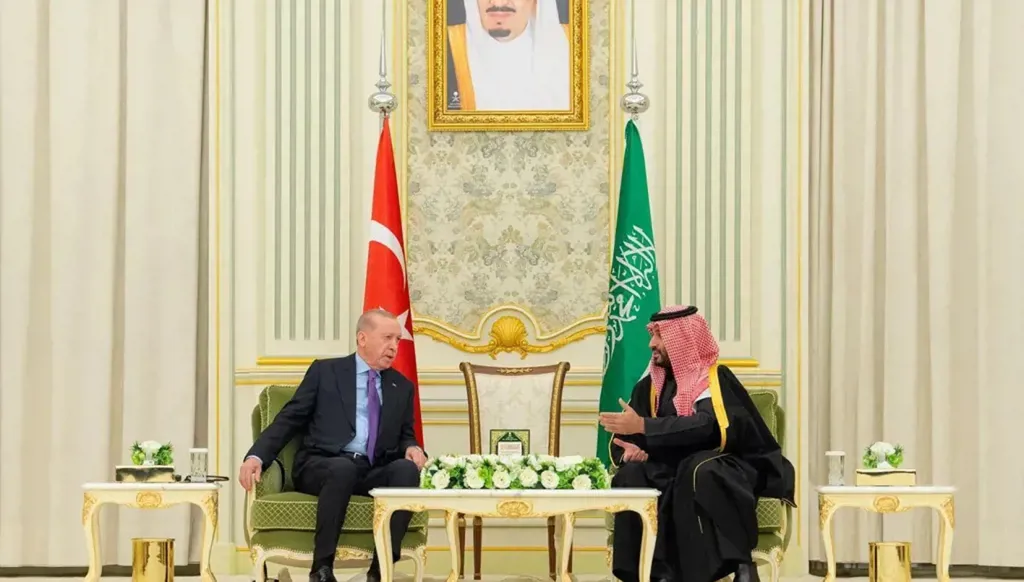


Crown Prince and Saudi Arabian Prime Minister Prince Mohammed bin Salman and Turkish President Recep Tayyip Erdoğan held an official meeting, during which they reviewed the brotherly relations between the two countries and pathways for mutual development. At the start of the meeting, the Turkish side praised the efforts made by the Government of the Kingdom of Saudi Arabia in serving the Two Holy Mosques and their visitors, commending the level of coordination between the two countries to ensure the comfort of pilgrims and visitors from the Republic of Turkiyë.
In a joint statement issued at the end of the visit, the two sides expressed their deep concern over the deteriorating humanitarian situation in the Gaza Strip and ongoing Israeli aggression. They emphasized the need to intensify relief efforts, establish a ceasefire, end the occupation, and realize an independent Palestinian state based on the 1967 borders, with East Jerusalem as its capital, in accordance with international legitimacy resolutions and the Arab Peace Initiative.
Both countries affirmed their membership in the Peace Council and support for the second phase of the comprehensive peace plan in Gaza. They raised the Turkish mediation efforts and the Saudi role in supporting a peaceful resolution of the Palestinian issue, affirming the importance of the Organization of Islamic Cooperation and the role of UNRWA.
Regarding Yemen, the leaders confirmed their support for Yemen’s legitimacy and unity, with the Turkish side praising the Kingdom’s role in efforts to end the Yemeni crisis.
On Somalia, they stressed support for the sovereignty and unity of Somalia and rejected any attempts to impose separatist entities. Similarly, they affirmed their support for Sudan’s unity and sovereignty, rejected any illegitimate entities, and praised their respective efforts to supporting peace and the ongoing humanitarian response.
On Syria, the two sides praised the efforts of the Syrian government, supported the ceasefire and integration, and confirmed the need for Israel to withdraw from the occupied Syrian territories and to stop terrorist organizations threatening the stability of the entire region. They affirmed the importance of preserving the sovereignty and unity of Syrian lands and fulfilling the Syrian people’s aspirations toward development and prosperity. They condemned the continued Israeli violations against Syrian territory and sovereignty, considering them clear breaches of international law and threats to regional security and stability, opening the door to increased violence and extremism.
On the Russian-Ukrainian crisis, the officials reaffirmed their support for a comprehensive settlement through negotiations in accordance with international law.

Relations and Areas of Cooperation
The two sides commended the strength of economic ties between the countries and agreed on the importance of strengthening them further, particularly in sectors of mutual priority, by leveraging investment opportunities offered by Saudi Vision 2030 and Turkey’s Century Vision in a manner that benefits the economies of both nations. They praised the level of trade exchange and stressed the importance of continuing joint efforts to increase non-oil trade volume, intensifying reciprocal visits between public and private sector officials, and organizing trade events in both countries through the Saudi-Turkish Business Council. They also emphasized the importance of completing free trade negotiations between the GCC and Turkey.
The leaders referred to the level of mutual investments, including Saudi investments in Turkey in the fields of finance, insurance, renewable energy, real estate, manufacturing, and services, as well as the vital role of Turkish companies operating in the Kingdom across various sectors, particularly engineering and construction, real estate development, and manufacturing industries. The Saudi side praised the projects executed by Turkish construction and consultancy firms in the Kingdom, and both sides expressed their readiness to foster cooperation to implement more infrastructure projects under Vision 2030.
The two sides praised the positive outcomes of the Saudi-Turkish Investment Forum held in Riyadh, which witnessed broad participation from major corporations in both countries, highlighting promising investment opportunities and the exchange of expertise across various fields, including tourism and hospitality, construction, telecommunications and IT, life sciences, and healthcare.
In the energy sector, they confirmed their role in contributing to the provision of energy for the region and global markets. The Turkish side highlighted the Kingdom’s leading role in enhancing the reliability and stability of global oil markets, serving the interests of both producers and consumers, and supporting global economic growth. They agreed to strengthen cooperation in oil supplies and derivatives, petrochemicals, and to explore investment opportunities in petrochemicals and agricultural fertilizers, while collaborating on innovative uses of hydrocarbon materials.
They emphasized their desire to enhance cooperation in electricity and renewable energy, expedite feasibility studies for electrical connectivity between the countries, exchange expertise in electricity and renewable energy technologies, network automation, security and resilience, grid connection, and energy storage technologies. They also stressed enhancing the involvement of companies from both sides in project implementation, in addition to cooperating on energy efficiency, rationalizing consumption, and capacity development in this field.
They welcomed exploring cooperation in clean hydrogen, developing its transportation and storage technologies, exchanging experiences and best practices, and strengthening collaboration in developing sustainable energy supply chains, thereby contributing to energy supply resilience and efficiency.
They agreed to strengthen cooperation in the exploration, extraction, and processing of mineral resources, underscoring the importance of international collaboration and joint projects in critical minerals to ensure supply chain security for global energy transitions.
On climate change issues, they reaffirmed their commitment to the principles of the UN Framework Convention on Climate Change and the Paris Agreement, focusing on emissions figures irrespective of their sources. The Saudi delegation welcomed Turkey’s presidency and hosting of the 31st session of the Conference of the Parties on climate change (COP31) in Antalya in November 2026, while the Turkish side praised the Kingdom’s efforts in this area. Both sides emphasized cooperation in carbon circular economy applications, according to a statement reported by the Saudi Press Agency (SPA).
They praised the level of coordination within the Saudi-Turkish Coordination Council and emphasized the importance of enhancing cooperation in the digital economy, artificial intelligence, emerging technologies, space, transport and logistics, civil aviation, justice and administration, culture, tourism, sports and youth, scientific and educational collaboration, media, environment, water, agriculture, food security, customs, health, and military industries.
The two sides stressed the importance of financing development projects and continuing cooperation in international forums and institutions, with the Turkish side supporting the Kingdom’s bid to host the G20 Summit in 2030.
In defense and security, they emphasized the activation of signed agreements, strengthening defense and security cooperation, combating terrorism, extremism, and their financing, tackling all forms of crime, exchanging expertise and training, and enhancing collaboration in cybersecurity.
The Crown Prince and Turkish President welcomed the signing of several agreements and memoranda of understanding during the visit, covering energy, justice, space, research, development, and innovation.
On the international front, they affirmed their determination to continue coordinating to maintain international peace and security, expressed concern over regional conflicts, and stressed the importance of regional cooperation in achieving stability and peace.