

The war Lebanon didn’t choose: Survival amid regional turmoil
From Hezbollah to Israel, from Iran to global repercussions, Lebanon pays the heaviest price in a conflict that reshapes borders, politics, and lives—yet its story remains overlooked.


 Messenger
 Whatsapp
 Threads
 Email
Email
 Print
Print
 X
X
 Facebook


One day, whether sooner or later, the ongoing war in the region must come to an end. There is no war without an end, even if some wars reignite every few years, as happens in Israel's conflicts with its neighbors and within Palestine. If the current active initiatives succeed in ending the war, each side will claim victory. Donald Trump would boast about destroying Iran's nuclear program and eliminating its hardline leadership, bringing them back “in line.” Similarly, Benjamin Netanyahu would reassure Israelis of the removal of the Iranian nuclear threat and the reduction of the missile program's ability to strike their cities and facilities. Iran, on the other hand, would pride itself on its “legendary” resilience, the survival of its regime, its capacity to strike Israel and American bases in the region, and imposing a maritime economic blockade that made the whole world cry out in pain by closing the Strait of Hormuz to international oil and gas trade.
The war's repercussions have affected the entire world, and perhaps the Gulf Arab states were the most impacted, due to Iran targeting their cities and strategic civil and economic facilities, despite not participating in the conflict and striving to spare the region from its disasters. However, these states are capable, once the war ends, of compensating for their losses, addressing its consequences, and benefiting from its lessons on political and strategic levels. Undoubtedly, a significant shift in thinking and planning will occur, and the post-war period will not resemble what came before.
This introduction is necessary to lead to the crucial question: What about the Israel–Hezbollah front, and where does Lebanon stand in the settlement currently being negotiated? Does it, as always, bear the highest price for this war?
Israel responded swiftly when discussions began regarding U.S.–Iranian contacts and Washington’s presentation of a 15-point paper (resembling surrender conditions) to Iran to halt the war. It drew a clear distinction between the war on Hezbollah and the proposed settlement by confirming, through its War Cabinet, that the war on Hezbollah would continue even if hostilities on the Iranian front ceased. This rapid Israeli declaration serves as a maneuver to preempt the settlement, imposing a fait accompli on the negotiators, or to preempt negotiations in order to claim a high price for ending the war on Hezbollah, should Iran attempt to include the Lebanese front in the settlement.
Lebanon is the weakest party in this war, which has escalated beyond a conflict with Hezbollah to a war threatening the Lebanese state in its entirety—militarily, politically, socially, and economically. It is an existential war for Lebanon, affecting its borders, demographics, and internal explosive factors, both hidden and visible. The discussion is no longer about why Lebanon became embroiled in this war or from where Hezbollah decided to participate alongside Iran—whether from Tehran, the southern suburbs, or secret hideouts. Lebanon is now fully in the midst of this turmoil, and the pressing question remains: What comes next?
The losses of any country affected by war cannot be compared to those of Lebanon. This small nation is the biggest loser relative to its size, capacity, and economy. Its losses far exceed those of Iran and Israel when measured against each country’s scale and resources, even though Lebanon did not choose the war in which Hezbollah engaged—driven instead by circumstances now well known. On top of that, Lebanon receives little attention, neither in negotiations nor in efforts to pressure Israel, giving the impression that Israel and the U.S. are united in “punishing” Lebanon and burdening it with the consequences of the war with Iran.
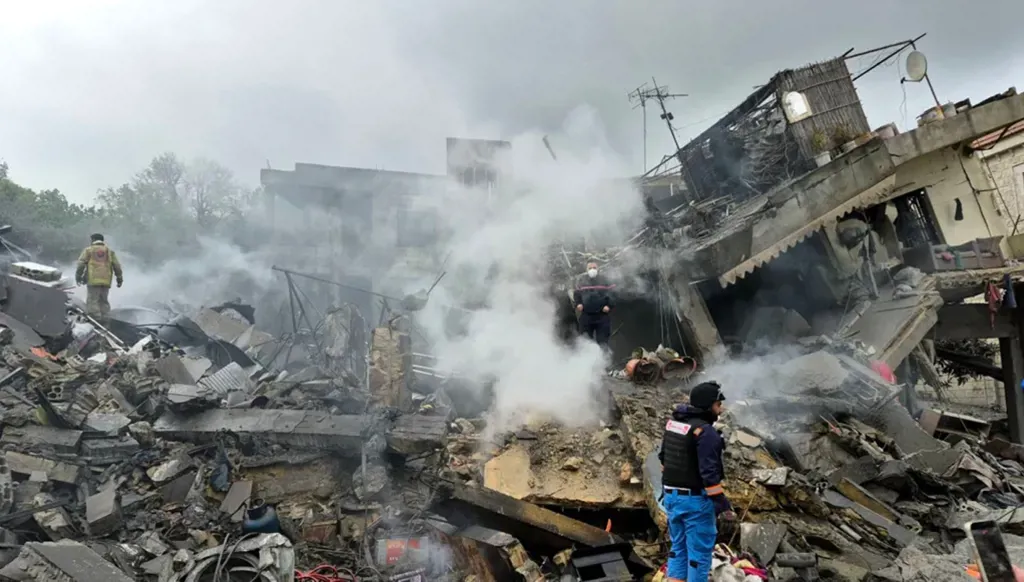
Israel uses Lebanon as an auxiliary battleground to reinforce its claims of victory: what it has not fully achieved in Iran, it compensates for in Lebanon, methodically destroying the southern suburbs and deploying thousands of soldiers to the strip it occupies. It has called up hundreds of thousands of reserves to expand the buffer zone it seeks, extending it as far as the Litani River—surpassing the few kilometers previously depopulated and destroyed during the 2024 war. This expansion mirrors Israel’s “elastic” borders, currently at the Litani River but potentially extendable to the Zahrani River near Sidon. Reaching the Litani also reopens an old issue everyone thought was settled—the matter of Litani water appropriation.
Israel follows a scorched-earth policy in the buffer zone, leaving no inhabitants who might become fighters. It destroys infrastructure both above and below ground, deepening Lebanon’s internal crisis, imposing unbearable economic burdens, and stirring unrest among its sects. This is especially evident in displaced areas, where disputes echo in statements and on social media—challenges, threats, insults, and sectarian strife that have exceeded normal levels, with no one appearing able to control them, perhaps because everyone is involved in one way or another.
It is Lebanon’s fate to always be a battlefield, perpetually ready for conflict. Any occupation of even a small part of its land ignites new resistance and provides strong justification for the continued presence of Hezbollah’s weapons, further complicating an already complex internal crisis.
Disclaimer: The opinions expressed by the writers are their own and do not necessarily represent the views of Annahar.