

Resolution 2817 marks shift in Gulf diplomacy and UN response to Iranian aggression
Arab states are increasingly building their own security frameworks and reducing reliance on external guarantees.


 Messenger
 Whatsapp
 Threads
 Email
Email
 Print
Print
 X
X
 Facebook


By Dr. Mohammed Ibrahim Al‑Zaheri and Eric Alter
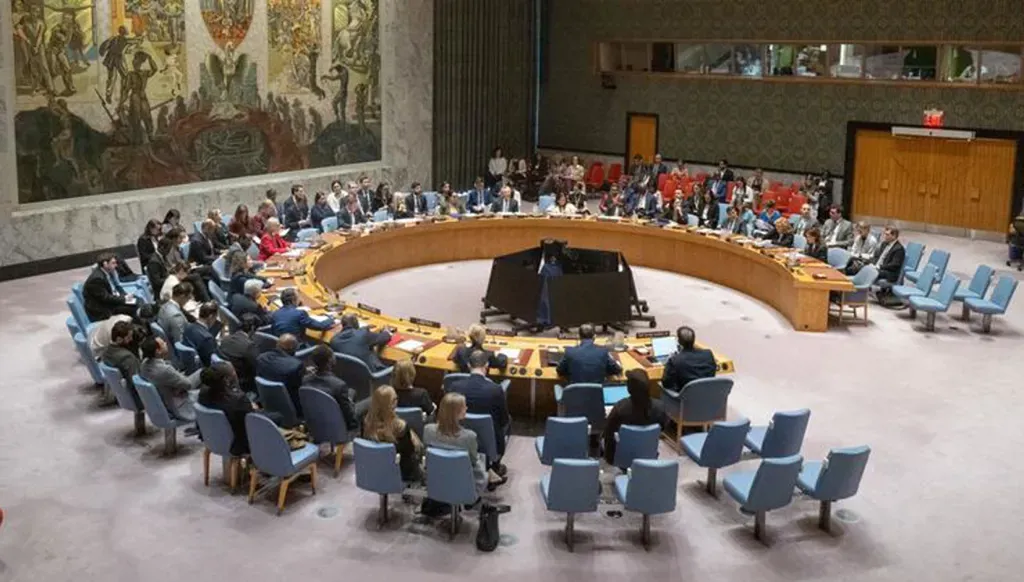
On March 11, 2026, the United Nations Security Council adopted Resolution 2817 with 13 votes in favor and none against, while China and Russia abstained. The resolution was introduced by the Kingdom of Bahrain, currently a non‑permanent member of the Council, on behalf of the Gulf Cooperation Council (GCC) states—Bahrain, Kuwait, Oman, Qatar, Saudi Arabia, and the United Arab Emirates—in cooperation with Jordan. It garnered unprecedented international support, with 135 countries co‑sponsoring the text, a record that underscores the breadth of consensus on the issue.
Although the resolution did not address the earlier U.S. and Israeli strikes that killed Iran’s Supreme Leader Ali Khamenei and targeted infrastructure inside Iran, it delivered a firm condemnation of Tehran’s recent actions. It described Iran’s missile and drone attacks against neighboring Arab states as violations of international law and a grave threat to international peace and security. The resolution demanded an immediate halt to such attacks, denounced the targeting of civilian areas, and reaffirmed the inherent right of affected states to self‑defense under Article 51 of the UN Charter.
The language of the resolution departed from the Council’s traditionally balanced tone, adopting a more unilateral framing of events. This prompted China and Russia to abstain, arguing that the text ignored what they termed “the initial aggression” preceding Iran’s response. The resolution was passed just days after U.S. and Israeli strikes inside Iran and Tehran’s subsequent retaliation. Nevertheless, it marked the first time the Security Council issued such a direct and unified condemnation of conventional military attacks carried out by Iran against multiple sovereign Arab states.
The decision carries historical weight. Before the 1979 Iranian Revolution, Iran under Shah Mohammad Reza Pahlavi was considered a pillar of Gulf stability and a close Western partner. The revolution transformed Iran into a revolutionary state intent on exporting its ideology and challenging neighbors it deemed insufficiently Islamic. This shift fueled the Iran–Iraq War (1980–1988), during which Gulf states provided billions in support to Saddam Hussein. Iran retaliated by targeting neutral oil tankers and mining Gulf waters, prompting early but largely ineffective UN resolutions.
After the war, Tehran largely refrained from direct conventional attacks on Arab territory, instead adopting a proxy strategy. It played a central role in establishing Hezbollah in Lebanon in 1982, supported Shiite militias in Iraq after the 2003 U.S. invasion, backed Bashar al‑Assad in Syria, and armed Yemen’s Houthis since 2015. Through these networks, Iran expanded its regional influence while avoiding sustained international censure.
For decades, Security Council resolutions on Iran—from Resolution 1696 in 2006 to Resolution 2231 in 2015—focused primarily on its nuclear program and missile development. Regional interventions received only passing mention. The escalation of February and March 2026 altered this trajectory. In response to U.S. and Israeli strikes that killed senior Iranian leaders, Tehran launched ballistic missiles and drones not only at U.S. military bases but also at residential neighborhoods, ports, and airports in Bahrain, Kuwait, Oman, Qatar, Saudi Arabia, the UAE, and Jordan.
In the UAE, where this article is written, missile fragments struck residential areas and hotels in Dubai and Abu Dhabi, killing seven civilians of 25 different nationalities and injuring more than 120 people. Iran, in turn, reported civilian casualties from the initial strikes on its territory. UAE Ambassador to the UN Mohammed Abushahab told the Council: “Through its indiscriminate strikes, Iran sought to spread terror among our communities. Yet our people responded with remarkable resilience and unity.”
The attacks also posed a direct threat to the Strait of Hormuz, a 21‑mile‑wide waterway through which roughly 20 million barrels of oil transit daily—about one‑fifth of global supply. Tankers from Saudi Arabia, the UAE, Kuwait, and Iraq rely on this passage, which has no practical alternative. Iran has previously threatened the strait, notably during the 1980s “Tanker War,” when it targeted commercial vessels and laid naval mines. Any major disruption today would trigger sharp increases in global oil prices and inflict economic damage across Europe and Asia—effects already beginning to surface.
Faced with direct threats from Iranian territory, GCC states responded with notable speed and unity. The broad support for Resolution 2817, with no opposing votes, reflects more than diplomatic success; it signals a strategic shift. Gulf states are no longer merely reacting to regional developments but are actively shaping international diplomacy and its agenda.
In recent years, Gulf capitals have significantly strengthened their defense systems and expanded diplomatic networks beyond traditional Western alliances. With Resolution 2817, Iran’s actions are now formally linked to threats against international peace and security, opening the door to tangible consequences—ranging from tighter sanctions to enhanced defense support for Gulf states. Iran’s diplomatic isolation, already pronounced, may deepen further.
At the same time, these developments send a clear message to allies and partners: Arab states are increasingly building their own security frameworks and reducing reliance on external guarantees. Yet effective pressure on Iran still requires broad international consensus. Resolution 2817 demonstrates that Arab‑led collective diplomacy can generate meaningful impact, even if it cannot by itself resolve all of the region’s tensions.
Dr. Mohammed Ibrahim Al‑Zaheri, Deputy Director General of the Anwar Gargash Diplomatic Academy and Eric Alter, Dean of Graduate Programs at the Anwar Gargash Diplomatic Academy.
Disclaimer: The opinions expressed by the writers are their own and do not necessarily represent the views of Annahar