

The rise and strains of Iran’s Islamic Republic: From revolution to regional powerplay
From the fall of the Shah to modern regional conflicts, Iran’s Islamic Republic faces the unraveling of its old order amid shifting international realities.


 Messenger
 Whatsapp
 Threads
 Email
Email
 Print
Print
 X
X
 Facebook
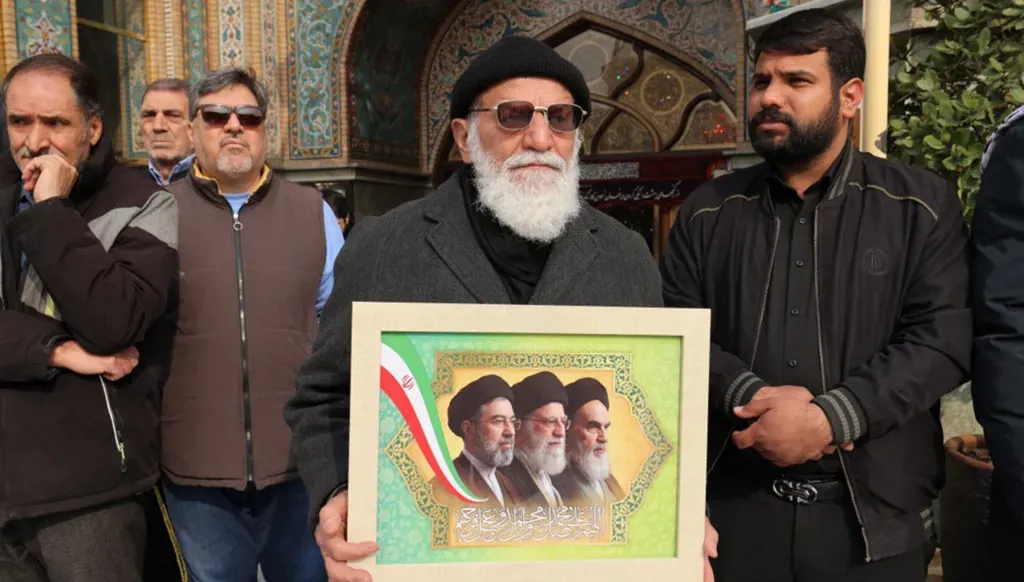


When a revolution succeeded in 1978 to remove Shah Mohammad Reza Pahlavi from power in Iran and resulted in the establishment of an Islamic Republic led by Ruhollah Khomeini in 1979, international circumstances—either by collusion or inadvertently—contributed to this change. The West generally moved the Iranian spiritual leader from his exile in France to his new 'throne' in his country. It wasn't necessarily a conspiracy that Khomeini was part of, but the rulings of necessity called for improvising an alternative judiciary from a reality-bound void.
In the calculations of that West, the urgent priority was the terms of managing the Cold War with the Soviet Union. Iran under the Shah had, for decades, stood as a strong barrier allied with the West and acting as its agent in the region. This strategic barrier against the "atheist" communist state had to be provided by an improvised "believing" Islamic state. The Cold War later vanished. The Soviet Union disappeared in 1991. Iran could no longer play its role within an expired international system, while the eight-year war with Iraq (1980–1988) strengthened its autonomous role as an ambitious leader of the Islamic world, preaching the export of its revolution to it.
Khomeini raised the slogan 'Neither East nor West, an Islamic Republic'. It appeared that the man was decreeing a model claiming to possess a margin of manipulation between the camps to establish his imagined world. It seemed that this heresy mastered dealing with the conflicting poles and fed on what the great conflict granted. The ‘conflict of nations’ forced the Soviets to withdraw from Afghanistan, and years later toppled the Taliban regime in Afghanistan and Saddam Hussein in Iraq. Tehran seemed to live in a harvest season after Sunni Islamists committed the sin of September 11, 2001.
Iran lost the virtue of wisdom, contemplation, and shrewd foresight. Consequently, it lost its freely gifted spoils without effort. It started crafting its own global system surpassing its major poles. In recent years, it appeared defiant of the existing rules, becoming a bloc of danger and threat to the West and the region on one hand, while not being favorably viewed by allies, such as Russia and China, to the point that they did not volunteer to protect it. While Tehran rode the horse of enmity against Israel, through proxies, it miscalculated to the extent of the "flood" on October 7, 2023, in the Gaza Strip, which it feared and cautioned against its omen.
What is happening to Iran and its regime these days is a complete antithesis to the necessity that imposed the establishment of that regime 47 years ago. This time, international circumstances are converging to end the validity of a 'Republic' whose functions have aged, and whose justifications for existence have disappeared. Iran is part of the region's geography and history, but its regime, as history teaches us, is subject to the Ibn Khaldun logic of the fall of states. What suggests this inevitability is not the American-Israeli bilateral war itself, but its escalating ferocity that is proceeding without an international counter-dissuasive. This reveals a rare consensus and intersection of 'necessity' at the moment of the end.
The page of the decades following 1979 will not be easily turned. It will take time, which may extend before the ends stabilize and the outcomes advance. And just as the fall of the Shah's regime event mapped out the early outlines of maps that affected the entire international system after years, the event of these days will establish another regional and possibly international scene.
And if Israeli Prime Minister Benjamin Netanyahu is hoping to create a new Middle East by force and not with the 'flowers' that Shimon Peres promised before him, then Netanyahu too is slipping into a truncated reading of history and the laws of power in a manner that might place him on the margins of a geostrategic reality ending the validity of a model that derived its survival from a Khomeinism and then Khameneism that expired.
Disclaimer: The opinions expressed by the writers are their own and do not necessarily represent the views of Annahar.