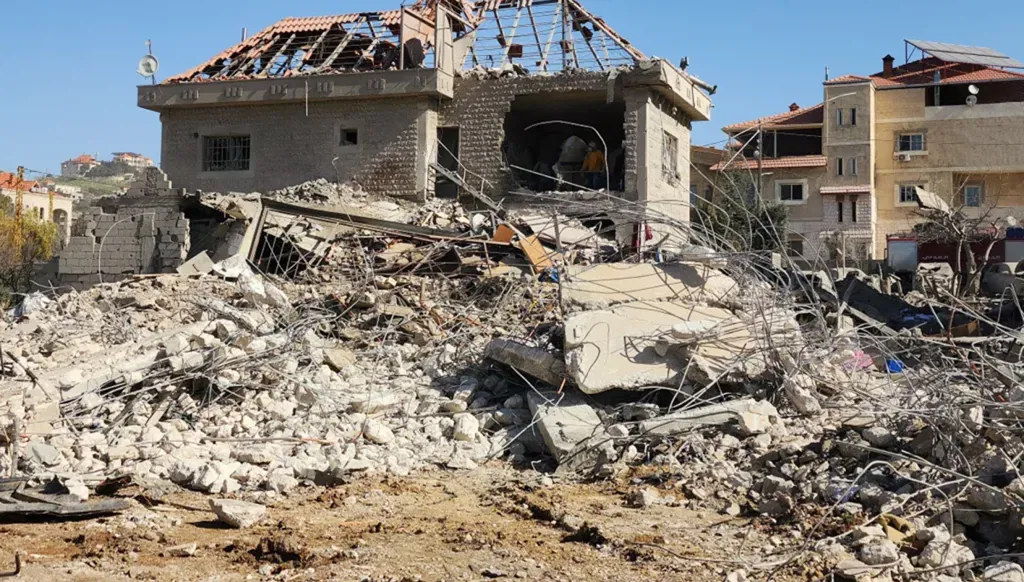
Severely damaged building in the village of Bednayel, Eastern Bekaa Valley, Lebanon, on February 21, 2026, following Israeli airstrikes. (AFP)
The exchange of messages between Israel and Iran is wearing down Lebanon in its new state, with authorities in a very precarious position, unable to use diplomatic efforts to stop Israeli aggressions on sites or regions within Lebanon.
They also cannot convince both domestic and international audiences that they have regained control over war and peace decisions in Lebanon, as they have claimed in recent months, despite significant changes occurring without demonstrating confidence in the state’s ability to do so. Lebanese officials continue to urge the international community to pressure Israel to halt its operations in Lebanon.
Exclusive scenes for Annahar from Baakline after the Israeli raids (Photo by colleague Lina Ismail)
Meanwhile, the latter, committed to maintaining its monopoly on weapons across Lebanese territory and reclaiming political and security decisions in Lebanon, cannot prevent Hezbollah from escalating its threats through ongoing “resistance” and declaring its intention to support Iran. This stance was announced by the party’s Secretary-General, Naim Qassem, regarding their determination to participate in a future conflict between Iran and the United States or Israel if the goal is to overthrow the Iranian regime—giving Israel the pretext to carry out “preemptive” strikes, which face no opposition or restraint from abroad, despite the threat they pose to Lebanon’s sovereignty. This is reinforced by the widespread belief that the party adheres to the Wilayat al-Faqih principle and takes orders from the Iranian supreme leader, intending to leverage its position and capabilities in Lebanon to defend Iran.
The official exhaustion also stems from the fact that the continued Israeli operations in Lebanon provide justifications for the party and support its narrative in rejecting the Lebanese government’s plan to disarm it, claiming that the state has failed in its approach and that “resistance” is the only way to deter Israel. The party asserts that Lebanon needs it and its weapons for defense, in contrast to other internal parties, who argue that its arsenal has entangled Lebanon in destructive wars and prompted Israel to reoccupy sites in the south under the pretext of supporting the Gaza war—a campaign the party waged independently of the decisions of the Lebanese state and people.
Exclusive scenes for Annahar from Baakline after the Israeli raids (Photo by colleague Lina Ismail)
Many fear that this exchange of messages over Lebanon’s head will set the country back by months, as it receives operational Israeli “warnings” indicating a violent response to any movement by local parties, causing significant disruption—especially as Lebanon attempts to demonstrate its ability to fully regain authority over all its territories. A prevailing political view, contrary to Israeli and other external assessments, holds that Iran’s arms and regional extensions remain as effective as Iran can leverage them to benefit itself—or at least to challenge the United States or Israel. There is a sense of exaggeration serving the interests of multiple parties in this context, including Israel, Hezbollah, and Iran, as well as differing objectives regarding the operational capabilities the party in Lebanon still retains, comparable to those it had previously. This does not reflect an assessment that the party prioritizes internal considerations—such as protecting its environment from further ruin and destruction—over its organic ties to the Iranian regime. Rather, it reflects a pragmatic calculation of not risking self-destruction, even if actions affecting Iran result in weakening the party and causing a significant setback for its regional political and security influence.
The assessment of significant exaggeration stems from field data collected after the war, while some continue to build on earlier exaggerations from previous phases of the party’s capabilities. These earlier claims were revealed—alongside Iranian capabilities—to reflect a reality that is markedly different, whether measured against advanced Israeli military technology, the aging of Iran’s military infrastructure, or an Israeli intelligence breach that dismantled the halo of power and propaganda surrounding it.
However, what weakens the promotion of the Lebanese narrative is Israel’s framing of events and everything related to the party, which positions Israel as almost the sole source of information at this level—especially as it demonstrates advanced technology in tracking the party’s elements and monitoring their movements, not only in the south but also in areas under the party’s control, reaching Baalbek.
But despite Lebanon’s perception of weakness in the party and its capabilities, and its inability to implement the “resistance” option—at least under current circumstances and in the foreseeable future—external assessments of the possibility of involving Lebanon in a war in support of Iran and the defense of its regime outweigh the Lebanese state, placing it in a lagging position that produces ripple effects in multiple directions and across various levels, at least within the context of the present situation.
Disclaimer: The opinions expressed by the writers are their own and do not necessarily represent the views of Annahar.



 Messenger
 Whatsapp
 Threads
 Email
Email
 Print
Print
 X
X
 Facebook


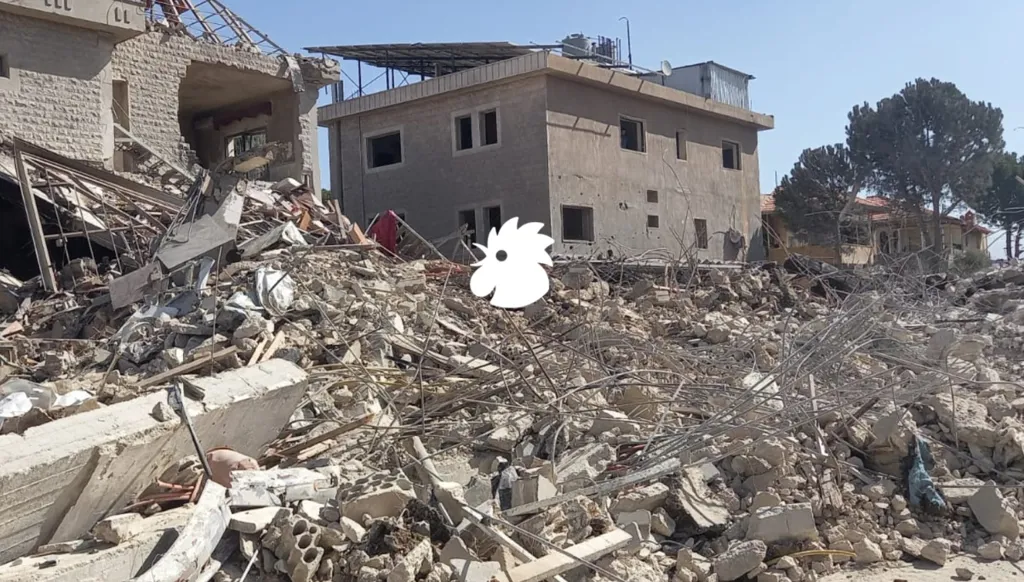 Exclusive scenes for Annahar from Baakline after the Israeli raids (Photo by colleague Lina Ismail)
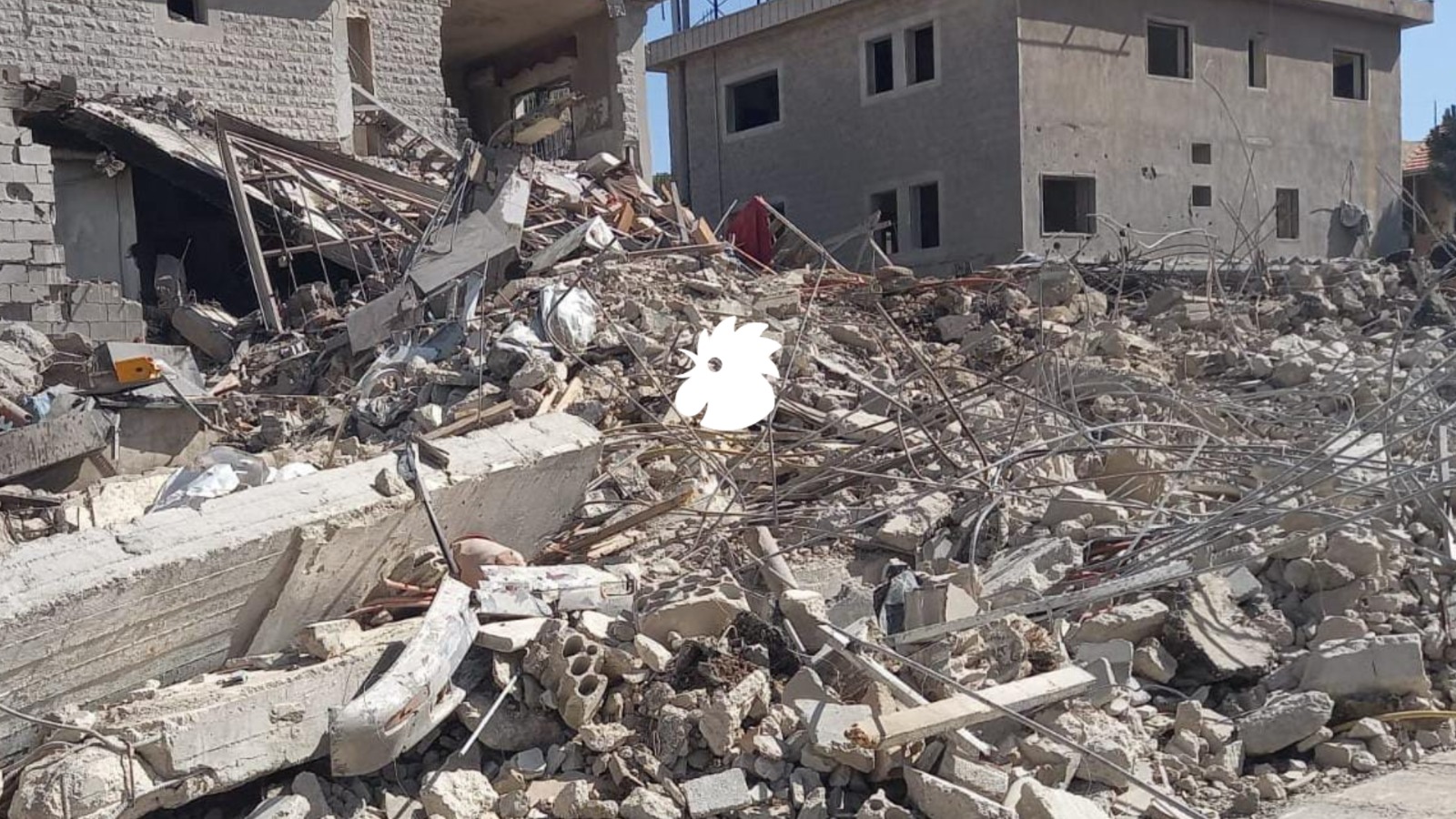 Exclusive scenes for Annahar from Baakline after the Israeli raids (Photo by colleague Lina Ismail)