

When Ideology fails: Iran’s descent into financial chaos and social upheaval


 Messenger
 Whatsapp
 Threads
 Email
Email
 Print
Print
 X
X
 Facebook
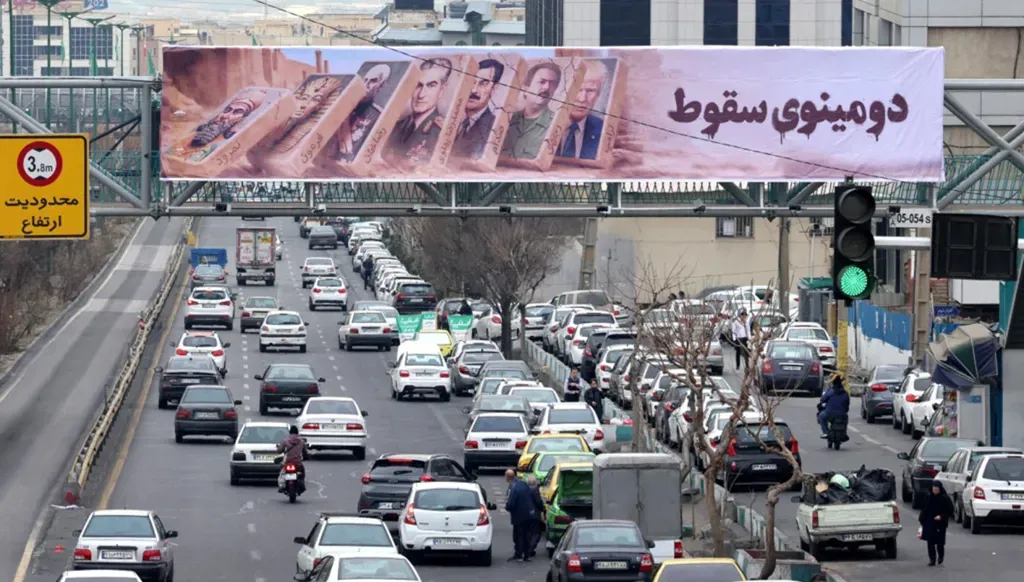


The crisis in Tehran is no longer simply a struggle between “reformists” and “hardliners”; it reflects the collapse of the political and economic model that has sustained the Iranian Islamic state for four decades, now entering a stage of senescence.
Like all totalitarian regimes, and despite its ideological rhetoric, the Iranian revolution has passed through three stages: first, the purely ideological phase; then the bureaucratic-political phase, in which the political apparatus permeates the ideological framework; and finally, a stage where the revolution becomes the private domain of bureaucratic and military elites. At this point, they no longer quarrel over the path to paradise or human salvation, but over the billions of dollars they control and manage. Consequently, the regime’s ideological legitimacy and its claims of eternal truth and authority are reduced to little more than a façade for managing crises and sustaining an economic deadlock.
For centuries, the clamor of porters in Tehran’s Grand Bazaar has provided the soundtrack to Iranian politics. Today, however, a heavy, ominous silence hangs over the market—a silence that is not the usual calm, but the tense stillness that comes before a storm.
Since the 1979 revolution, Iran’s bazaar has been the backbone of the social contract. Today, however, it stands half-closed, following the astonishing collapse of the toman—where numbers are no longer mere financial indicators, but a death knell for the social contract that tied the bazaar to the religious and military establishment for decades.
In physics, chaos is measured by a quantity called entropy. Recently, this concept has been applied to political economy as an analytical tool, giving rise to the complex framework of “Political Economy Entropy.”
As January 2026 begins, the Islamic Republic teeters on the edge of “Maximum Economic Entropy.” The scene in Tehran goes beyond the usual narratives of “hardliners” versus “reformists”; it reflects a rare historical moment in which the regime’s capacity to manage entropy is failing—not only from external pressures, but due to the internal collapse of its political-economic model. This breakdown accelerates the disintegration of its ideological legitimacy, following the convergence of the “Twelve-Day War” with the “Snapback” sanctions. The entropy trap has fully materialized, first manifesting as financial chaos that far exceeds even the most alarming official inflation figures.
At 1.45 million rials per dollar, the decline was not merely cyclical—it marked a moment when sovereign trust tore apart, dragging foreign exchange reserves down with it and plunging the Iranian economy into deep “entropy” and structural chaos. Prices no longer function as market indicators; instead, they have become signals of existential fear.
Desperately, Bazshakian sought to restore financial stability, implementing a “shock therapy” triple-tier fuel pricing system. But in an economy bleeding credibility, the move acted like pouring oil on fire. Prices skyrocketed, turning the middle and lower classes—already crushed by daily hardships—into the fuel for a hunger-driven uprising. The government printed money to cover deficits, eroding its value; prices surged further to compensate, triggering yet more currency printing in a hellish spiral reminiscent of Weimar Germany in 1923—but with a distinct Middle Eastern ideological flavor and a nuclear backdrop.
Even more dangerous than the numbers is the sociological transformation that accompanies them!
Historically, the “Bazaar-Mosque” alliance was the bedrock on which the ambitions of the Shah in the 1970s, Saddam Hussein, and later the United States were all thwarted. The clergy exercised authority and issued fatwas, while the bazaar thrived, providing funding networks and logistical support.
This time, the protests did not originate in the universities, but from the very heart of the bazaar, as the regime had ceased to be its protector and had become the direct cause of its ruin.
Just as in Damascus in 2011—where the conservative merchant, who closed his shop every Friday to pray at the Umayyad Mosque, became a protester chanting against the regime—it became clear that the alliance had died, having lost its most loyal social base. This is a moment of organic detachment that cannot be repaired with speeches about “resistance” or “stoicism.”
Not only that, strategists in Tehran continue to gamble on the illusion of an “alternative geopolitical network,” relying on the Shanghai Cooperation Organization and BRICS as a supposed new economic and political lifeline. They soon discovered the naivety of this bet.
Even with the end of the unipolar American era, we now live in a “Geopolitical Lattice,” where international relations are neither rigid blocs nor a simple East-versus-West divide. Instead, they form a complex web of intertwined interests, in which the ties between “major partners” are governed by precise calculations of gain and loss.
After the “trigger mechanism” was activated, Beijing avoided jeopardizing its relations with the West or disrupting energy markets, and it did not challenge Security Council decisions. Chinese banks were the first to freeze Iranian company accounts, while Russia offered only verbal support.
The “entropy” scenario reaches its climax after the “Twelve-Day War.” For decades, Tehran relied on “asymmetric deterrence”—militias and missiles—to protect itself. Now, its deterrence lines have collapsed, along with the strategies meant to prevent conflict from reaching its territory—strategies into which Tehran poured billions. This has created a terrifying void in the current system, leaving the Iranian leadership with a stark choice: either yield to the demands of the streets and the international community, or risk a path of suicidal escalation.
Tehran’s options are narrowing at an astonishing pace. Attempts at internal reform have so far failed, as the system has lost the flexibility needed to absorb shocks. Its external gambles have collided with the national interests of major powers, leaving two possible scenarios: either a forced transformation from within the elite—a kind of “white coup” to salvage what can be saved—or a chaotic, total collapse that could reshape the map of the Middle East.
As the bazaar closes early in fear of night demonstrations, current dynamics suggest that Iran is not merely experiencing another “manageable” crisis, but undergoing a true “phase transition” in political-economic terms. In Iran’s political marketplace, the people—and a significant portion of the traditional elite—are moving toward liquidating their stakes in the “revolution project.”
The question remains: how will this unfold, and at what cost to the Iranian people, in a global geostrategic landscape beset by raging storms? History, politics, and economics offer a harsh but simple lesson: no ideology, however entrenched, can withstand the law of entropy when the price of bread exceeds the value of the coin that buys it. In Iran, physics has finally joined forces with economics to deliver its final verdict.
The most perilous moments for a totalitarian regime are those when it begins to attempt reform.
Disclaimer: The opinions expressed by the writers are their own and do not necessarily represent the views of Annahar.