

Iran faces moment of truth: Protests rage as regime’s regional ambitions collapse
From Hezbollah in Lebanon to Syria and Venezuela, Tehran’s attempts to project power abroad have backfired, leaving the regime exposed at home as millions demand accountability and change.


 Messenger
 Whatsapp
 Threads
 Email
Email
 Print
Print
 X
X
 Facebook
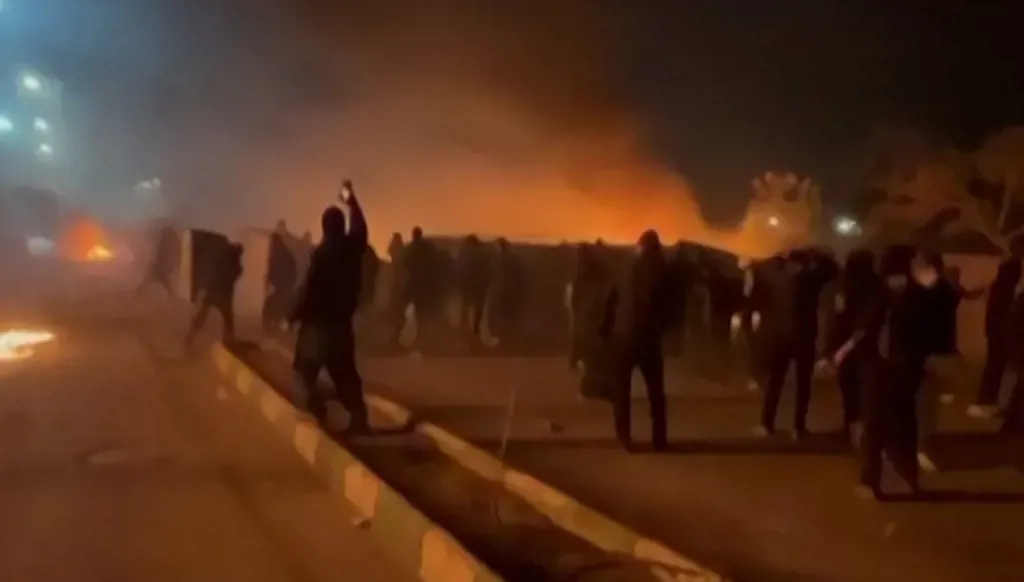


Popular protests in Iran are intensifying, signaling that change is inevitable, sooner or later, despite the current regime’s stubbornness. What makes this wave of protests particularly significant is that it spans most regions of the “Islamic Republic” while simultaneously exposing the authorities’ inability to provide solutions for ordinary citizens. In response, Iranian leaders—including Supreme Leader Ali Khamenei—have relied on repression, confirmed by measures such as cutting off the internet to isolate protesters. They appear to believe that, in the absence of online communication, violence is the most effective way to suppress a genuine popular uprising.
The protests are simply the culmination of the failures of the regime established by Ayatollah Khomeini in 1979—a regime that has consistently been unable to provide solutions to Iran’s pressing problems. On the contrary, it becomes increasingly clear that the Iranian leadership, guided by the doctrine of Wilayat al-Faqih, is continuously focused on projecting power beyond its borders to its proxies.
The regime has long relied on exporting its crises beyond Iran’s borders under the banner of “exporting the revolution,” a strategy that helped shield it from domestic change. The Iran-Iraq War (1980–1988) was a clear example of this outward focus, used to justify internal failures. Despite its rhetoric, the Iranian regime has never achieved its stated goal of becoming independent from oil and gas revenues. Over time, dependence on these resources has only grown, in direct contradiction to the promises made by Khomeini.
Since the establishment of the current regime 46 years ago, Iran has played a disproportionately large role in regional affairs. The West—particularly the United States—exerted immense pressure after the Iran-Iraq War, while Iran simultaneously sought to intimidate the Gulf Arab states. In reality, the “Islamic Republic” only reinforced each Gulf state’s desire to align more closely with the United States rather than distance themselves from it. In short, Iran ended up playing the role that America required of it—nothing more.
Currently, the Iranian regime is forced to defend itself within the borders of the “Islamic Republic.” Nearly all of its bets on projecting regional dominance—through its proxies, from Hezbollah in Lebanon to the Houthis in Yemen, and including the minority-led regime in Syria, which has effectively collapsed—have failed.
In the end, only the truth remains: the Iranian regime must confront its internal problems. It must face the reality that exporting domestic crises beyond its borders is no longer an effective strategy. Demonstrators in Tehran and other cities—including Tabriz, Isfahan, and Mashhad—are asking a simple but pressing question: where has Iran’s money gone? What has the “Islamic Republic” gained by funding sectarian militias and Sunni groups like Hamas, while nearly half of its population lives below the poverty line?
The simple fact is that Iran is now facing a moment of truth. The Iranian people deserve clear answers about how the authorities have spent the nation’s wealth—funds that have gone into fueling destruction and instability in Lebanon through Hezbollah. And this is just one example.
The moment of truth imposed itself in mid‑2025 when Iran came under attack first by Israel and then by the United States. It became evident that the “Islamic Republic” is little more than a paper tiger, and that the long‑delayed reckoning with the Iranian people has finally arrived, with no escape. The regime could no longer avoid acknowledging its failures—a failure that began in Lebanon and Syria and extended as far as Venezuela, which, before the reported kidnapping of Nicolás Maduro and his wife and their transfer to New York, had been a key base for Iran to circumvent U.S. sanctions while providing support to Hezbollah.
At the beginning of 2026, the Iranian regime faces its moment of truth. Its retreat from Damascus was, in reality, a retreat from Tehran itself. There is no longer any escaping reality. If the regime does not collapse this year, as widely expected, it will do so next year. It can no longer export its crises abroad, a policy that has spectacularly backfired.
Disclaimer: The opinions expressed by the writers are their own and do not necessarily represent the views of Annahar.