Abdel Halim Hafez: From Popular Love to Reverent Worship
Abdel Halim emerged as one of the leading artists in Egypt following the 1952 July Revolution, becoming the singer of the people and the revolutionaries
When the July Revolution occurred in 1952, Egypt possessed three leading singers: Umm Kalthoum, Mohamed Abdel Wahab, and Leila Mourad. In the aftermath of the revolution, some called for banning their performances, claiming the singers represented “the old regime.” Leila Mourad, in particular, faced accusations surrounding her loyalty because of her Jewish roots.. Although Mourad published a letter defending herself, she ultimately retired at the peak of her youth and artistic brilliance.
King Abdulaziz of Saudi Arabia nevertheless intervened on behalf of Umm Kalthoum and Mohamed Abdel Wahab. Following his intervention, Abdel Nasser believed that hostility toward them would not serve the interests of the young revolution.Mohamed Abdel Wahab and Umm Kalthoum were also astute enough to demonstrate their loyalty to the new regime. Yet despite their demonstrated loyalty, many still believed the revolution should have its own singer, poet, and writer.
Among all the poets, the young Salah Jahin was the most enthusiastic. As for the leading novelists, Youssef El Sebai, appeared to express the spirit of the revolution most vividly. And among the young singers, such as Karem Mahmoud, Mohamed Qandil, and Mohamed Roushdy, many were drawn to Abdel Halim Hafez. Abdel Halim, who had a poor performance in his first concert in Alexandria, causing the audience to berate him and demand he leave the stage, was not chosen as a popular or spontaneous favorite. Rather, he was an official selection by the new authorities, who wanted a young artist who belonged to their generation.
Abdel Halim’s appearance on the musical stage aligned perfectly with the emergence of Nasser and his comrades on the political stage. The Nightingale, as he was known, remained loyal, singing praises to Gamal by name and regularly performing at the annual Revolution Day celebrations. He enjoyed protection and immunity, allowing him to sing against the Tripartite Aggression, for the High Dam, and to rally spirits after the 1967 setback—producing dozens of patriotic songs, most of which have since faded into obscurity.
Abdel Halim, through his music, became the embodiment of the July Revolution with its dreams of a nascent republic, denouncement of feudalism and monarchy, call for social justice and the rights of the poor, and embrace of Egyptian and Arab nationalist aspirations.. This opened the way for his legend to flourish, both in Egypt and across the Arab world, fueled by people’s belief in the dreams and promises he sang, celebrating the grandeur of nationalist “musical” glory that listeners could hear on the radio, even if they did not witness it in reality. Even his films and public presence embodied the spirit and ideals of the revolution, both before and after its setbacks.
In a way, Halim was the singer of the people and the revolutionaries, not the singer of “kings and princes,” like his teacher and first patron, the musician Mohamed Abdel Wahab.
While Abdel Wahab took pride in his close relationship with the Prince of Poets, Ahmed Shawqi, a descendant of aristocrats and a protégé of the Khedivial Family, and downplayed his popular roots and birth in the working-class Bab al-Sha‘ria neighborhood, the Nightingale brought an entirely contrasting legend: that of an orphaned child raised in shelters, suffering the effects of schistosomiasis, and cared for by his older sister.
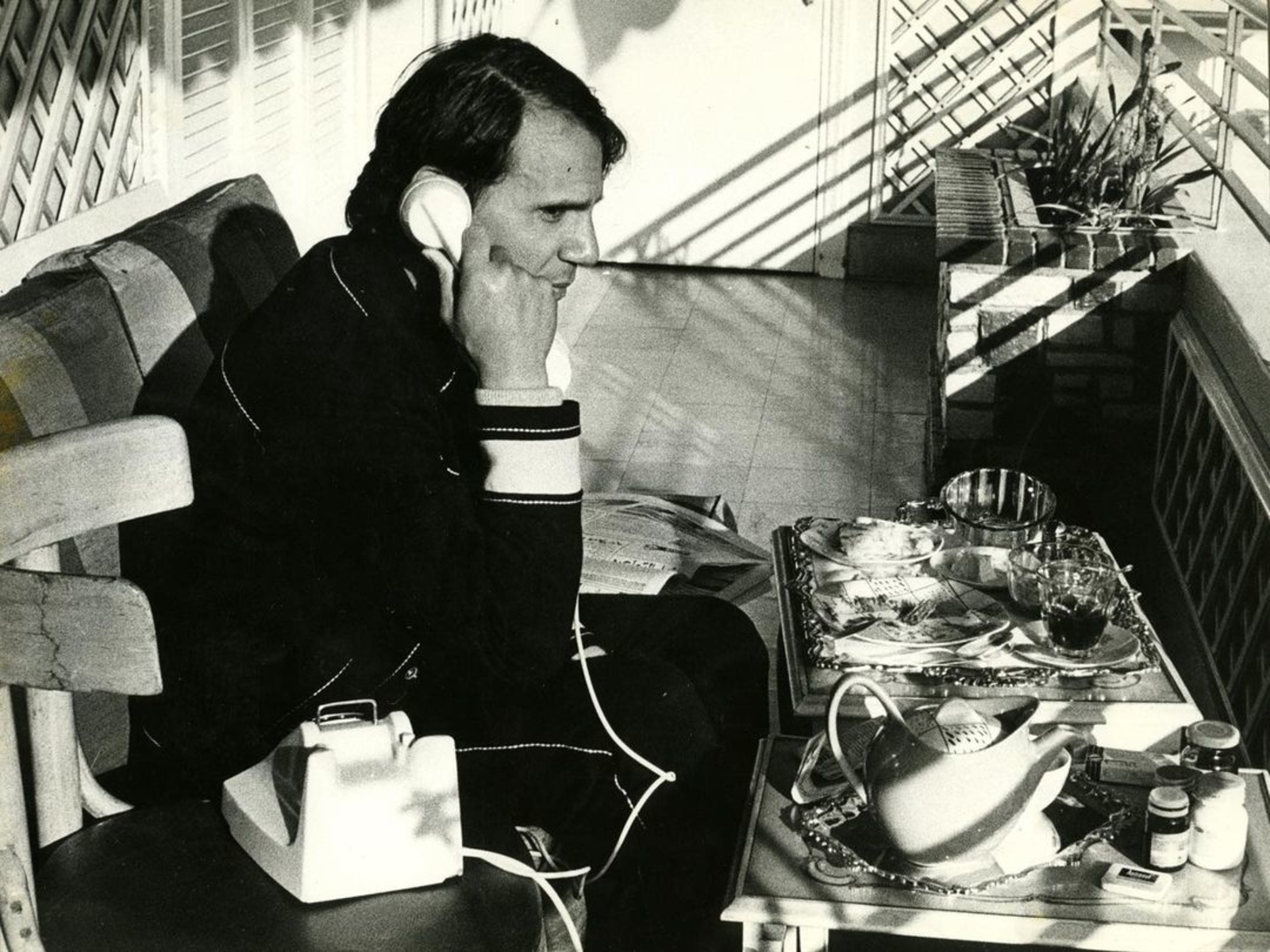
Abdel Halim on the balcony of his home. (Archive)
He had a personal story and a humble childhood that made him relatable to ordinary people, giving them hope that their talents could prevail regardless of their poverty. Most of his films revolved around this theme: the gifted, emotional singer from humble origins who deserved to rise socially through his talent and marry the beautiful, wealthy heroine—whether it was Sabah, Shadia, or Mariam Fakhr Eddine. He was a figure who expressed the hopes and feelings of the broad, humble, and marginalized public. In many ways, he seemed in harmony with Abdel Nasser’s symbolic and political fatherhood.
This sense of orphanhood did not disappear once he became a famous star; it continued to resonate in his voice, his music, and his fragile style of performance, which relied more on emotion and sensitivity than on sheer power or virtuosity.
And because Halin never married or had children, he remained, in a sense, perpetually orphaned—everyone’s son, for all fathers and mothers alike—and continued to be a beloved figure for all the young women who learned about love through the lyrics of his songs.
Many heartbroken girls found solace in his voice and sighs, and every lover considered him her symbolic beloved, as if he belonged to her alone.
His legendary presence was accompanied by a prolonged battle with illness, and a people witnessed images of his medications, hospitals, and treatment journeys,, their empathy and love for him only deepened.His death at the young age of forty-eight became a shattering event, marking the end of nationalist dreams, promises, and hopes. The end of imagined love stories, and the windup of an entire era defined by his music, poetry, and meanings.
The ending was devastating, expressed in a legendary funeral, tears, and the breakdown of thousands of fans, including instances of young women attempting suicide; an intensity of grief perhaps unmatched for any other artist besides the Nightingale.
Anyone who visits his apartment in the upscale Zamalek district will find the stairs, walls, and elevator door adorned with thousands of messages from Nightingale fans across the Arab world. Generations who never lived through his legend have nonetheless fallen under its spell, seeing in him lost and forbidden love, and the subtlest emotions in a harsh, unforgiving reality.
Abdel Halim received overwhelming love throughout his career, both official and popular. Singers began imitating his voice and music, claiming affiliation with him, such as Emad Abdel Halim. Dozens of programs and documentaries were produced about him. Nearly half a century after his passing, fascination with Halim has transformed into something resembling unconscious worship: an addiction to his songs, presence, images, and to the thousands who visit his apartment to see his clothes, belongings, and bedroom. This admiration sometimes reaches the point of obsession, following every detail of his life. Such devotion and reverence are expressed either through identification with his songs and biography or by considering Halim to be godlike, existing above ordinary human beings.



 Messenger
 Whatsapp
 Threads
 Email
Email
 Print
Print
 X
X
 Facebook