

U.S. takes an active role in Egypt-Ethiopia Nile talks


 Messenger
 Whatsapp
 Threads
 Email
Email
 Print
Print
 X
X
 Facebook
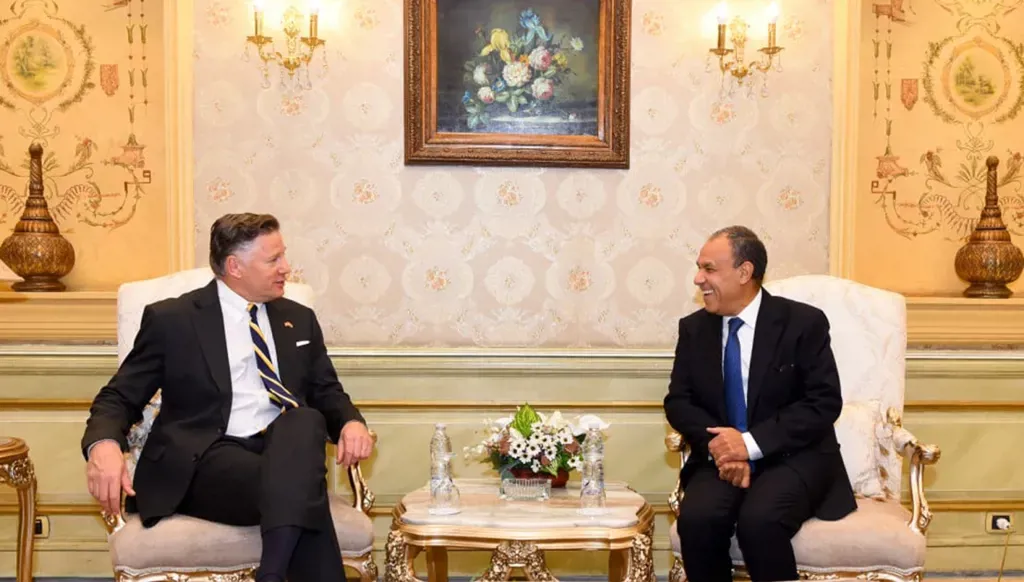


The United States has taken initial steps to fulfill President Donald Trump’s pledge to resume mediation between Egypt and Ethiopia over the Renaissance Dam crisis, which Cairo fears could impact its share of Nile River water.
This follows a letter of appreciation from President Trump to Egyptian President Abdel Fattah El-Sisi on Friday, January 16, in which he expressed his willingness to "relaunch American mediation to reach a responsible, lasting solution to the issue of Nile water sharing."
Washington’s initiative comes as part of an African tour by U.S. Deputy Secretary of State Christopher Landau, which began Sunday with a visit to Egypt and will also include stops in Ethiopia, Kenya, and Djibouti.
Very excited to be leaving tomorrow for my first trip to Egypt 🇪🇬, Ethiopia 🇪🇹, Kenya 🇰🇪, and Djibouti 🇩🇯. Looking forward to advancing @POTUS @realDonaldTrump's priorities of developing commercial and economic ties and promoting security and peace. One of the great privileges of…
— Christopher Landau (@DeputySecState) January 23, 2026
Dr. Mohamed Ezz El-Din, head of the Nile Institute for African and Strategic Studies, told Annahar that the U.S. intervention represents a "real opportunity" to overcome the current crisis, noting that "the opportunity lies in the fact that the United States has thrown a stone into the stagnant waters of disputes between Cairo and Addis Ababa."
Egypt suspended negotiations with Ethiopia in December 2023, after nearly 12 years of arduous talks, following Addis Ababa’s refusal to reach a binding agreement on the management and operation of the Renaissance Dam that would safeguard the rights and interests of both downstream countries (Egypt and Sudan) and the upstream country (Ethiopia).
Water Security
On Sunday, Landau met with Egyptian Foreign Minister Badr Abdelatty to discuss several bilateral and regional issues, including water security. A statement from the Egyptian Foreign Ministry noted that Abdelatty "appreciated Trump’s message and his valued efforts to promote regional and international peace and stability, as well as his recognition of Egypt’s pivotal role in supporting regional security."
The Nile provides roughly 90% of Egypt’s water resources, yet the country faces severe water scarcity, with per capita availability having fallen below the water poverty line of 1,000 cubic meters per year to less than 500 cubic meters.
Trump has shown a special interest in this issue on more than one occasion.
Cairo considers its historical share of the Nile waters a matter of life and death, making the situation highly sensitive and prone to escalation if its water interests are threatened.
Experts indicate that Cairo may have suffered some impact during the years-long project to fill the dam’s 64-billion-cubic-meter reservoir, which was completed in September 2025.
Former Assistant Secretary-General of the Organization of African Unity, Ambassador Ahmed Haggag, expressed optimism about the resumption of U.S. mediation, telling Annahar: "Washington has extensive influence in Ethiopia and across the Horn of Africa, making its mediation likely to be effective."
A Key Partner
Ezz El-Din emphasizes that "Washington’s involvement as an active, key partner rather than merely an observer could create a significant shift, as a country of the United States’ size can ensure both the signing of an agreement and its sustained implementation."
He adds: "The Horn of Africa is highly volatile and could erupt at any moment, posing threats not only regionally but also to global trade, much of which passes through the Bab al-Mandab Strait."
Ezz El-Din also highlighted Ethiopia’s efforts to secure a direct Red Sea port, noting: "Egypt will not turn a blind eye to these efforts and will not allow them, particularly as Ethiopia seems to believe it can once again rely on a policy of fait accompli, procrastination, and delay, as it did with the Renaissance Dam."