

A royal visit that reveals western confusion


 Messenger
 Whatsapp
 Threads
 Email
Email
 Print
Print
 X
X
 Facebook
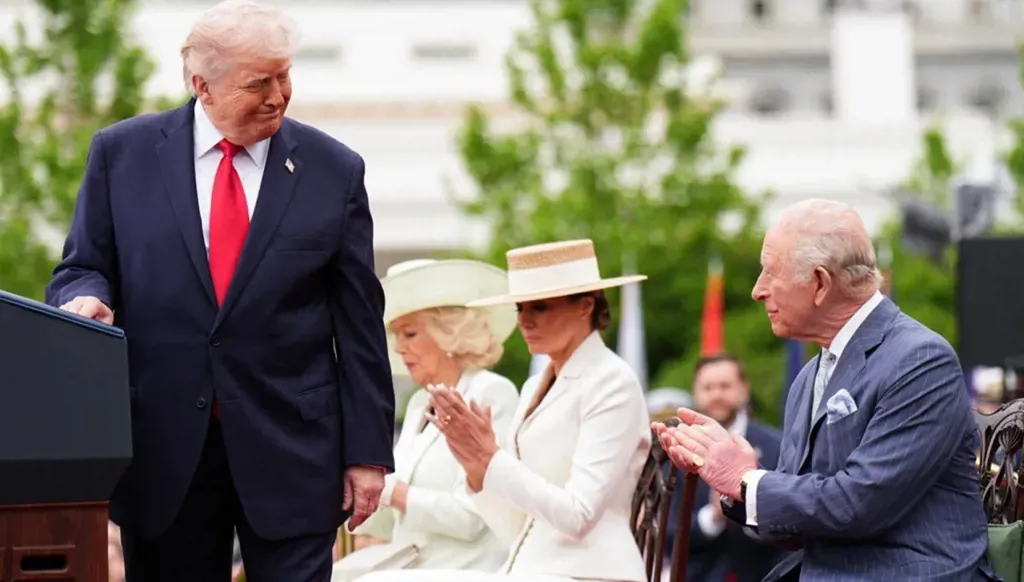


Washington, as it welcomed the King of Britain on the 250th anniversary of its independence from him, was not entirely sure which story it wanted to tell about itself.
Amid flags mistakenly raised for another country, military bands evoking the attire of the revolution against the Crown, and a president striding forward, cutting across Queen Camilla’s path to shake hands as he pleased, the West that once prided itself on the precision of its protocol now seemed to falter even in arranging its own symbols.
Symbols in disarray, meanings in tension
King Charles III’s visit to the United States was not merely a ceremonial occasion added to the record of the so-called special relationship between London and Washington. It took place on fractured ground, marked by political disagreements and by trade and value-based disputes that led many in Britain to speak of the erosion of the Western alliance in the Trump era. In this context, small details in Washington take on greater significance.
They reflect not only confusion within a protocol team, but also a deeper disorientation within a system searching for a new language of power and finding nothing but recycled symbols that no longer fit the moment.
For a municipality in the heart of the American capital to raise Australian flags instead of British ones, just hours before the arrival of its king, is not a mere technical mistake. It is a condensed image of a Western world that has begun to treat its allies as a single indistinguishable bloc, even as it demands that the rest of the world choose its camp with precision.
The same world that once drew borders and flags for others now confuses the colors of its closest ally’s flag, then demands that others memorize all its red lines by heart.
In the White House grounds, where the highest standards of protocol were expected to be on display, Trump advanced with his characteristic stride, crossing the space between the king and the queen to extend his hand as if he alone owned the stage.
The moment, captured by cameras and broadcast across screens, is not simply a slip by a man unfamiliar with ceremonial rules. It encapsulates the spirit of American politics in the Trump era: the self pushing forward while others rearrange themselves around it. If this is how relations between allies are sometimes managed, how then are they handled with adversaries?
A borrowed past and a selective present
As for the military attire that brought back memories of the American Revolution against the British Crown, it reopened a deeper question: what narrative does the West want to present about itself today? The United States, which gained independence from the king two and a half centuries ago, invokes that same moment of rebellion in front of another monarch from the same lineage, yet at the same time it needs his symbolism to mend the image of a troubled alliance.
It is as if the message wavers between two discourses: we are the state that freed itself from the Crown, and we are the state that still needs it to legitimize its actions.
Even Charles’s decision, in coordination with Buckingham Palace, to avoid meeting the victims of Jeffrey Epstein or their representatives during the visit reflects another form of moral selectivity.
Here too, reputation is managed with a delicate balance: justice is postponed when it threatens the image of the Crown, yet it is expedited when it concerns distant adversaries. This moral inconsistency is part of the same story: the story of a West that demands strict standards from the world while negotiating its own standards behind closed doors.
Fractured prestige and fading certainty
In the end, what Charles’s visit to Washington, which concludes today, reveals is not only the state of a bilateral relationship between Britain and the United States, but the condition of an entire system that is no longer certain of its own image. At a time when flags, attire, and handshakes were tools for crafting carefully measured prestige, those very details have become evidence of that prestige wavering.
The world we see today from our capitals is no longer the West of traditional international relations textbooks. It is a West that hesitates in its own protocol, argues with its own past, and struggles to convince itself that it remains the center of the world.
Yet a single camera is enough, in a matter of seconds, to expose its uncertainty: flags are mistaken, distances become awkward, and meaning itself begins to slip away.
Disclaimer: The opinions expressed by the writers are their own and do not necessarily represent the views of Annahar.