The cost of being a woman who won’t hide
Al Hashimy pays the price for being a woman who is expected not to be a woman during official working hours, as if the job requires her to erase her nature and identity. She is punished for being a woman who did not deny her true self to satisfy fragile, male-defined standards in the workplace.


شارك على
 مسنجر
مسنجر
 واتساب
 ثريدز
ثريدز
 بريد إلكتروني
 الطباعة
شارك على




I stepped out of the press conference room to find a group of male colleagues chuckling in the hallway. Since I was still an intern at university, eager to learn everything—including the secret behind their laughter—I asked what was going on.
“Have you not seen that ridiculous woman over there?” they answered my question with a question: “Have you not noticed how trivial she is?”
“Who does she think she is? Or rather, who does she imagine herself to be? A geisha?” one colleague added, still laughing.
I realized that the “ridiculous woman” in question was one of the diligent journalists I admired and tried to learn from. What action had made her the object of the men’s ridicule, prompting one of them to compare her to traditional Japanese dancers?
She had taken out an exquisite hand fan from her bag—she was generally an elegant woman—and it was clear that she had customized it herself rather than bought it ready-made, as the colors and patterns matched her outfit perfectly. She fanned herself lightly in front of her face. That was it. She was considered “ridiculous” simply because she showed particular care for her appearance.
Since I was still learning, I absorbed the lesson quickly. I learned that anything associated with femininity must be left outside the workplace, so that each of us can wear the uniform of so-called “professionalism” and “competence” and enter the office having erased the woman we are. Before a female employee clocks in, she must strip away her habits, her personality, her priorities, her feminine fears, her vulnerabilities, her interests, her hobbies, her emotions, and her ease in expressing them. All of this is required to be taken seriously in a misogynistic environment and to avoid being deemed “ridiculous.”
And sometimes I failed, like the time I got angry over a viral clip of a deranged person kicking an animal, and suddenly I became “the overly dramatic woman who cannot take a joke.” I learned that to keep their respect, and remain “strong and rational” by their definition, I also had to shed my sensitivity and compassion, since those were considered undesirable feminine traits.
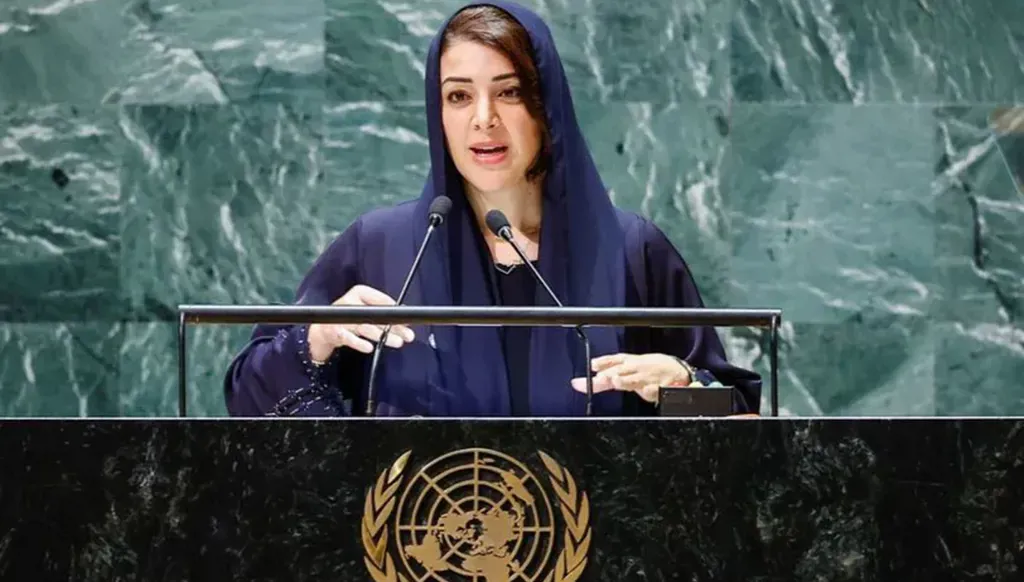
Working women know these unspoken rules, which is why we stand in solidarity with Her Excellency Reem Al Hashimy, Minister of State for International Cooperation, against the campaign launched against her since her appearances on CNN.
The reactionaries mocked her warm voice, ridiculed her calm way of speaking, derided her facial expressions, and made jokes about her measured pace of speech. They projected unhealthy sexual fantasies onto her natural femininity and misinterpreted her peaceful energy. They refused to take her seriously unless she became a harsh “iron woman,” a war-hungry politician, or adopted a loud, abrasive rhetorical style that never fit her personality in the first place.
Al Hashimi pays the price for being a woman who is expected not to be a woman during official working hours, as if the job requires her to distort her nature and identity. She is punished for being a woman who did not deny her true self to satisfy fragile masculine standards in the workplace.
But our minister has nothing to prove to them, for their rejection of her femininity reflects only their deep-seated contempt for women participating in professional life.
Disclaimer: The opinions expressed by the writers are their own and do not necessarily represent the views of Annahar

العلامات الدالة
الأكثر قراءة