Former Lebanese telecom ministers face state orders to recover public funds
Lebanon’s Court of Audit enforces financial recovery from ex-ministers and telecom companies to reclaim public funds lost through mismanagement. Their fines remain largely symbolic.



شارك على
 مسنجر
مسنجر
 واتساب
 ثريدز
ثريدز
 بريد إلكتروني
 الطباعة
شارك على


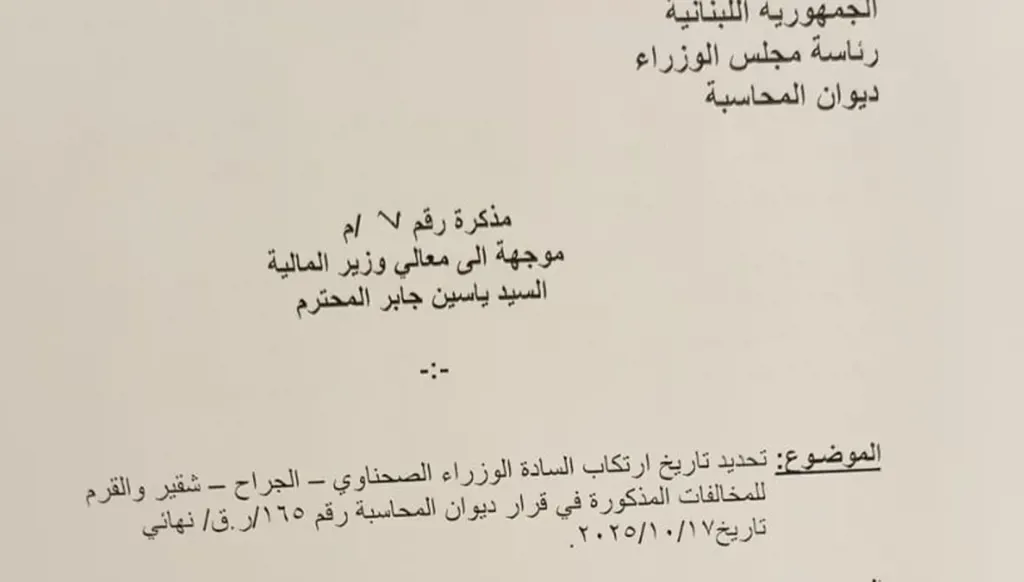


The decision by Lebanon’s Court of Audit in the case of the former Ministers of Telecommunications has become a pivotal moment in the course of public accounting, as it moved the matter from a theoretical ruling to actual implementation. Collection orders issued based on the Audit Office’s judgment are not mere recommendations; they are enforceable financial orders.
The decision by Lebanon’s Court of Audit (First Chamber, chaired by Judge Abdul Rida Nasser with judges Mohamed Al-Hajj and Joseph Kesrawani) imposed fines on the former ministers Nicolas Sehnaoui, Jamal Al-Jarrah, Mohammad Shaqir, and Johnny Al-Qorm—while also obligating entities connected to the case to pay prescribed sums or return assets. The amounts for the collection orders were set as follows: $8.07 million for Sehnaoui, $11.3 million for Al-Jarrah, $11.3 million for Shaqir, and $4.92 million for Al-Qorm. Zain Company was ordered to pay $2.75 million, and MIC 2 Company was asked to take steps to recover 123 parking spaces valued at approximately $4.92 million, as part of the damage to the public treasury.
The Ministry of Telecommunications prepared these orders and referred them to the Ministry of Finance on December 17, 2025, to begin the administrative enforcement stage. The Ministry of Finance clarified the enforcement process: Minister of Finance Yassine Jaber told Annahar that the Minister of Telecommunications signs the collection orders, while the role of the Finance Ministry is limited to notifying the Treasury Directorate and requesting that the concerned parties pay into the public treasury—which has already been done.
He emphasized that refusal to pay could trigger enforcement measures under the Public Accounting Law, including the seizure of assets, noting that “anything is possible” within the legal framework. He also confirmed that appeals do not halt enforcement unless explicitly ordered by the competent judicial authority, meaning that execution proceeds in parallel with judicial review.
At the same time, a defensive legal process has begun. Shaqir and Johnny Al-Qorm submitted requests for reconsideration to the Court of Audit while Al-Jarrah asked the Ministry of Telecommunications for documents related to contracts completed during his tenure to support his defense. Nicolas Sehnaoui has not yet submitted any official documents. These steps reflect the exercise of the right to defense, but they do not automatically suspend enforcement.
A notable development concerns Johnny Al-Qorm, who submitted a power of attorney including a waiver of the disputed parking spaces. If this waiver is officially registered through the real estate offices, it could lead to the cancellation of the collection orders specifically tied to this issue, since the goal is to restore the public right rather than double the penalty. The relevant authorities will contact the real estate offices and the State Litigation Authority to verify full implementation. If confirmed, the state would recover the assets themselves, and Al-Qorm would be exempt from the portion of the collection orders linked to them. If the implementation is not completed, the orders remain in effect.
In addition to the dollar-denominated compensation, debate arose over the fines stipulated in Article 60 of the Court of Audit. The Ministry of Finance sent an inquiry asking how they should be calculated, and the response emphasized that the text in force at the time of the violations must be applied.
The dates were set as follows: Sehnaoui in 2012, Al-Jarrah in 2018, Shaqir in 2019, and Al-Qorm in 2022. All of these preceded the amendment of Article 60 under Law 329/2024, meaning the old text applies. Accordingly, the fine is calculated at 1.5 million Lebanese pounds for each minister, as prescribed before the amendment. After the collapse of the currency, this amount has become largely symbolic compared with the estimated damages of tens of millions of dollars.
This highlights the fundamental difference between the fine and the collection order: the fine is a legal penalty imposed in Lebanese pounds and based on the date of the violation, whereas the collection order is compensation for the actual loss, issued in dollars because the damage occurred in that currency.
For this reason, Lebanon’s Court of Audit did not prominently highlight the value of the fines in the text of the decision, in order to avoid giving the impression of a contradiction between millions of dollars lost and a nominal fine. Instead, the focus was on the actual compensation, which aims to restore public funds. Jaber emphasized that “the texts are clear to anyone reviewing the laws, and the response to the inquiry on fines was sent via official correspondence,” noting that “the legal process is applied as written, without interpretation beyond the text.”
Article 61 adds another layer, linking the value of the fine to a percentage of the minister’s gross monthly salary at the time of the violation. This requires consulting the Expenditures Directorate at the Ministry of Finance to determine the salaries at that time. While this detail reflects a technical complexity in calculating fines, it does not affect the substance of the major compensations associated with the collection orders.

العلامات الدالة
الأكثر قراءة