Netanyahu’s reluctant step: Signing the Peace Council document ahead of Trump meeting
Before the meeting with Trump to discuss Iran, Netanyahu was asked to do something he was reluctant to do: sign the document joining the Gaza Peace Council.


شارك على
 مسنجر
مسنجر
 واتساب
 ثريدز
ثريدز
 بريد إلكتروني
 الطباعة
شارك على


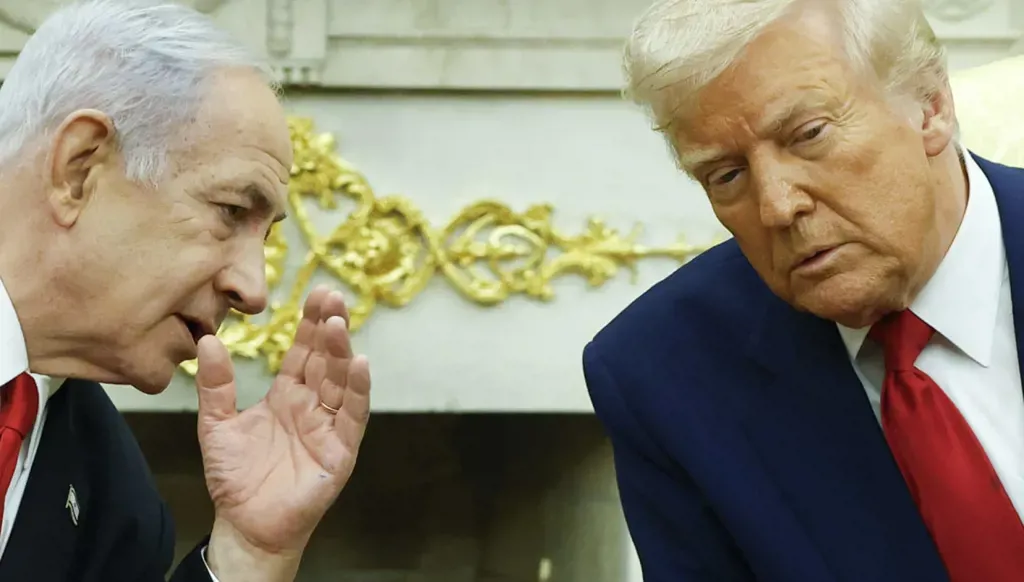


Donald Trump sent his friend Benjamin Netanyahu back to Israel empty-handed. There is a convergence of ideas between them, and perhaps even an alignment of goals, but the way they pursue them differs. The Israeli Prime Minister knows he will get what he wants regarding Iran, but this time he cannot be in the spotlight because Trump is leading and listening attentively to other friends in the region. Netanyahu is very familiar with the corridors of the U.S. administration and even more so with the inner workings of the current administration. That is why he should not have intervened in the way he did, which Ali Larijani, Secretary of the Supreme National Security Council, mocked by saying that Netanyahu wanted to teach Americans how to conduct negotiations.
Before his meeting with Trump to discuss Iran, Netanyahu was asked to do something he did not want to do: sign a document joining the “Peace Council.” He complied, but he was not asked about the daily violations in Gaza and the West Bank. Even before entering the Oval Office, Trump had posted on Truth Social that he would give Iran a chance to negotiate, leaving Netanyahu with no argument that negotiations were futile. And even his other argument—that mobilizing U.S. power was a chance to deliver a decisive strike against Iran—was undermined because Trump does not want a partner in deciding such an action.
The Iranians are calling for negotiations to resume where they left off in June 2025, claiming they were close to reaching an agreement with the Americans when Israel sparked a war to derail it. If this were true, Washington would not have allowed a war it did not want, nor would Trump have turned negotiations into a “war trick” or ordered surgical strikes on major nuclear facilities. If there were a nearly ready deal, he would not now approve sending a second aircraft carrier to pressure Iran to stop testing bargaining limits. There may be a repetition of the trick, but with a different maneuver.
In practice, Tehran has not yet agreed to Washington’s conditions, nor has it found a way to justify any “concessions” domestically. It is likely they will not because agreeing would amount to the “surrender” that Trump publicly demanded.
Washington’s willingness to return to negotiations in Oman and exclusively on the nuclear file is intended to gauge how close Iran is to meeting its conditions. Notably, an Iranian official hinted at a willingness to “discuss enrichment levels.” Washington insists on zero enrichment, but Iran references the precedent of the 2015 agreement, which set 3.67% as the enrichment level and allows a return to that level or agreement on another level, provided monitoring and inspections are strengthened.
By going to Washington, Netanyahu aimed to show that Israel is a partner and directly concerned party in the negotiations, or even a counterweight to Trump, pressing him to include Iran’s ballistic missile program and its support for regional proxies in the talks. These two issues have always been on the U.S. agenda and were at the top of the list of 12 Iranian demands since Trump’s first term. In fact, the missile issue was central in 2018 when Trump decided to withdraw from the nuclear deal.
Although Netanyahu suggested at the time that he played a behind-the-scenes advisory role in that decision, his recent trip aimed to highlight a personal role that he could leverage domestically. He miscalculated, however, by ignoring that Trump is also personally involved—starting with condemning the killing of protesters, then preparing militarily to punish the Iranian regime, and finally putting both war and negotiation options on the table.
Trump and Netanyahu each pursue their own interests, but Netanyahu is driven by an annihilationist approach and does not hesitate to immerse Iran in chaos and civil wars, whereas Trump consults continuously with major Arab states and Turkey and takes their input into account. If Iran were attacked to overthrow its regime or even just to target its defensive and offensive capabilities, it could retaliate in ways that destabilize neighboring countries, affecting U.S. interests. Therefore, the Trump administration is forced to consider the “day after” the war, something Israel’s government did not do in its war on Gaza.
Netanyahu understood that, despite being America’s top ally in the region, Trump did not regard him as having the decisive voice on Iran and that he would only be involved in the process through coordination and when necessary.
He will be careful not to disrupt U.S. plans, whether military or diplomatic, but he will not hesitate to exploit the Iran crisis to undermine the “Gaza Agreement” and continue changing the legal and administrative reality in the West Bank to seize and annex land, without Washington being able to stop him. If the negotiations succeed, which Marco Rubio called “the hard task” in Munich, Netanyahu will likely label any deal as “bad” so he can present a list of demands to Trump, just as he did with Barack Obama.
Disclaimer: The opinions expressed by the writers are their own and do not necessarily represent the views of Annahar

العلامات الدالة
الأكثر قراءة