Cairo’s mesaharati: A woman’s drum awakens the city for Ramadan
Dalal Abdel Qader keeps alive a centuries-old tradition, drumming through the streets before dawn and bringing joy, memories, and community spirit to Maadi every year.


شارك على
 مسنجر
مسنجر
 واتساب
 ثريدز
ثريدز
 بريد إلكتروني
 الطباعة
شارك على


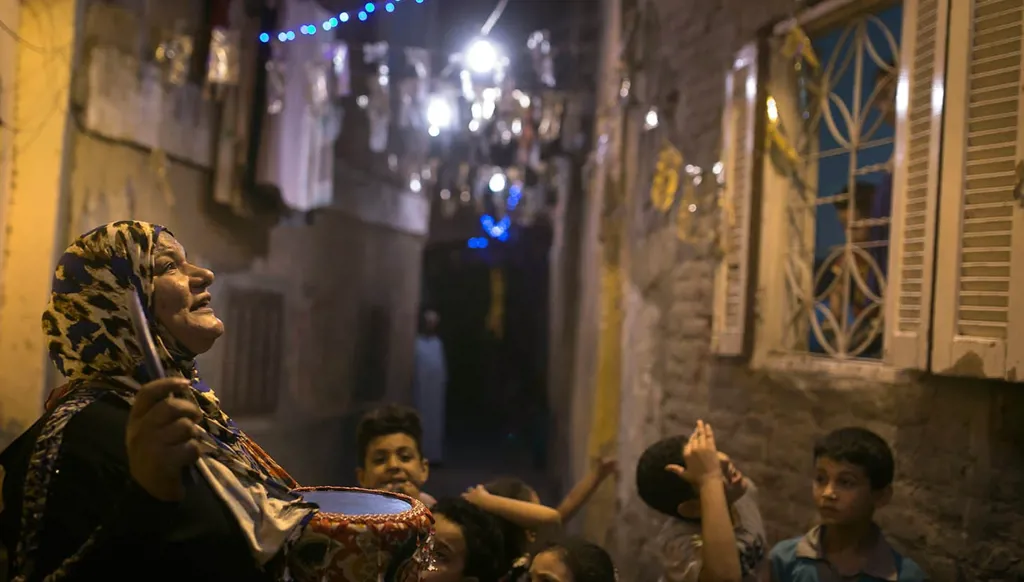


“Wake up, sleeper, and unite the blessings… and say you intend tomorrow, if you live… the month is fasting and the dawn is rising… wake up, sleeper, and honor the Provider… Ramadan Kareem.”
This is the call of Dalal Abdel Qader, known as the Mesaharati of Maadi, echoing through the streets of Maadi (south Cairo) during the nights of Ramadan. She moves from alley to alley, roaming the streets until the dawn call to prayer, her drumbeats blending with her voice as she wakes the sleepers for suhoor, the pre-dawn meal. She awakens them while reviving memories of childhood and youth, carrying forward traditions that reflect the warmth and intimacy unique to the holy month.
Windows open to greet her, children rush out to accompany her on her rounds, singing along and asking her to call out their names. Dalal calls the names of both young and old. Her voice is not just a wake-up call—it is an annual ritual that carries the warmth of Ramadan, filling it with joy and a spirit that no modern technology can recreate.
The mesaharati is one of the most prominent traditional symbols of Ramadan. It has existed in Egypt since the Fatimid era. Although it was a profession reserved exclusively for men for hundreds of years, Dalal Abdel Kader, 54, broke this tradition. The work is physically demanding and requires long nights in the cold pre-dawn hours, making her dedication both impressive and surprising.
Annahar met Dalal at her home in Dar Al-Salam (south Cairo), where she recalled her beginnings and the story of how she became a mesaharati: “It happened by chance after my brother passed away in 2012. He was a mesaharati, and when Ramadan came that year, our neighborhood felt a deep sadness because no one was going around to wake people for suhoor. I decided to revive the tradition so it wouldn’t disappear. I have been working as a mesaharati for 15 years. I don’t consider it a profession in the usual sense, but a Ramadan ritual through which we experience the fragrance of the holy month, its beautiful customs, and its spiritual essence.”
Ramadan preparations
Speaking about her preparations for Ramadan, she said: “A week before the month begins, I start getting ready. I replace the covering of my drum so it looks new and sounds louder and stronger. This year, I decorated it with a picture of the Egyptian footballer Mohamed Salah, whom I admire greatly, and I pray for his health. Another part of my routine is training my feet for the long distances I walk during suhoor. I regularly drink hot beverages to strengthen my vocal cords, and I practice calling out names loudly. I also prepare my clothes, making sure my outfit is cheerful and festive.”
Regarding the clothes she wears during suhoor, she told Annahar: “I wear a beautiful Ramadan cloak, decorated with the distinctive khayamiya fabric used for the month. It adds a festive cheer that fits the atmosphere. I also make sure I look neat and presentable, because as soon as the children see me, they rush toward me, come down into the street to hug me, greet me, and gather around me.”
The mesaharati defies technology
Despite the modernity and technological advances that have changed many aspects of daily life, the mesaharati remains present in Egyptian neighborhoods as a Ramadan symbol and tradition, evoking nostalgia for a simpler time. With her calls, often including the names of children and local residents, and the rhythm of her drum preceding the dawn prayer, she creates opportunities for social connection and human warmth. The presence of the mesaharati has become an essential part of the Ramadan scene, making it hard to imagine the nights of the holy month without her, no matter how many alarms or smartphones exist.
Dalal confirms this, saying: “This is a Ramadan tradition that isn’t affected by modern technology. People don’t wait for me to wake them, they are usually already awake, but they look forward to my passing because of the joyful atmosphere it brings. It’s a custom they anticipate every year and take delight in.”
Working in popular neighborhoods or upscale areas?
Dalal roams the streets of Maadi, specifically the neighborhoods of Ard El-Basri, Fayza Kamal, and El Sad El Aaly, where she grew up. She says she once tried visiting upscale areas, but she didn’t experience the same engagement she finds in popular neighborhoods. “It felt like I was waking the dead,” she explains. “No one paid attention to the tradition or interacted with me the way they do in the more lively, popular areas. So I decided to stay among the people who understand it and enjoy it.”
And so, Hajjah Dalal continues her journey, guarding one of Ramadan’s oldest traditions, committed to preserving these joyful rituals and keeping them alive in the memories and hearts of the people.

العلامات الدالة
الأكثر قراءة