Lebanon’s dollar dilemma: Gold rises, cash remains locked
While Central Bank assets swell with soaring gold, most public sector deposits are trapped in local currency or frozen dollars, leaving only a fraction usable for government spending.



شارك على
 مسنجر
مسنجر
 واتساب
 ثريدز
ثريدز
 بريد إلكتروني
 الطباعة
شارك على





The provisional balance sheet of the Central Bank of Lebanon as of January 31, 2026, reflects a positive shift in asset values due to the rapid rise in gold reserves, which increased by around 3.3 billion dollars over just two weeks.
At the same time, public sector deposits have become a focal point of financial discussion, revealing a gap between their book value, rising to approximately 805 trillion Lebanese pounds (based on the official exchange rate of 89,500 pounds per dollar used in the balance sheet), and their actual capacity to provide “fresh” US dollar liquidity.
The vast majority of public sector deposits are either in Lebanese pounds or in local dollars (non-tradable USD accounts), leaving less than 1.2 billion dollars in truly available “fresh” cash. This reality severely limits the Treasury’s actual room for maneuver, even though the mechanism of providing around 250 million dollars monthly in exchange for Lebanese pounds continues to cover the state’s basic expenditures, including public sector salaries and wages.
This creates a fragile balance that relies more on liquidity management than on a structural improvement of the financial situation.
In detail, the Central Bank’s mid-month balance sheet for January 31, 2026, showed a significant rise in the value of gold reserves during the second half of the month, reaching around 46 billion dollars compared to approximately 42.6 billion dollars in mid-January—a gain of about 3.3 billion dollars in just two weeks.
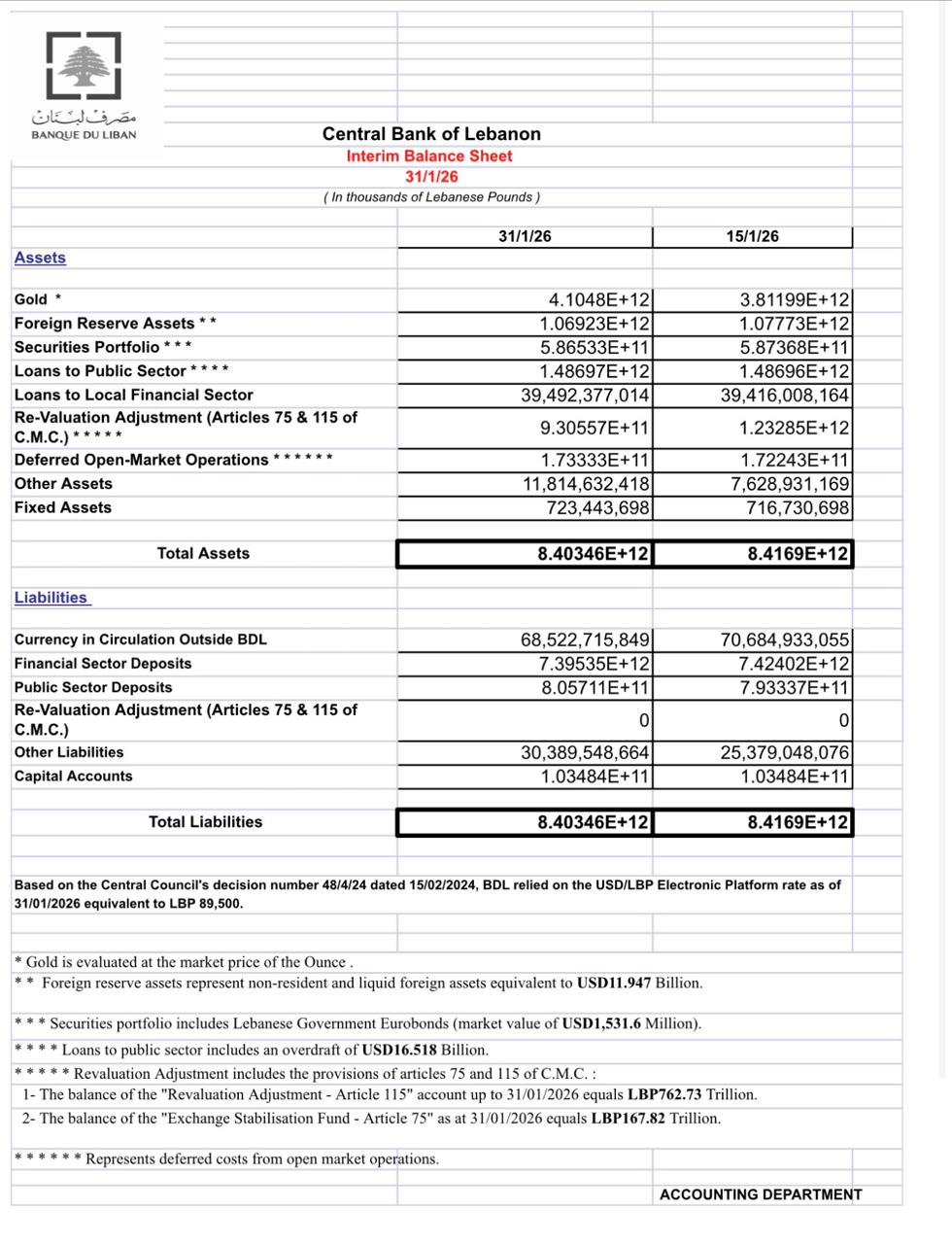
Conversely, foreign currency reserves recorded a modest decline, falling to 11.94 billion dollars at the end of January, down from 12.04 billion dollars in mid-January, a drop of nearly 100 million dollars. This decrease is largely due to the Central Bank increasing withdrawals related to Circulars 158 and 166, while the number of beneficiaries grew to around 350,000 depositors, signaling a potential gradual reduction in available US dollar liquidity in the coming months.
Analysis of public sector deposits
Since February 2023, the Central Bank has applied a single official exchange rate of 89,500 pounds per dollar for its balance sheet, regardless of whether the dollar is classified as local or “fresh.” Sources at the Central Bank told Annahar that using two different rates was discontinued because it conflicts with international accounting standards and the IMF’s guidelines, which require a single rate when preparing the balance sheet.
Public sector deposits at the Central Bank include all accounts belonging to ministries and government departments, especially the Ministry of Finance (Treasury), as well as public institutions and municipalities, the National Social Security Fund, the tobacco monopoly (Regie), social affairs ministry projects, the Electricité du Liban (EDL), the Council for Development and Reconstruction, and other official institutions and authorities.
At the official rate of 89,500 pounds per dollar, total public sector deposits of around 805 trillion pounds are equivalent to roughly 9 billion dollars. However, at the local dollar’s market rate of 15,000 pounds, the actual value drops to around 6.6 billion dollars.
The deposits are distributed as follows: approximately 2.7 billion dollars in local dollars, 1.2 billion dollars in “fresh” dollars, and 455 trillion pounds in Lebanese pounds (equivalent to roughly 5 billion dollars in fresh dollars). Consequently, the vast majority of public sector deposits are in Lebanese pounds or non-tradable local dollars, while deposits in “fresh” US dollars do not exceed 1.2 billion dollars. This means the actual usable amount in “fresh” dollars is under 1.2 billion dollars, not 9 billion.
It is worth noting that, in coordination with the Ministry of Finance, the Central Bank provides the Treasury with about 250 million dollars monthly in exchange for Lebanese pounds at the rate of 89,500 pounds per dollar. This allows the Treasury to meet its obligations in “fresh” dollars, primarily covering public sector salaries and wages.

العلامات الدالة
الأكثر قراءة