Egypt and Turkey: From confrontation to coordination – Can interests truly reconcile?
Years of tension give way to cautious coordination, as Ankara and Cairo balance ideology, security concerns, and regional influence.


شارك على
 مسنجر
مسنجر
 واتساب
 ثريدز
ثريدز
 بريد إلكتروني
 الطباعة
شارك على


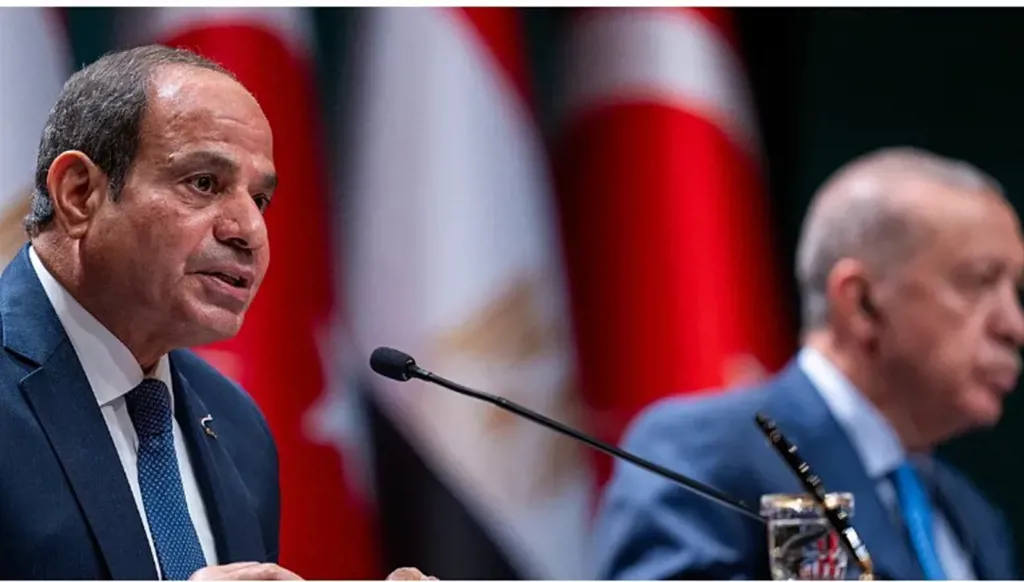


The recent visit of Turkish President Recep Tayyip Erdoğan to Cairo, accompanied by carefully calculated official hospitality, marks a pivotal political moment in the course of Egyptian-Turkish relations, indicating deeper regional shifts and a victory for the logic of state interests over ideological and confrontational gambits. The visit, with all its symbolism, cannot be separated from a context that began in 2013, following the June 30 Revolution that ended the Muslim Brotherhood’s rule in Egypt. At that time, Ankara took a hostile stance toward the Egyptian state, going so far as to sever political ties, launch a diplomatic and media campaign against the new leadership, and directly embrace Brotherhood members, granting them residencies and media platforms used to incite against Egypt, cast doubt on its institutions, and disparage its leadership, army, and people.
The situation intensified with the Turkish President openly betting on the fall of the Egyptian state, stating on multiple occasions that he would never sit with President Abdel Fattah el-Sisi or shake his hand—an expression of a mistaken reading of the Egyptian societal nature, which rejected the Brotherhood and their project, and a clear mix of ideological stance and the requirements of realpolitik.
Conversely, the Egyptian experience revealed a different approach to managing disputes. Despite the severe positions taken by some countries toward the Egyptian revolution, including the political, economic, and media pressures that clearly affected Egypt internally, President el-Sisi did not resort to escalatory rhetoric or emotional and offensive reactions. Instead, he adhered to a calm and calculated language guided by state considerations rather than momentary impulses, as if anticipating the future—aware that relations between countries are not governed by a logic of perpetual hostility, and that time would realign positions and reveal losing bets.
Subsequent years confirmed the validity of this vision, with the retreat of political Islam projects in the region, shifting priorities of states under the pressures of security and economic challenges, and Egypt’s reinstatement as an indispensable regional actor.
In this context, Turkey found itself confronting a new reality: a stable Egyptian state, a leadership enjoying popular legitimacy, and a pivotal role in critical issues such as Libya, the Eastern Mediterranean, the Palestinian question, the security of the Red Sea, and counter-terrorism. Turkey’s margin for maneuver had narrowed, underscoring the need for repositioning and a shift from an ideology-driven confrontational policy to a pragmatism guided by national interests.
From this perspective, the Egyptian-Turkish rapprochement can be understood as an implicit acknowledgment of the failure of an entire political phase, rather than the result of Egyptian concessions. Cairo did not change its positions, retreat from its policies, or alter its approach to any contentious issue with Ankara. The shift came from the Turkish side’s recognition of the regional power balance and the enduring resilience of the Egyptian state, which was never susceptible to being broken or isolated.
It is impossible to discuss this rapprochement without addressing one of the most sensitive and complex issues: the residency of Muslim Brotherhood elements in Turkey, and their use of this position to establish media and political platforms aimed at attacking Egypt, discrediting its leadership and institutions, and inciting against its regime. Indeed, this issue, given its security and political implications, must have been part of the agenda during the visit discussions, even if not explicitly stated, as it represented one of the primary sources of distrust between the two sides and one of the clearest manifestations of interference in Egyptian affairs.
With the rapid developments in the relationship between the two countries, envisioning a genuine partnership or effective regional coordination becomes challenging without a comprehensive resolution to this heavy legacy—whether through halting media incitement, ending the use of Turkish territory as a launch pad for attacks on Egypt, or recalibrating the political and media presence of Brotherhood elements in line with Turkey’s international commitments and principles of good neighborliness. This security issue is not merely a unilateral Egyptian demand but a regional necessity in the face of escalating cross-border challenges and growing threats from extremist organizations and politicized media networks.
The success of any rapprochement between Cairo and Ankara ultimately depends on the Turkish side’s seriousness in translating the political shift into concrete measures that reflect a genuine break from a phase in which groups and media tools were used as instruments of pressure and bargaining.
As for the other issues discussed—from the Eastern Mediterranean to Libya, the Palestinian question to energy security and navigation, and extending to economic and investment cooperation—these matters are driven by the logic of coordination, underscoring that shared interests have become more pressing than old disagreements, provided they are managed within a framework of mutual respect and non-interference in internal affairs.
Thus, the question posed by the title remains open: Do interests truly reconcile and prepare the way for the future? The answer depends on both states’ ability to consolidate this shift and the extent of their commitment to a new discourse, reflected in policies and in the management of disputes, without burning bridges.
Disclaimer: The opinions expressed by the writers are their own and do not necessarily represent the views of Annahar.

العلامات الدالة
الأكثر قراءة