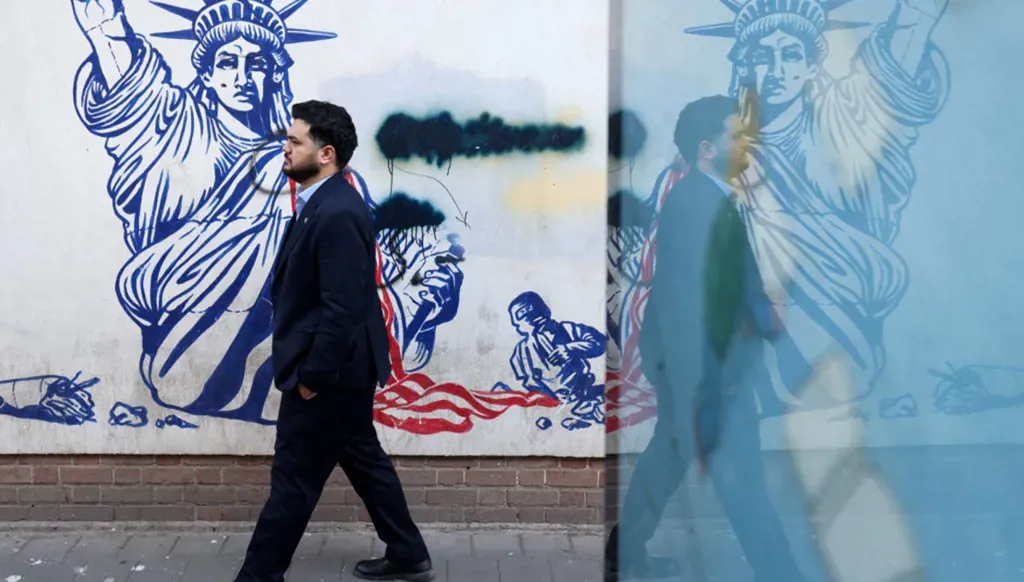
Man walks past mural of Statue of Liberty with broken torch on former U.S. embassy in Tehran. (AFP)
For the first time since the U.S. began its military buildup near Iran about three weeks ago, there are signs of potential de-escalation between Washington and Tehran. One such sign came on Saturday, when U.S. President Donald Trump told Fox News, "Tehran is talking to us, and we'll see if we can do something."
Simultaneously, Ali Larijani, Secretary of Iran's National Security Council, stated that, "contrary to the artificial atmosphere created by the media, a framework for negotiations is progressing."
In recent days, diplomatic contacts aimed at easing tensions and reviving dialogue between the U.S. and Iran have intensified. These include a visit to Tehran on Saturday by Qatari Prime Minister and Foreign Minister Sheikh Mohammed bin Abdulrahman Al Thani, a visit by Iranian Foreign Minister Abbas Araghchi to Ankara, a phone call between Egyptian President Abdel Fattah el-Sisi and Iranian President Masoud Bazashkian, discussions by Saudi Defense Minister Prince Khalid bin Salman in Washington, Larijani’s visit to Moscow, and Turkish President Recep Tayyip Erdogan’s proposal to facilitate a call between Trump and Bazashkian.
The new diplomatic opening comes amid ongoing mutual military threats between the U.S. and Iran. Trump has pressed his "large fleet heading [to the Persian Gulf]," while Iran’s Supreme Leader Ayatollah Ali Khamenei warned that "any American attack will ignite a regional war." The Iranian Revolutionary Guard has begun live-fire drills in the Strait of Hormuz, and the U.S. Central Command responded with warnings against "any unsafe or unprofessional behavior near U.S. forces."
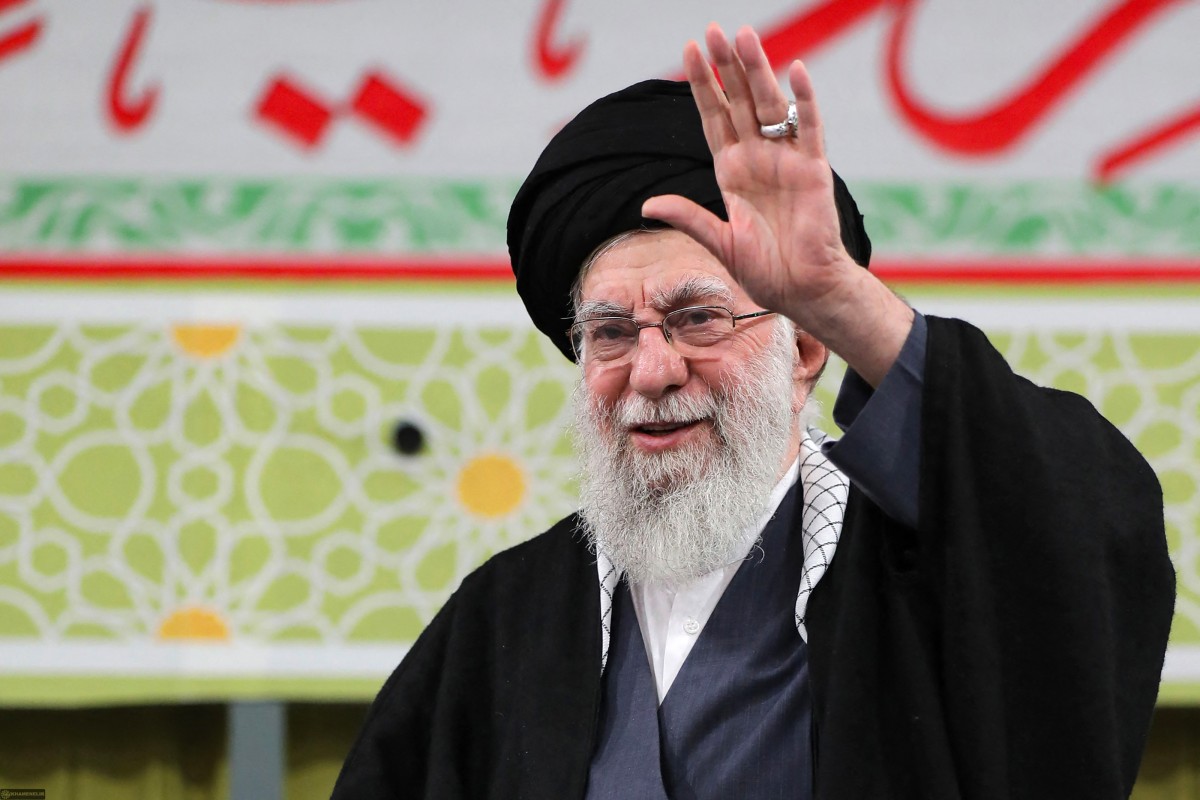
Iran's Supreme Leader Ayatollah Ali Khamenei waving during a meeting with a group of Iranians in Tehran, February 1, 2026. (AFP)
Amid the declared positions and threats, both sides are moving toward a possible exchange. Trump has dropped rhetoric about regime change in Iran and scaled back talk of supporting protesters. Tehran, in turn, has waived the conditions it had set for returning to the negotiating table. The remaining disagreements focus on the agenda: Trump insists on an agreement that includes Iran’s full cessation of uranium enrichment, limits on its missile capabilities, and an end to support for its regional “proxies.” Iran, however, says it is ready to discuss only its nuclear program and considers its military capabilities a red line.
The negotiating skills of both sides will be crucial in shaping the agenda, provided the desire to avoid war outweighs the urge to impose impossible conditions. Calculations about the potential consequences of war versus the benefits of reaching an agreement also play an important role.
In this context, if Trump concludes that a quick strike to destabilize Iran in a "Venezuelan style" is impossible—his military options become highly unpredictable and he is far more likely to seek the diplomatic option.
For Iran, threats to its regime have reached a fever pitch as recent protests follow the disastrous June War, a worsening economic crisis caused by U.S. and European sanctions, the designation of the Revolutionary Guards as a terrorist organization, U.S. efforts to block the return of its ally Nouri al-Maliki to Iraq’s premiership, and India’s active purchase of Venezuelan oil as a substitute for Iranian oil. Predictably, the regime's weakened position makes Tehran more inclined toward diplomacy with the United States.
Calculations on both sides are likely prompting engagement with ongoing diplomatic efforts, potentially sparing the Middle East from another upheaval.
Disclaimer: The opinions expressed by the writers are their own and do not necessarily represent the views of Annahar.
منتخب الرأس الأخضر يصنع المفاجأة في كأس العالم 2026 ويتأهل إلى دور الـ32 بعد إنهائه الدور الأول بثلاثة تعادلات مع إسبانيا وأوروغواي والسعودية... من هو هذا المنتخب؟



 مسنجر
مسنجر
 واتساب
 ثريدز
ثريدز
 بريد إلكتروني
 الطباعة