Between pressure and partnership: Egypt’s strategic approach to Washington
The Egyptian–American experience during the Trump era reflects an advanced model for managing strategic partnerships in a volatile international environment. It is a model based on managing disagreement rather than avoiding it, and on containing it within an institutional framework that safeguards national interests and prevents a slide into rupture or dependency.


شارك على
 مسنجر
مسنجر
 واتساب
 ثريدز
ثريدز
 بريد إلكتروني
 الطباعة
شارك على


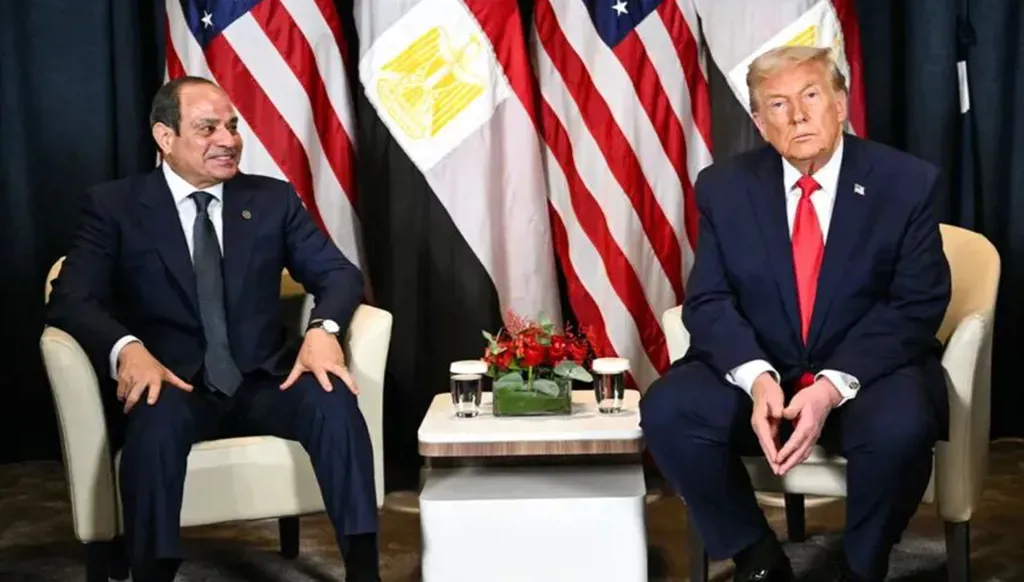


Egyptian–American relations have witnessed a methodological and institutional shift in the recent period, which can be described as a transition from coolness and caution to a higher level of strategic understanding, within an international context marked by rising tension and by the US administration under President Donald Trump relying on non-traditional mechanisms to manage foreign policy, often based on direct pressure and, at times, confrontational language as a negotiating tool.
This shift reflects an interactive dynamic between Cairo and Washington that did not arise from protocol meetings or symbolic diplomatic exchanges, but rather from a deliberate process of recalibrating the course of the relationship within a framework that preserves the interests of both sides, without compromising Egyptian sovereignty or the strategic constants of national policy.
With the beginning of President Trump’s second term, divergences in strategic positions emerged between the two sides on several regional issues, foremost among them developments in the war in the Gaza Strip, which is a Palestinian territory under Israeli blockade. Cairo adopted a firm stance against any attempt to impose arrangements that could lead to the displacement of the population, undermine Palestinian rights, or threaten Egyptian national security. This position, reflecting deeply rooted strategic constants, led to a phase of American restraint in direct engagement with the Egyptian role, which prompted the activation of precise diplomatic tools, including reducing levels of direct presidential engagement, refusing to conduct official visits, and refraining from participation in certain international forums with strong US influence. These measures were not merely situational responses but constituted a conscious strategy to manage disagreement and define the boundaries of partnership without entering into open confrontation or media escalation.
The significance of this approach is reinforced when compared with the experiences of other US allies, such as Western European countries, Canada, and Japan. International experience has shown that pursuing appeasement paths, whether through concessions or public confrontations, often leads to political and diplomatic instability. This indicates that the core problem was not the nature of the political disagreement itself, but rather the way it was managed and how responses were calibrated toward non-traditional actors in US politics.
In this context, the Egyptian choice represented a third path, based on calm firmness, maintaining institutional channels of communication, and adhering to core positions without reformulating or relinquishing them. This reflects a strategic capacity to manage relations within a precise equation that balances independence with shared interests.
As complications in Gaza intensified and the limits of US options on the ground became apparent, the American side began to reassess Egypt’s position in the regional equation, not merely as a party subject to pressure, but as a pivotal actor that cannot be bypassed in any arrangements related to de-escalation or crisis management. This shift was reflected in increased political coordination, the presentation of a US plan to halt the fighting, and President Trump’s visit to Sharm el-Sheikh, which carried political implications beyond the protocol context and signaled a restoration of recognition of Egypt’s regional role. In this framework, the meeting between the two presidents on the sidelines of the Davos Forum, which is an annual global economic and political gathering in Switzerland, embodied the existing path of relative understanding and extended the principles of strategic recalibration of the bilateral relationship.
The praise directed by Trump toward President Abdel Fattah el-Sisi, particularly regarding firmness and clarity, takes on significant analytical meaning when compared with the US president’s statements toward other allies. It points to an awareness within the US administration that traditional pressure tools do not lead to a change in Egypt’s positions; on the contrary, they may result in further calm rigidity, which calls for a different mode of engagement based on strategic understanding rather than dictates. This shift becomes even more important when examining the file of the Ethiopian Renaissance Dam, a large hydroelectric dam built by Ethiopia on the Blue Nile, which was reintroduced onto the agenda of political dialogue between Cairo and Washington. Trump expressed clear sympathy with the Egyptian position, affirming support for Egypt’s right to Nile waters and signaling his intention to engage in efforts aimed at resolving the dispute, while holding the Biden administration responsible for what he described as financing that contributed to the completion of the project.
This position illustrates a combination of political pragmatism and the reopening of contentious files. Despite the importance of this development, Cairo is dealing with it with methodological caution, mindful of past US administrations, which have shown that statements, regardless of their strength or sympathy, do not necessarily translate into binding policies. The core value instead lies in keeping a political window open to re-internationalize the issue within a more balanced and stable framework.
In conclusion, the Egyptian–American experience during the Trump era reflects an advanced model for managing strategic partnerships in a volatile international environment. It is a model based on managing disagreement rather than avoiding it, and on containing it within an institutional framework that safeguards national interests and prevents a slide into rupture or dependency. This indicates that Egypt did not change its core principles, but rather redefined its strategic tools, benefiting from a precise reading of the international environment, a deep understanding of unpredictable political personalities, and a clear awareness of the limits of power and the ways it can be employed to enhance its ability to protect vital interests and capitalize on tactical opportunities within a long-term trajectory.
Disclaimer: The opinions expressed by the writers are their own and do not necessarily represent the views of Annahar

العلامات الدالة
الأكثر قراءة