The metaverse reality check
After years of bold promises, the metaverse is increasingly seen as a limited-use technology rather than a transformative social platform.


شارك على
 مسنجر
مسنجر
 واتساب
 ثريدز
ثريدز
 بريد إلكتروني
 الطباعة
شارك على


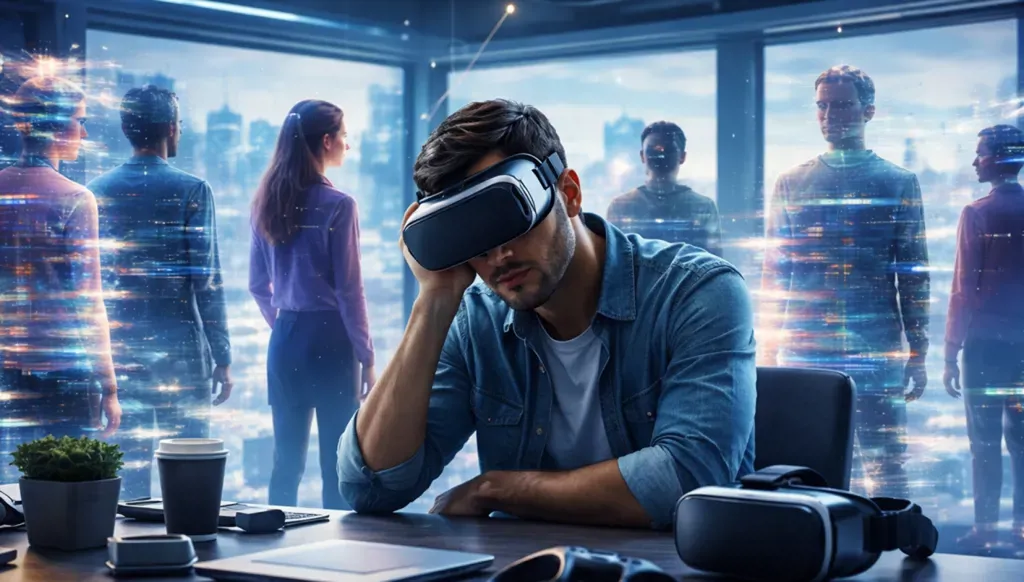


From their early days, metaverse projects promised to redefine digital social life by creating a virtual world in which users could interact more freely, as if they were living in a new, realistic space. This vision heralded a revolution in human communication, but reality showed that the metaverse failed to deliver convincing everyday uses for ordinary users and did not succeed in attracting a broad audience as companies had expected.
Virtual avatars were often limited in movement and unnatural, with a complete absence of basic social cues such as eye movement and facial expressions, which reduced the appeal of the experience and its practical value.
For many, the metaverse appeared to be a childish virtual world, where avatars were presented in a rigid way that did not reflect real human behavior, leading to weak social interaction.
With Meta announcing cuts to several metaverse projects in January 2026, including the closure of its virtual reality workplace app Horizon Workrooms and the suspension of some business-focused virtual reality services, critics and users began to see this as the end of a major phase of earlier ambitions, somewhere between mockery over the company’s heavy financial losses and surprise at an ambitious idea that failed to succeed.
This was followed by layoffs in the Reality Labs division, which is responsible for developing metaverse projects, affecting teams working on games and virtual experiences. These shifts indicate that Meta is no longer betting on the metaverse as a core pillar of its strategy, instead moving toward greater investment in artificial intelligence and wearable technologies such as smart glasses. This reflects a practical shift away from the metaverse’s grand promises.
On the technical side, virtual reality devices have seen significant improvements in recent years, from image quality to more visually comfortable environments, as well as the ability to track eye movement, gestures, and facial expressions. Reports suggest that these advances could support a more natural user experience, but so far they have not been widely implemented in real social platforms, and there is still no official data after January 2026 confirming the achievement of fully natural interaction within the metaverse.
By contrast, there remain specific, practical opportunities for using the metaverse in education, training, and intensive social interaction in certain contexts. For example, students can take virtual trips to explore ancient cities or three-dimensional molecules and galaxies, and language learners can practice conversation with international partners in shared spaces. These technologies may also help older adults and people with disabilities take part in group activities that are difficult in the traditional physical world, such as interactive games around a virtual table. These experiences rely on natural social cues, such as body language and eye movement, which helps preserve social interaction skills and provides an experience closer to reality, without being a permanent substitute for real-world communication.
Overall, the metaverse is no longer seen as a lasting alternative to real social interaction, reflecting a shift in expectations among both companies and users. Nevertheless, the technology still has significant potential to support education, training, and social interaction in specific contexts, enabling people to connect in practical and meaningful ways, away from exaggerated ambitions of turning every aspect of life into a virtual world.

العلامات الدالة
الأكثر قراءة