

Hezbollah, Lebanon, and the legacy of regional “Red Lines” politics



 Messenger
 Whatsapp
 Threads
 Email
Email
 Print
Print
 X
X
 Facebook


It appears that “Hezbollah,” in its latest form of attacks—devoid of any logical or legitimate justification, whether old or new—is attempting to defend a notion of “resistance” whose legacy amounts only to the escalation of four catastrophic and absurd wars on Lebanon following the withdrawal of the Israeli army from the south in 2000. It does so by invoking the same equation under which Hafez al-Assad long operated, coexisting with the Israeli occupation of Lebanon and adapting to it through complete submission to the equation of “red lines.”
The party’s discourse in the current fragile truce is characterized by a familiar, often persistent duality, but now marked by a lack of shame. In its vehement campaigns against President Joseph Aoun and PM Nawaf Salam, it threatens and intimidates with the fate of Anwar Sadat, invoking the specter of civil war. Meanwhile, its theorists articulate Khamenei’s successor’s absent deal within the current mullah-regime system, which allows the party to retain its arms indefinitely. The party cannot be reprimanded for falling into its most fragile propaganda tactics when it attacks the Lebanese authority and all internal opponents, claiming they are tools of America and Israel, while its allegiance to Iran has catastrophically crushed Lebanon. It boasts of the gravest sacrifices known to any sect, denomination, party, or group in Lebanon, sacrificing Lebanon at the altar of its regional allegiance.
Hafez al-Assad's equation introduced the initial concepts of long-term adaptation between enemies on Lebanese soil, legitimizing regional exploitation by accommodating America’s then-dominant regional powers, through the establishment of “red lines” that limited Syrian military intervention, as well as the Israeli security belt in the south. This equation persisted for long periods across different eras, until the successive collapse of the Syrian-Iranian guardianship framework and the transformation of concepts inherited from the Cold War period.
After the July 2006 war, “Hezbollah” made use of what remained of Hafez al-Assad’s old equation, entering into wars and internal confrontations while continuing to reassure Israel of its stable commitment to the longest ceasefire ever, which at times came close to resembling a prelude to potential peace. However, the requirements of the “Iranian Revolutionary Guard” necessitated the opening of support fronts through its arm in Lebanon, and successive collapses followed—from supporting the Assad regime in Syria, to supporting Gaza, and then supporting Iran.
The most recent event, however, surpassed all previous material and human catastrophes, erasing the last conceivable remnants of an old narrative that survives only in the party’s imagination, now in a state of deep denial after the catastrophic foundational losses it suffered along the path of sacrificing everything in support of Iran.
Accordingly, what becomes strongly evident in its discourse and in the fierce adversarial behavior of its supporters and environment toward “all others” among the Lebanese is the myth of arms, as if it were truly the soul of the party and the oxygen of its environment, suggesting that without the weapon bearing the banner of regional function, the party would not have existed in the first place.
Now, ancient dreams resurface, such as the complete submission of America to Iran, including its regional branches. The party shows no regard for the Lebanese authority or for the Lebanese people in its pursuit of exclusive control over weapons.
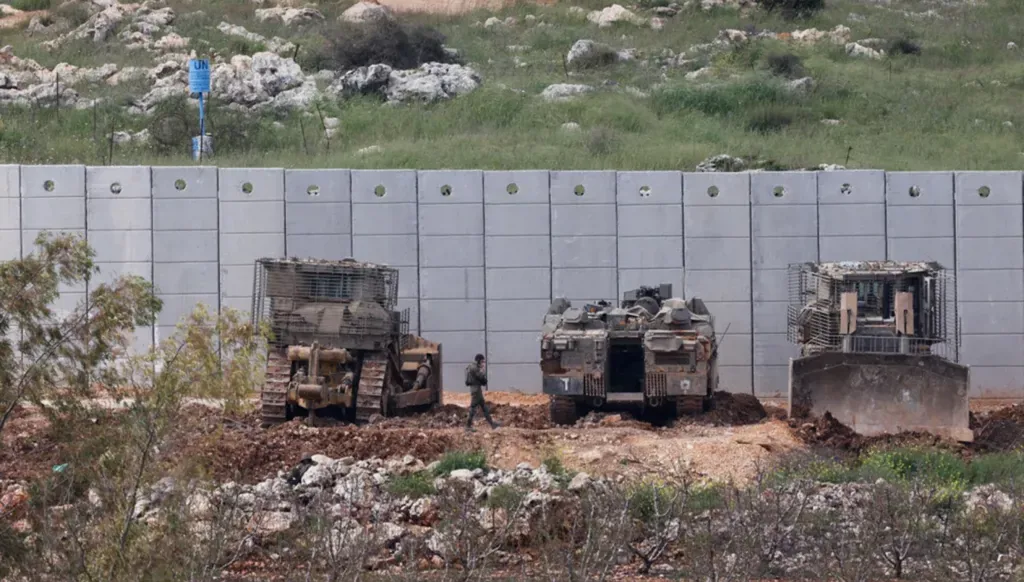
Perhaps its deeper bet lies with Israel itself, which is shaping a reality in which its army focuses on the “yellow line” and a buffer zone, suggesting a form of sustained occupation that could extend to direct control or fire dominance over as much as ten percent of Lebanon’s territory.