

When blackmail becomes doctrine: Iran’s regional strategy and Lebanon’s collapse of illusions


 Messenger
 Whatsapp
 Threads
 Email
Email
 Print
Print
 X
X
 Facebook
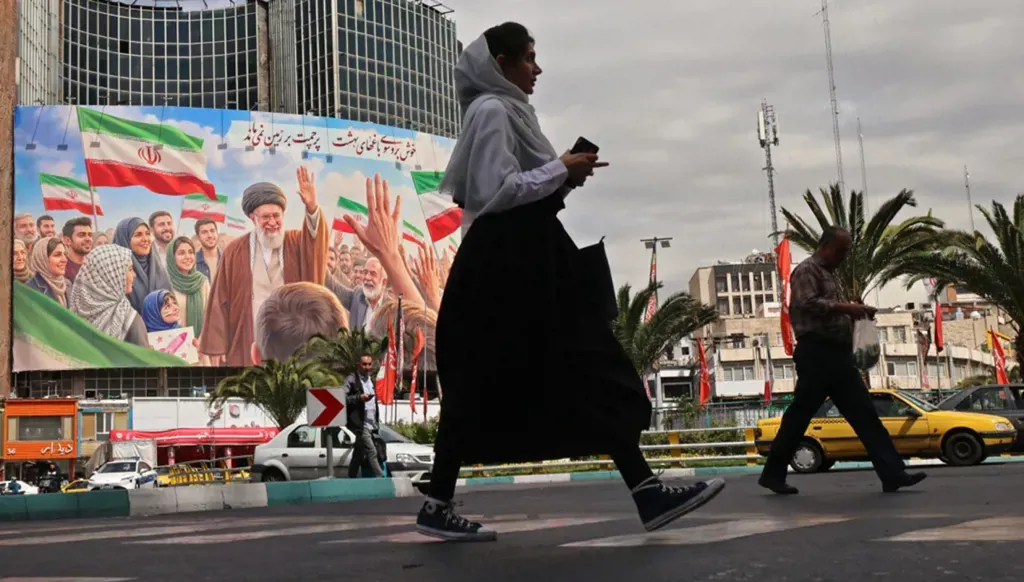


Iran reopened the Strait of Hormuz, only to shut it again shortly afterward. Whether it is actually capable of closing it or not is beside the point. What matters is that Iran’s behavior largely reflects internal power struggles driven by several factors.
More importantly, the Strait of Hormuz, like Iran’s attacks on the Gulf states, represents a continuation of a policy of blackmail that the Islamic Republic has mastered since its establishment.
At the forefront of the factors pointing to internal tensions is the coup carried out by the Revolutionary Guard on the day Supreme Leader Ali Khamenei was assassinated on February 28. In this context, the decision to close the strait again, with all the escalation it implies, appears to confirm the Islamic Republic’s refusal, represented by the Revolutionary Guard, to acknowledge its defeat in the recent war.
This war exposed the regime’s inability to reform itself and adapt to shifting regional realities, while also highlighting the dominance of extremists over Iran’s decision making.
Resorting to the Strait of Hormuz card is simply an extension of the blackmail strategy the ruling system in Tehran has pursued since 1979. The regime founded by Ayatollah Khomeini adopted the slogan of exporting the revolution. It initially focused on Iraq, given its Shiite majority, which eventually led to a war between the two countries from 1980 to 1988.
However, it is important to note that the foundations of this blackmail approach were laid even before the Iran-Iraq war. They were established when the Muslim Student Followers of the Imam's Line seized US embassy diplomats in Tehran and held them in humiliating conditions, claiming the embassy was a den of spies.
The first success of the blackmail policy
The detention of the American diplomats lasted 444 days. It marked the first success of the blackmail policy that the Islamic Republic would go on to practice with skill. The hostage crisis was characterized by a hesitant response from the administration of Jimmy Carter, which launched a failed rescue attempt. The poorly planned operation ended in disaster when a helicopter crashed in the Iranian desert near Tabas. US forces had been expected to land there to rescue the embassy diplomats, but sandstorms prevented the mission from proceeding. After that attempt, the Carter administration appeared to resign itself to the Iranian reality.
The blackmail policy proved effective, and the Islamic Republic has never abandoned it. It has applied this strategy both directly and through its proxies. For example, Hamas carried out suicide operations in the West Bank and inside Israel with Iranian backing.
Everything Hezbollah did in Lebanon, including the assassination of Rafic Hariri and many figures who upheld national sovereignty, was supported by Iran. This included, of course, the takeover of Beirut and the mountains in May 2008 as a prelude to asserting control over the country. That control was effectively consolidated when Iran secured the election of General Michel Aoun as president on October 31, 2016, in his capacity as Hezbollah’s candidate for the presidency.
Lebanon pays the price
Everything in the region has changed, but Iran’s blackmail policy has not. The wars the Islamic Republic ignited across the region, on the sidelines of the Gaza war, have now spilled into Iran itself. Yet the Revolutionary Guard has found no response to the United States and Israel other than continuing its policy of blackmail.
Lebanon has paid a heavy price for this Iranian strategy. The country has come to understand that the time has arrived to break free from Iranian dominance. The recent address by President Joseph Aoun to the Lebanese people reflects this very sentiment. Lebanon has no choice but to negotiate with Israel in order to end the Israeli occupation brought about solely by Hezbollah.
In the end, the key question remains: where will Iran’s blackmail policy lead it? The answer is further destruction. What began as a strategy of blackmail has ended in a devastating war with no exit except through acknowledging reality. That reality is that Iran has no option but to return to being a normal state that lives in peace with its neighbors, abandoning ambitions of dominance and the exploitation of sectarian tensions.
There is no path forward without abandoning this policy of blackmail. The question is whether the Iranian regime is capable of changing its nature, or whether blackmail, which it has mastered, is inseparable from its very structure to the point that the regime itself would not survive without it.
Disclaimer: The opinions expressed by the writers are their own and do not necessarily represent the views of Annahar.