

Lebanon’s political memory of 2004: Can old patterns still repeat?


 Messenger
 Whatsapp
 Threads
 Email
Email
 Print
Print
 X
X
 Facebook
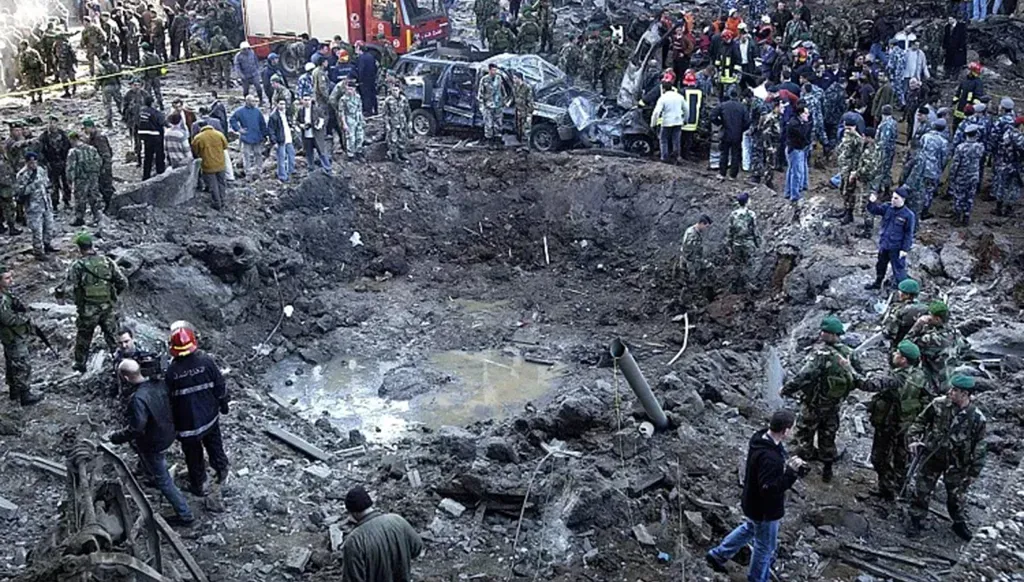


Some believe that politically motivated assassinations will return to Lebanon, basing this belief on the rhetoric recently adopted by Hezbollah, with support or direction from Iran.
This reminds Lebanese officials of the fate of Prime Minister Rafik Hariri, and some draw parallels between the approach of President General Joseph Aoun and that of the late Egyptian President Anwar Sadat, who was assassinated. Others resort to caricature and humiliation, as the semi-official Iranian Tasnim Agency did when it depicted Aoun’s head as a ball being kicked by Americans and Israelis. The examples are too numerous to count.
So, will Lebanon return to the criminal scene that inaugurated its most prominent seasons on October 1, 2004, with the attempted assassination of former minister and MP Marwan Hamadeh, marking the start of the confrontation with United Nations Security Council Resolution 1559 issued one month before that terrorist event?
Hezbollah, in all its internal and regional dimensions, may be going through a more difficult period than the one it experienced in the autumn of 2004, following the issuance of Security Council Resolution 1559, which called for the withdrawal of the Syrian army from Lebanon and the disarmament of allied militias, primarily the party.
The “Axis of Resistance” at that time paved the way by threatening and humiliating Lebanese figures supportive of the resolution, both during the phase of lobbying for its issuance and later during efforts to implement it. When it found that the prelude had failed, it moved on to implementing the threats, and Lebanon entered a period from October 1, 2004, until all decision-makers in Lebanon relegated Resolution 1559 to oblivion in speeches, documents, and statements.
Effectively, the chain of assassinations did not stop until the axis secured a decisive victory over the coalition supporting Resolution 1559.
This suggests that the “Axis of Resistance” might be tempted to revert to the strategy it used successfully during that period.
Based on this logic, some may find that the current verbal, rhetorical, and political attacks, if they do not deter the Lebanese authorities from pursuing positions opposed by Hezbollah and Iran, might once again lead the axis to adopt a “deterrence mechanism” represented by bombings, assassinations, and the creation of blacklists.
However, while some look to a future shaped by past experiences, the “Axis of Resistance,” drawing on other resources, might find many weaknesses that prevent a return to such a scenario, given that the circumstances of the past do not align with those of the present.
In the previous phase, those holding state power and institutions feared the major change brought by Resolution 1559, concerned that they would be its victims and would lose their influence and gains. Thus, they colluded with all their capacity in support of the plan, providing it with all necessary assistance, whether by supplying information to its executors or by withholding data from those it targeted.
In principle, there are no current victims of the desired change; the opposite might actually be true now.
In that period, the Syrian regime was a full partner in creating the intimidation scenario and had a vested interest in it. Accordingly, it exchanged services with the “axis.” Currently, the new Syrian regime has moved to a position completely opposite to that of the former regime, and what benefits the “axis” now harms them, while what weakens the “axis” strengthens them.
Most importantly, the Islamic Republic of Iran has managed the dynamics of the conflict in a way that has, at times, helped it avoid direct involvement in war. In the current phase, however, much has changed, as Tehran appears to be seeking ways to avoid direct confrontation, prioritizing damage limitation over further entanglement, amid Israeli efforts aimed at weakening or toppling the regime.
As for Hezbollah itself, even if it retains the capacity for verbal threats, it lacks confidence in its ability to keep secrets, as Israeli intelligence appears to have penetrated decision-making circles. Consequently, the exposure of any intended action could quickly turn the intended intimidation effect against it.
In facing the major challenges since 2004, the “Axis of Resistance” possessed answers to complex questions and was confident in its ability to impose its view on regional and international decision-makers; thus, weakening internal players opposing it was productive in its effects.
However, it is currently not in that position at all. This time, external forces are acting against it more than internal ones, its leadership is more targeted from outside than within, and the intense pressure for change does not stem from internal will but from external conditions. Internal failure to achieve set objectives will leave room for external forces to act independently.
Accordingly, the scenario of confronting Resolution 1559 is suitable for reminiscing but not for execution!
Disclaimer: The opinions expressed by the writers are their own and do not necessarily represent the views of Annahar.