The “Smoke Screen” economy: JPMorgan Chase CEO Jamie Dimon maps five risks that could redraw global markets
From war shocks and AI disruption to inflation, Europe’s slowdown, and the future of money—why Wall Street is preparing for a world where stability is no longer guaranteed.
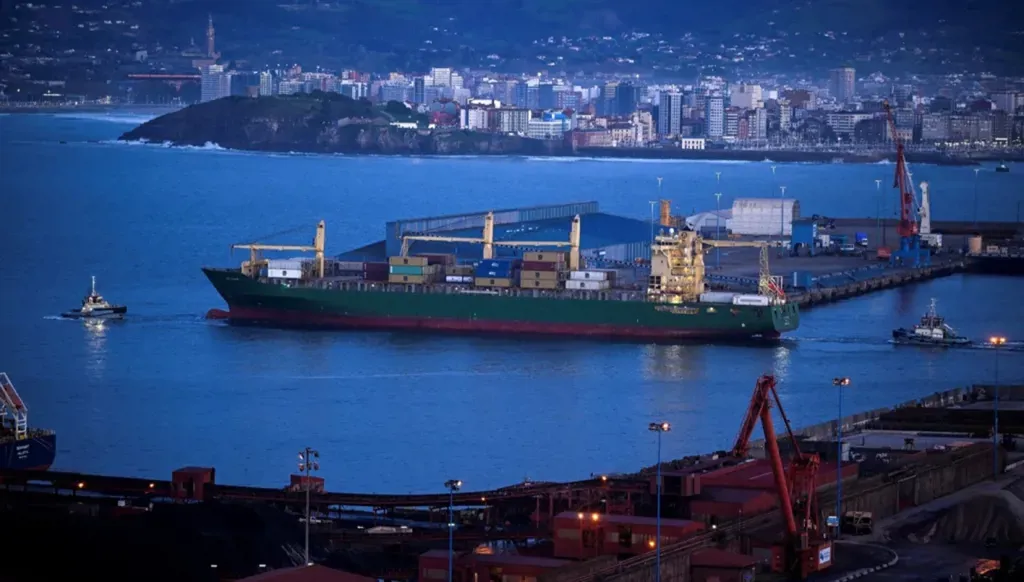
A photo taken on March 17, 2026, shows tugboats assisting the container ship MSC Salina III, sailing under the Portuguese flag, as it departs the port of the Spanish city of Gijón. (AFP)
In his most severe annual message in two decades, Jamie Dimon, CEO of JPMorgan Chase, warned that the prevailing optimism in the markets might be a “smoke screen” obscuring the vision of five existential risks. He sees 2026 not merely as another economic year, but as a turning point that could reset the global financial system under unprecedented pressures. So what are these risks?
1-The War in Iran: The Shock the World Has Yet to Absorb
Dimon views the war in Iran as the “black swan” of 2026. While analysts focus on daily price fluctuations, he stresses that markets have yet to price in the “actual disruption” to supply.
This matter has a structural impact, as the closure of the Strait of Hormuz not only pushed oil prices above $114, but also crippled the supply of helium and rare gases vital to the tech industry. Kenneth Rogoff, former chief economist of the IMF, says, “We are not facing a pricing crisis, but a supply chain efficiency crisis that could take us back to the scarcity of the 1970s.”
2-Stubborn Inflation: The Trap of High Interest Rates
Dimon warns of latent inflation; while markets await rate cuts, the war and massive U.S. defense spending have reversed the trend.
The lurking danger is that the gradual rise in inflation in April 2026 may force the U.S. Federal Reserve to raise rates later to 7% or 8%. And let’s not forget that the American fiscal deficit exceeding two trillion dollars acts as a constant driver of inflation, making a “soft landing” a distant wish.
3-Blockchain Giants: The Threat "From Outside the System"
For the first time, Dimon categorizes “blockchain” companies and stablecoins as strategic competitors threatening the core of the traditional banking system. The shift lies in the fact that these technologies are no longer merely “speculative assets,” but have become payment infrastructures that rival the SWIFT system.
Companies issuing stablecoins now control cash flows comparable to those of medium-sized bank deposits, thereby drawing liquidity away from the traditional banking system and reducing banks’ lending capacity.
4-Artificial Intelligence: A Revolution Beyond "Adaptation" Capability
Though he believes AI will cure diseases and reduce the workweek to 3.5 days, Dimon fears a widening “adaptation gap.” He sees that the speed of job elimination in financial services, programming, and the middle class exceeds governments’ capacity for retraining.
JPMorgan estimates that AI could affect 300 million jobs globally, placing pressure on social safety nets at a time when budgets are already strained by deficits.
5-Europe: The Old Continent in Its "Critical Decade"
Dimon sees Europe entering a phase of “fatal stagnation.” As the U.S. and China accelerate in the race for technology and energy, Europe remains mired in bureaucracy and energy shortages.
If we look at the digital reality, we see that Europe’s GDP has continued to shrink relative to the U.S., falling from 90% in 2000 to 70% in 2026. The continent is now “strategically paralyzed” amid a war on its borders and a suffocating energy crisis sweeping across it.
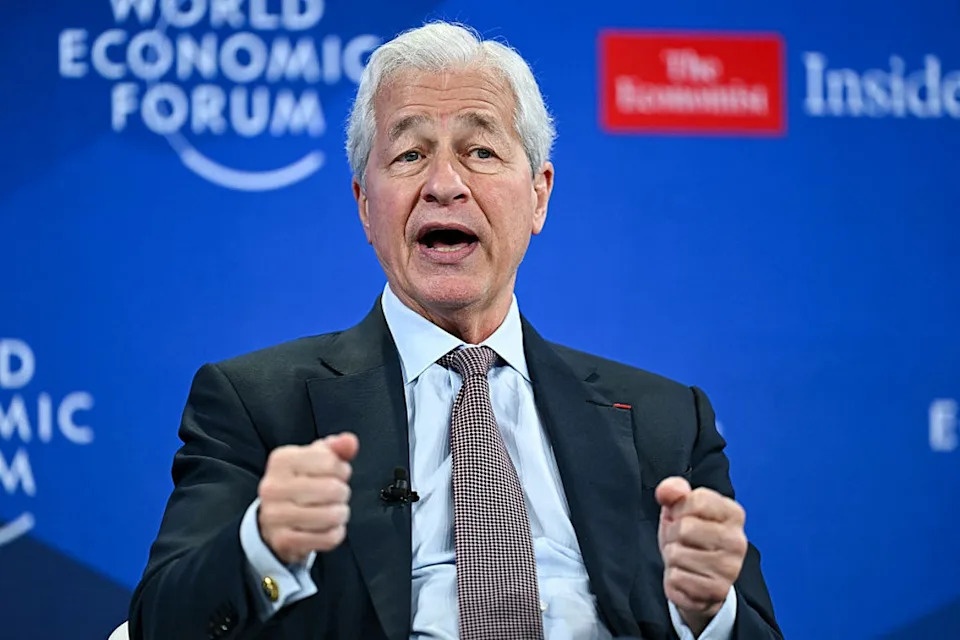
JPMorgan Chase CEO Jamie Dimon (AFP)
What is the Protection Portfolio?
The protection portfolio is not designed for quick profits but for survival and hedging against violent market fluctuations. Dimon believes we are moving from an era of “easy money” to one of “capital scarcity.” So how should individuals construct a safer portfolio, and which sectors can truly act as havens amid the five risks mentioned above?
The immediate step is to prepare for a high-interest-rate scenario (8%) and steer the portfolio away from “debt” and bets that depend on lower rates.
Meanwhile, maintaining a portion of cash liquidity (15–20%) is essential. In times of war, liquidity enables investors to seize opportunities during sudden price collapses. Instead of choosing long-term bonds whose value declines with rate hikes, it is preferable to opt for bonds maturing in one or two years to benefit from higher yields.
In the energy and commodities sector, it is crucial to hedge against disruptions in the Strait of Hormuz and invest in major oil companies with substantial reserves outside conflict zones, such as U.S. shale producers or firms operating in the North Sea and Brazil.
In the base metals sector, copper and lithium stand out as key choices. With the ongoing “green transition” and AI boom, demand for these metals is expected to rise regardless of broader economic conditions.
What About Defense and Technology?
Apparently, global military spending is expected to continue rising over the next decade. Defense companies such as Lockheed Martin and Raytheon benefit from long-term government contracts and serve as a buffer against geopolitical tensions.
Instead of investing broadly in all tech companies, Dimon focuses on those with a “competitive moat” in AI, such as firms supplying AI infrastructure like Nvidia or Microsoft, as well as companies developing regulated digital payment systems that could serve as an alternative or complement to the traditional banking system.
Finally, gold remains the ultimate refuge against currency collapse and hyperinflation, with experts recommending allocating 5–10% of a portfolio to physical gold or gold funds.
Despite all challenges, the U.S. dollar remains the world’s primary reserve currency, and its status as a safe-haven asset during crises tends to strengthen its value.




 Messenger
 Whatsapp
 Threads
 Email
Email
 Print
Print
 X
X
 Facebook