Lebanon’s new round of talks with Israel: Echoes of 1983 and a changing political landscape
As Beirut prepares for direct negotiations in Washington, contrasting domestic forces revisit the legacy of the May 17 Agreement while insisting that today’s balance of power has fundamentally changed.
This is not the first time Lebanon has entered into direct negotiations with the Israelis. The experience of negotiations that ultimately led to the May 17 Agreement in 1983 is still still vivid in people's minds as a milestone in contemporary political history, both in terms of its process and its results and implications.
Thus, the question posed after Lebanon officially announced its intention to begin a round of direct negotiations with the Israeli side in Washington is: what are the similarities and differences between the circumstances of the negotiations conducted 43 years ago and those whose first sessions are scheduled to start next Tuesday?
The pertinence of the question lies in the fact that some are waiting and betting in order to base their assumptions accordingly, and on the results, their internal calculations. Furthermore, will the upcoming experience be similar to the past experience, despite the passage of time?
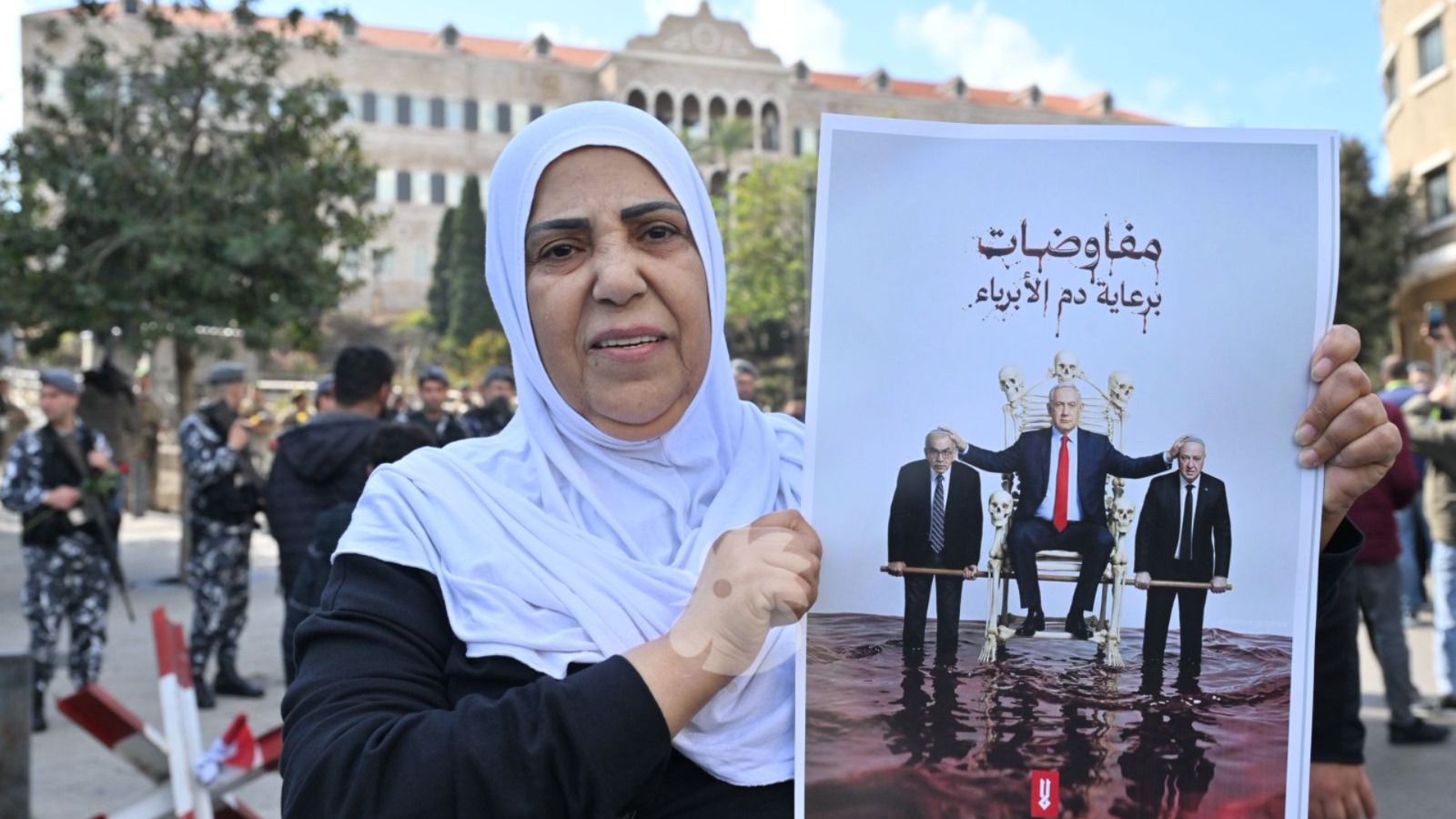
Protester in front of the Serail (Houssam Shbaro)
The reality is that the previous negotiations, like those provisionally planned, took place under the pressure of significant Israeli military action. The first experience, as is known, came shortly after a defeat of the Palestine Liberation Organization and its allies in the “National Movement,” and shortly after a wide-ranging Israeli invasion of the south and other areas, culminating in Israeli forces entering the capital, which sparked a drastic political shift in the country’s governance, paving the way for a political structure that quickly adopted the option of direct negotiations with Israel under American auspices.
These negotiations lasted more than a year, alternating between Khalde and Nahariya in Upper Galilee, and resulted in a peace agreement, the May 17 Agreement, so named for the day it was approved by Parliament with a comfortable majority.
But the ruling structure that approved it with great difficulty failed to provide the means for its protection and continuity, so the council that had approved it ultimately repealed it, as if it had never been.
Among the differences, according to some, was that the strength of the opposition to the agreement was very strong at that time, providing grounds to overturn it, especially since Hafez al-Assad’s Syria withdrew its initial support for it and incited its downfall, while some parties of the “National Movement” had just launched an actual resistance, and at the same time, a necessary alliance emerged between the leader of the Amal Movement, Nabih Berri, and the leader of the Progressive Socialist Party, Walid Jumblatt, who decided to begin a political and military confrontation against the government. At a higher level, the “National Salvation Front” was formed, which included prominent figures such as Sleiman Frangieh, Rashid Karami, and Adel Osseiran, and it began political opposition to the government and its performance.
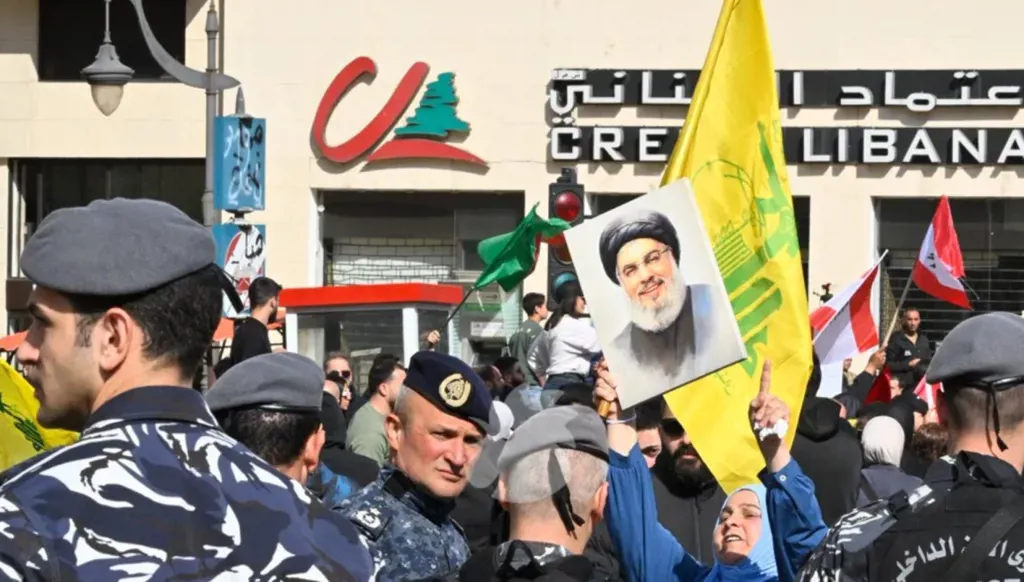
Remarkably, “Hezbollah,” which openly carries the banner of preemptive objection to the proposed direct negotiations between Lebanon and Israel, threatens to repeat the experience of opposition that successfully led to the collapse of the then-new agreement through the negotiations of that period, and it pre-emptively threatens a similar end to any agreement resulting from the upcoming negotiations, especially since it has sent several messages during the past hours through initial movements in some streets of the capital.
However, notably, the “Anti-Hezbollah” front, which strongly supports the negotiation process as the only option to end the party’s dominance, quickly organized a firm response to this threat, with the broad headline “The old circumstances have changed,” meaning that the time when the party could bring about change through various forms of objection has passed, and the facts and circumstances that combined to defeat the May 17 Agreement and “achieve a victory” for its opponents have completely changed. In their view, there is no “cross-sectarian and regional resistance front,” nor is there Hafez al-Assad’s Syria supporting the opposition trend. Additionally, there is no “general Arab-Sunni mood against understandings with the Israelis.” More importantly, the leaders who previously took on the call to overthrow the May 17 Agreement, Speaker Nabih Berri and Walid Jumblatt, are now in a different place and hold alternative views that some see as, in essence, “a regret over what was done back then.”
Moreover, there is confidence that the Presidency of the Republic and the Prime Minister's Office, which firmly adopt the option of direct negotiation, are not open to “maneuver and compromise.”
With these opposing visions and calculations, the advocates of negotiations proceed with their option, while dissenters continue on their path of objection. The irony is that both sides are quietly confident that their choice will ultimately prevail, as neither shows any willingness to retreat toward middle-ground solutions.
Disclaimer: The opinions expressed by the writers are their own and do not necessarily represent the views of Annahar.



 Messenger
 Whatsapp
 Threads
 Email
Email
 Print
Print
 X
X
 Facebook