

Ideological regimes and the refusal of defeat


 Messenger
 Whatsapp
 Threads
 Email
Email
 Print
Print
 X
X
 Facebook
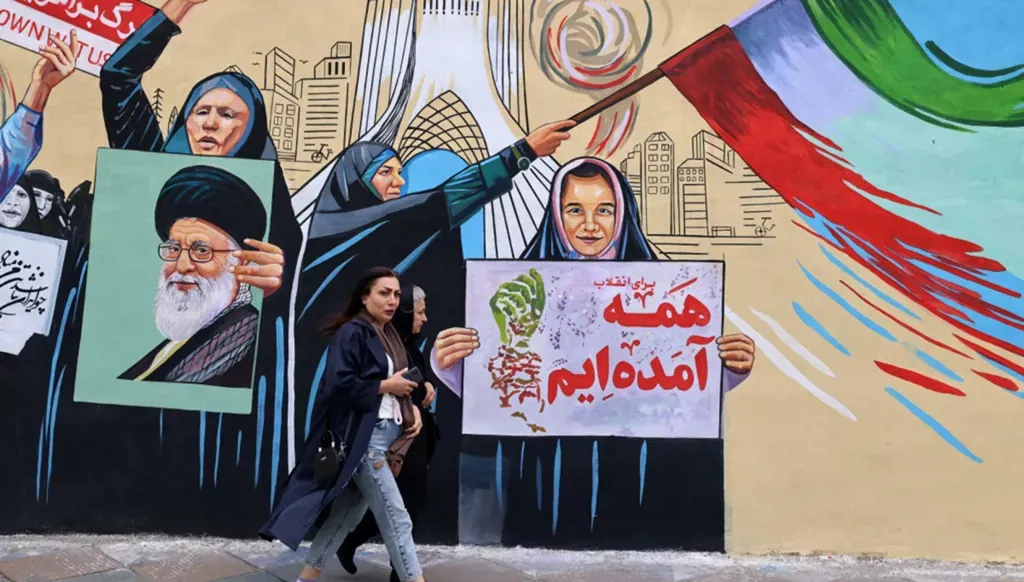


The Iranian regime is currently experiencing one of the most difficult moments in its history. After a series of intense American and Israeli air strikes that caused extensive destruction to its military and economic infrastructure, the regime continues to refuse to acknowledge defeat.
This behavior is not unique to the Iranian regime and at its core the Revolutionary Guard, but rather a common trait among all totalitarian ideological regimes and groups. Their survival depends entirely on the idea of salvation and the myth of the great leader who knows what is best for the nation. In the Iranian case, the weight of a historical sense of victimhood in Shiite ideology is evident, along with ideas related to the hidden Imam, which provide a capacity for mobilization and for accepting the notion of imagined victory. Therefore, acknowledging defeat would mean the collapse of legitimacy from its very foundation and the disintegration of the mental image that ideological regimes, whether religious or ideological, have built among their populations over decades.
The Great Promise
What drives these regimes to deny reality even after it has become obvious to everyone? First, the construction of legitimacy based on the Great Promise. These regimes do not derive their strength from real achievements, but from historical promises of eternal victories. Therefore, acknowledging defeat would mean the complete destruction of this narrative.
Second, the total control of information. We have seen how the regime in Iran prevents the Iranian people from accessing the internet and communicating with the outside world. A totalitarian state turns defeats into external conspiracies or strategic victories, benefiting from its monopoly over the media. This recalls the broadcasts of Iranian television and the Tasnim news agency, as well as the Iraqi information minister al Sahhaf, who used to speak of routing the American forces, while American troops had already entered Baghdad.
Third, fear of internal accountability. Defeat opens the door to questions about competence, corruption, and decisions in which the people were not consulted, and it may lead to an internal uprising.
Fourth, an all or nothing mindset. A regime that controls all parts of the state, politics, economy, security, and culture, sees any retreat as the end of its existence, not merely a change in people or decisions.
Divine Winds
Japan’s experience in World War II provides an extreme example of this refusal. In October 1944, after devastating naval defeats, “kamikaze” aircraft, meaning “divine winds,” were launched in suicide attacks against the American fleet. Young pilots flew planes loaded with explosives, crashing them into Allied ships, turning their own bodies into weapons. The emperor was considered a near divine figure, and loyalty to him was absolute. Although the attacks did sink some American ships, they did not change the course of the war. Thousands of Japan’s best young men died, and the war ended in total Japanese defeat. The “kamikaze” experience was not a military defense but an expression of an extreme nationalist ideology that rejected surrender.
The Iraqi model under Saddam Hussein reproduced the same pattern in another form. After the occupation of Kuwait in August 1990, Saddam rejected all international mediation. This led to Operation Desert Storm in January 1991, which ended with the Iraqi army being expelled on 28 February with heavy losses. Instead of reassessing his decisions, Saddam Hussein’s regime turned its violence inward, brutally suppressing uprisings in Basra and Kurdish regions. It also used human shields to protect strategic facilities, exactly as Iran’s Revolutionary Guard does today by recruiting children and bringing in militias from Iraq, Syria, and Afghanistan. The regime continued to deny defeat for another ten years until its final collapse in 2003. A similar case can be seen in Slobodan Milošević’s Serbia, which ended with his arrest by the International Criminal Tribunal after a heavy NATO bombing campaign.
Historical experience shows that ideological regimes are structurally bound to fail. They impose rigid utopian ideologies on changing societies and complex international realities. Internally, they prioritize loyalty over competence and eliminate democracy and peaceful transfers of power. In the Iranian case, the regime became preoccupied with the Islamization of the state and the export of its revolution, treating it as an imagined long-term missionary project instead of addressing real problems and investing in the country’s human, material, and cultural resources. The collapse of the Soviet Union, the fall of the Baathist regimes in Iraq and Syria, and the decline of ideological parties worldwide all demonstrate that slogans do not build states, and utopianism inevitably collides with the realities of the modern state.
In conclusion, denial drives these regimes to commit even greater mistakes and prolongs the suffering of peoples. The time has come for civil political projects based on competence, science, and peaceful transition of power, away from fantasies of eternal salvation. Defeat may mark the end of regimes, not of peoples; it can instead be the beginning of real reform, as the Japanese example demonstrates.
Disclaimer: The opinions expressed by the writers are their own and do not necessarily represent the views of Annahar