Victory without a winner: Inside the US–Iran ceasefire and its hidden terms

Opinion 10-04-2026 | 12:41

Victory without a winner: Inside the US–Iran ceasefire and its hidden terms

Between the Strait of Hormuz and competing claims of victory, the agreement signals not an end to conflict but a recalibration of influence, deterrence, and control in the Middle East.
Victory without a winner: Inside the US–Iran ceasefire and its hidden terms
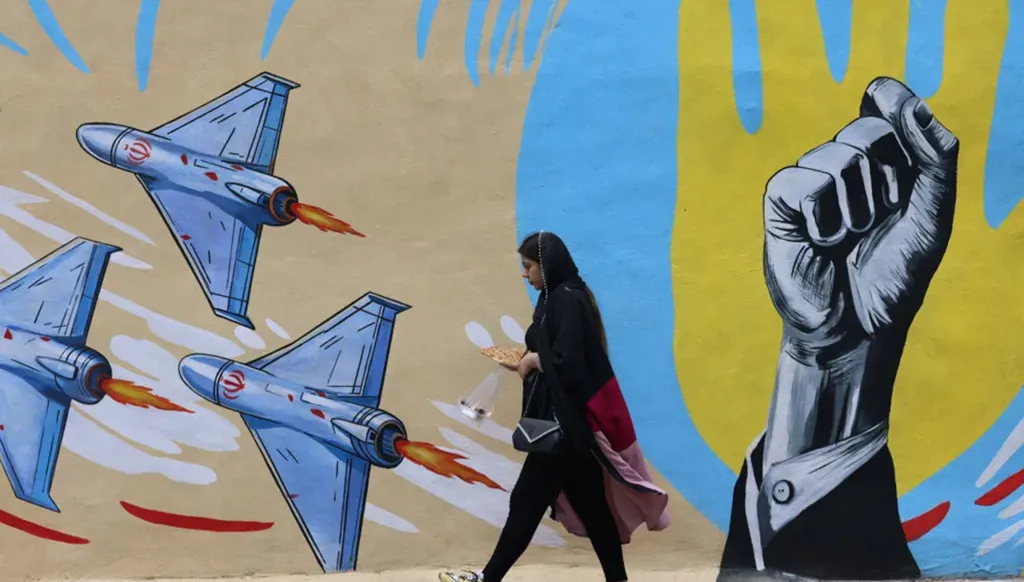
A woman walks past an anti–United States and Israel mural in Tehran on April 8, 2026. (AFP)
Smaller Bigger


In moments of great transformation, the significance of an event lies not in what is announced, but in what it reveals about the limits of both power and incapacity. The ceasefire agreement between the United States and Iran, announced hours ago, cannot be read as the end of a brief war, nor even as a temporary settlement, but rather as an intense moment that encapsulates the nature of the conflict itself: a conflict without resolution, a victory without a winner, and a defeat unacknowledged by any side.

The language of victory

From the very first moment, it was clear that each party rushed to craft its own narrative. In Washington, Donald Trump spoke the language of complete victory, asserting that military operations had achieved their objectives and that the ceasefire came after the United States had "restored deterrence." In Tehran, the language was equally decisive, with the Supreme National Security Council declaring it an Iranian victory and stating that the United States was forced to accept terms it had rejected just weeks earlier. Between these narratives, the disagreement lies not so much in the details but in how what happened is defined: is it a successful conclusion to a limited military operation, or an implicit acknowledgment of a new balance of power?


The reality, as revealed by events, falls into a gray area between the two narratives. The war that lasted weeks did not end with a clear military decision. The United States did not overthrow the Iranian regime, nor did Iran manage to impose a complete deterrence equation. Nevertheless, the ceasefire was not a voluntary choice but rather a response to a harsher truth: continuing the war would have led to a much higher cost than any potential gain. Here, specifically, the true nature of the agreement appears: not peace, but a forced halt.


The difference between the English and Persian versions of the agreement is not merely a matter of wording but a direct reflection of this delicate balance. The American narrative emphasizes that Iran presented a negotiation initiative and that Washington accepted it as a framework for discussion, without fully committing to its content. Meanwhile, the Iranian narrative goes further, claiming that this initiative became a binding foundation and that the United States effectively agreed to discuss issues it had previously refused, foremost among them the lifting of sanctions and its regional role.


Between these perceptions, it can be said that the American version more accurately describes what was achieved on the ground, while the Iranian version more accurately reflects what Tehran seeks to establish politically. The mere transition of the United States from a position of refusal to one of negotiating on the basis of a partial Iranian proposal in itself marks a significant shift in the rules of the game. It is not a complete Iranian victory, but it is certainly not a defeat.

However, the most sensitive point in this agreement is not related to language or wording, but to geography, specifically the Strait of Hormuz. This maritime passage, which has long been at the heart of tensions, has become in this round a key to the agreement itself. For Washington, ensuring freedom of navigation was a fundamental condition for halting operations. For Tehran, Hormuz was the most important card it held, not only as a tool of pressure but also as a symbol of sovereignty and regional influence.


What appears to have been reached is a middle ground, opening the strait to navigation, but within arrangements that in some way recognize Iran’s role in securing or influencing it. This point, despite its apparent simplicity, carries deep implications. It means that the question is no longer whether Iran can close the strait, but who holds the right to organize transit through it. This is a shift from the logic of threat to the logic of management, and from a conflict over disruption to negotiation over influence.


In this context, speaking of a "winner" or a "loser" becomes a simplistic distortion. What has been achieved is a tactical victory for both sides and a deferred strategic defeat for both. The United States succeeded in demonstrating its ability to strike and deter, but it could not impose its final terms. Iran proved its ability to withstand pressure and establish itself as an indispensable player, but it did not obtain the gains it aspired to, chief among them the complete lifting of sanctions.


More importantly, this agreement does not close the conflict, but rather reshapes it. It does not address the roots of the crisis, but postpones its eruption. The negotiations that are supposed to follow the ceasefire will determine whether this pause will turn into a path toward settlement or into a short truce preceding a more complex round. In both cases, what has fundamentally changed is the nature of the balance: the United States is no longer able to impose its will unilaterally, and Iran is no longer in a position that can be easily ignored or contained.


Perhaps the most accurate description of what happened is that everyone gained something but lost greater things. They gained the ability to avoid the worst, and lost the possibility of resolution. In a world forming on the rhythm of consecutive crises, this may be the new definition of victory: to stop before collapse, not to win completely.


The ceasefire agreement does not answer the question of who won as much as it poses a deeper question: Are we at the beginning of a new regional order in which power balances are being redefined, or is it merely a short break in a conflict that has not yet reached its peak? The answer, most likely, has not yet been written.

العلامات الدالة

الأكثر قراءة

اقتصاد وأعمال 4/7/2026 9:18:00 AM
انخفاض بسعر البنزين... ماذا عن المازوت؟
اسرائيليات 4/9/2026 10:47:00 AM
الجيش الإسرائيلي: لعب دورًا مركزيًا في إدارة مكتبه وتأمينه
لبنان 4/8/2026 9:02:00 PM
غارة عين سعادة تكشف هدفا غير معلن… ومسؤول في حزب الله نجا من الضربة.
لبنان 4/9/2026 12:24:00 PM
فيديو يُظهر لحظة استهداف البارجة بصاروخ كروز بحري يحمل شعار "حزب الله"