

Zelensky in Damascus: Ukraine steps into the Middle East arena
From Gulf-backed drones to Turkish diplomacy, Ukraine maneuvers into Syria, reshaping regional alliances and challenging traditional power balances.


 Messenger
 Whatsapp
 Threads
 Email
Email
 Print
Print
 X
X
 Facebook
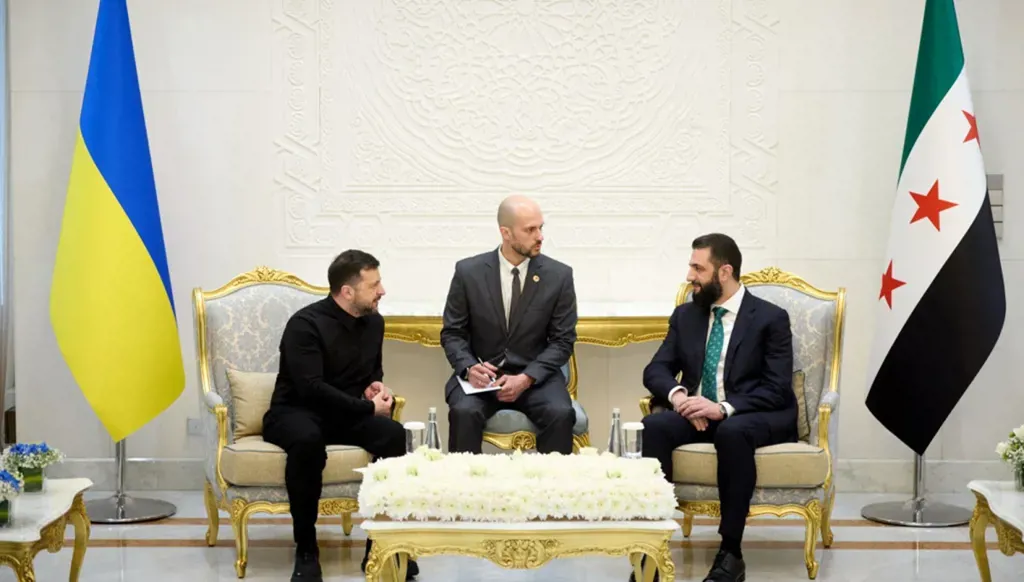


Ukrainian President Volodymyr Zelensky visited Damascus on Sunday. This marked the first visit by a head of state to Syria during President Ahmad Al-Sharaa's tenure this year, and the third overall following last year’s visits by Emir of Qatar Sheikh Tamim bin Hamad and Palestinian President Mahmoud Abbas. While Damascus has seen a series of Arab and international visits highlighting changes in Syria since the previous regime's downfall, the Ukrainian visit followed a controversial scenario and execution.
The visit could have been a typical, routine affair, marked by receptions, farewells, joint statements, and emphasis on historical relations accompanied by the usual platitudes. However, Kyiv’s strongman arrived in an unannounced and almost secretive manner, following a Gulf tour and a visit to Istanbul, where he met Turkish President Recep Tayyip Erdoğan, before arranging an urgent visit to Damascus.
A new regional transformation
The details do not end here: a Turkish plane transported him and his delegation to Damascus International Airport, accompanied by Turkish Foreign Minister Hakan Fidan. A Turkish-Ukrainian political landing took place in Damascus, featuring three-way meetings that suggested the formation of a new axis between Ankara, Kyiv, and Damascus. To complete the picture of peculiarity and contradiction, it should be noted that Zelensky, the main adversary of Russian President Vladimir Putin, entered a historically Russian sphere of influence, not far from its military bases in the country.
Something is being devised within a transformative map that is affecting the region and the world. Zelensky appears to be taking advantage of the circumstances of the war against Iran and enjoys maneuvering space due to Washington’s focus on this major event. He carries his portfolio, promoting his country’s intercepting drones in a market open to modern technology—intercepting drones with drones. He has forged historic strategic agreements with Saudi Arabia, the UAE, and Qatar, involving Gulf investments that finance Ukrainian military industries, including its renowned intercepting drones.
There are whispers in Damascus that Syria could become a strategic location for Ukrainian factories financed by the Gulf. Nothing official has been leaked. However, what has been announced points to forthcoming defensive cooperation. Damascus can rely on Ukraine, which has long maintained the infrastructure for producing Russian weapons, as an alternative to any Russian reluctance to fulfill agreements. The Turkish escort of Zelensky’s trip suggests Ankara’s eagerness to support Syria’s defenses at a time when the country is being seriously considered as a strategic energy corridor from the Gulf to Europe.
Zelensky’s zeal in the region is provoking major capitals. Ukraine, which has been enduring a war waged by Russia for four years, has become a security exporter to the world and a competitor to major countries in the Middle East arms market. Even the technology for intercepting drones is now being produced extensively by British factories, offering exclusivity and cost-effectiveness that make it more attractive compared to the costs of traditional interceptive missiles.
Israel's sensitivity
Zelensky’s visit to Syria heightens Israel’s sensitivity—firstly, due to its military and arms dimension, and secondly, because of the Turkish sponsorship, which is disliked by Benjamin Netanyahu and his government. However, Zelensky is undoubtedly aware of this sensitivity, and he has the means to manage Israeli reservations. Moreover, the defensive intercepting drones do not disrupt the balance of power nor impede Israel’s operational freedom.
Turkish sources are quick to deny rumors of a Turkish plan to undermine Russian influence in Syria through Ukraine’s competitive entry. These sources note that Erdoğan phoned Putin before Zelensky’s arrival in Istanbul, without confirming whether the talks addressed the Damascus leg of the guest’s tour. Damascus, through its official channels, is also quick to deny that its relations with Kyiv come at the expense of its ties with Moscow.
These platforms assert that one cannot compare a decades-long relationship with Moscow, despite all the past Russian support for Bashar al-Assad’s regime, with a fledgling relationship with Kyiv that is only days old. However, they do not rule out the possibility that Zelensky’s visit could anger Putin, with potential repercussions within Syria.
There are murmurs that the "Coast" movement has quieted only after new agreements between Damascus and Moscow deprived its "remnants" of the Russian backstop they had relied on as a guarantee of a return to an outdated rule.
Disclaimer: The opinions expressed by the writers are their own and do not necessarily represent the views of Annahar.