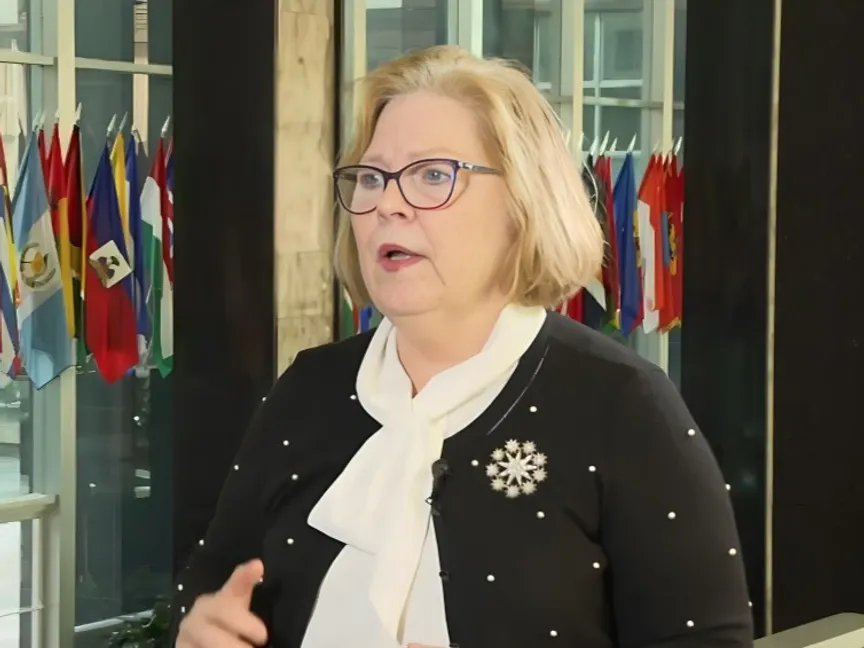
Barbara Leaf on Lebanon and Syria: Why military action alone can’t solve the region’s conflicts
Exclusive insights from the former U.S. diplomat reveal how Israel’s military campaigns, U.S. priorities, and political negotiations shape the fragile Middle East balance.
Barbara Leaf, the former U.S. Assistant Secretary of State for Near Eastern Affairs in the Biden administration and former U.S. Ambassador to Abu Dhabi, told Annahar in an exclusive interview from Washington that Israel cannot disarm Hezbollah through purely military action, emphasizing that "disarmament is also a political task."
The former U.S. diplomat, who currently serves as a Senior Advisor for International Policies at Arnold & Porter, said that “the U.S. administration is currently not interested in Lebanon, and Israel is not currently interested in negotiating with it,” and predicted that the Israeli war in Lebanon will continue “as long as the conflict with Iran persists.”
"There is a sense that Netanyahu is indeed turning Lebanon into another Gaza. What is your assessment?"
"Tragically. First and foremost for the Lebanese people, but also for the Israeli people. It seems to me that Netanyahu's government lacks a clear strategic plan for the military's actions. By that, I mean there is no viable, final political goal that both enhances Israel's security from an Israeli perspective and is realistically achievable."
"In a strange way, what we see in Lebanon mirrors the situation between the U.S. administration and Iran: engaging in a military conflict with military objectives, but without sufficient clarity on the final political outcome, and with strategic goals that are either unclear, unachievable, or both. In Israel, as a democracy with many voices expressing opinions, concern is growing. Some military personnel, including former officers, have expressed that disarming Hezbollah is beyond the capabilities of the Israeli army. I personally agree with this assessment, because ultimately, disarmament is as much a political task as a military one, and logically, it is closer to being a political mission."
Therefore, the Israeli army cannot achieve this alone. What the army can do—what armies generally excel at, along with air forces—is destroy weapons depots, infrastructure, and control territory. But to what end is the land being controlled? Israel has had a very unfortunate history of occupying southern Lebanon, and I hope it does not repeat that, because military occupation will not achieve its goals, whatever they may be. Moreover, such an approach would not only cause significant humanitarian suffering but also pose a real risk of completely destabilizing Lebanon, creating a security nightmare for many countries, not just Israel.
No interest in Lebanon currently *Do you think this war in Lebanon will continue for a long time, given that Israel's goal is to disarm Hezbollah, while you say that this goal can only be achieved through political negotiations?
"What I can say is that this war is likely to continue as long as the conflict with Iran persists. Part of the reason is the current lack of significant interest from the United States in Lebanon. The U.S. focus, both at the leadership level and at lower levels, is entirely on Iran. When the conflict with Iran ends, this may create an opportunity for the U.S. administration to redirect its attention to Lebanon—and I hope that indeed happens."
American Diplomat Barbara Leaf (X)
*Do you get the impression that the U.S. administration has given Israel free rein in Lebanon?
"Actually, that is happening. I don’t know if it is an intentional approach, but it is occurring on the ground because the United States is not focused at all on what is happening in Lebanon. Whether intentional or not, that is the effect we are seeing."
"Decisive end" •The Lebanese president and prime minister have stated that they want direct negotiations with Israel, while the Israeli government refuses, and the French say that the U.S. administration is interested in this issue. What is your opinion?
"No, I do not think so. For now, it is clear that Israel's priorities are purely military—that is, to clear as much land as possible in the north, to the greatest extent, freeing it from threats or perceived threats. Again, I believe this could change; the dynamic could shift completely once the conflict with Iran reaches some kind of decisive end—decisive, and I emphasize that with an asterisk."
* The French say that the U.S. administration is interested in negotiations between Lebanon and Israel
"There is a condition for the region to regain any measure of stability, which is for the conflict to have a decisive end—that is, an end that is negotiated. This is not at all clear at the moment. As soon as the war with Iran concludes under such terms, I believe the U.S. administration would be interested in encouraging direct negotiations, which would be positive. But for now, the United States is simply not focused on this issue, nor is it a priority."
* But is the United States very interested in Syria? Israel is also destabilizing Syria and dividing the Druze between those loyal to Israel and those supporting Syria’s sovereignty, isn’t it?
"It has been clear since the fall of Assad's government in December 2024 that there is a significant gap between Israeli and American goals in Syria. This gap has been somewhat covered up and partially reduced thanks to the efforts of Ambassador Tom Barrack in promoting direct talks between the governments, as well as Washington’s pressure on Israel to halt bombing. Nevertheless, this gap still exists."
"The Israeli government has been very clear that it does not trust the government of Ahmad al-Sharaa nor consider it a viable partner, and it does not believe this government can control its territory or mitigate threats coming from it against Israel. Meanwhile, President Trump was also very clear, as he wants to see stability in Syria and for Gulf countries and others to invest in it, providing economic momentum—that is, economic weight—to support stabilization efforts."
Meanwhile, as with other issues in the region, the Syrian file is somewhat frozen and unfolding in the shadows while the United States focuses on Iran. Therefore, what Israel is doing regarding the Druze community is not a priority for this administration, if they are even following these developments at all.



 Messenger
 Whatsapp
 Threads
 Email
Email
 Print
Print
 X
X
 Facebook