

Netanyahu and Trump: A case study in unequal influence
How a smaller state leveraged structural opportunities to shape US strategic decisions and regional policy.


 Messenger
 Whatsapp
 Threads
 Email
Email
 Print
Print
 X
X
 Facebook
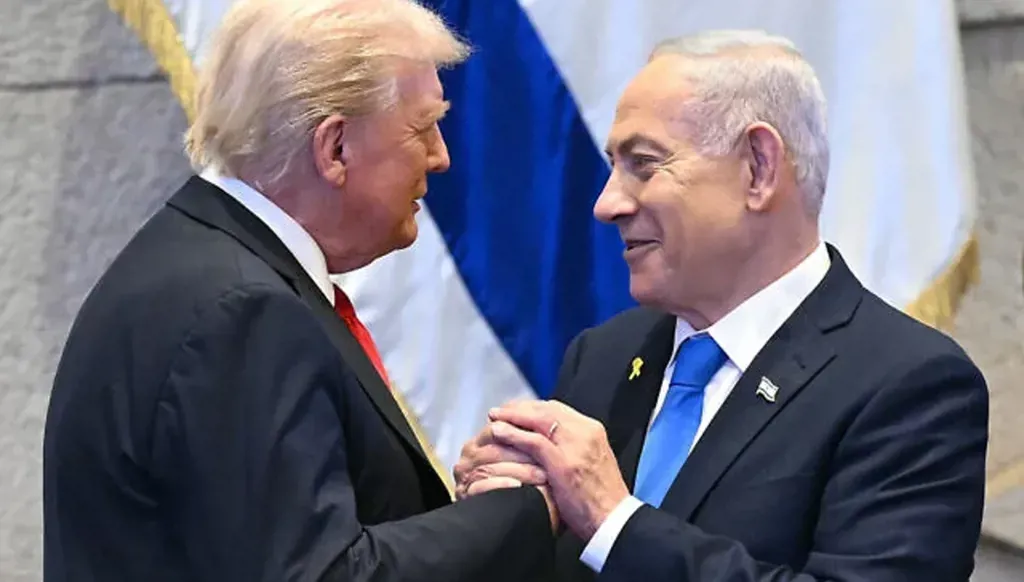


It is rare to find a useful case study on unequal influence in contemporary international relations like the one between Israeli Prime Minister Benjamin Netanyahu and US President Donald Trump.
Since Trump returned to the White House, Netanyahu has visited Washington at least six times, a pace unprecedented in the history of US-Israeli relations. This pattern raises the question of the circumstances under which a smaller state can shape the strategic behavior of a dominant state.
Netanyahu’s Goals
The favorable conditions for the current situation were not created solely during Trump’s second term but were built during his first term through a series of political decisions that systematically linked US foreign policy to Netanyahu’s objectives.
During his first term, Trump recognized Jerusalem as the capital of Israel and moved the US embassy there. He also recognized Israeli sovereignty over the Golan Heights and supported Israeli settlements in the West Bank. This American shift was one that previous Israeli governments had often pursued without success. The domestic political consequences were tangible. When Trump withdrew from the Iran nuclear deal in 2018, Netanyahu’s Likud party experienced a notable rise in popularity in opinion polls. These concessions translated into political gains for Netanyahu in Israel, while Netanyahu’s alliance with Trump provided the American president with a reliable and enthusiastic ally in a region of great strategic importance.
Maximum Pressure
With Trump’s return to office, the structural foundations of his first term were repeated and intensified. The United States suspended its membership in the United Nations Human Rights Council due to its positions on the genocide in Gaza, halted all US funding to UNRWA, and reinstated its maximum pressure policy on Iran.
These measures aligned closely with Netanyahu’s policies. The fact that they were implemented in the early days of the new term reflects the extent to which US policy on these issues matched Israeli priorities.
Following this, the world witnessed a gradual expansion of Israeli regional military operations, carried out in close coordination with the United States and with its material support. Yet the situation with Iran represents the peak of Netanyahu’s influence on Trump.
Netanyahu has long been one of the strongest advocates for overthrowing the Iranian regime, and he worked tirelessly to advance this goal with every US president and every member of Congress who visited Israel. While previous administrations had carefully rejected his proposals, Trump opened the door to him completely.
From this perspective, the decisive factor does not appear to be Netanyahu’s ability to influence by itself, but rather Trump’s preexisting willingness to act—an inclination that Netanyahu did not create but was uniquely positioned to exploit. Nonetheless, according to many senior analysts, Netanyahu’s impact on Trump’s decisions regarding Iran was significant.
The consequences of this influence now extend across multiple areas: military, economic, and diplomatic. Iran’s closure of the Strait of Hormuz caused major disruptions in global oil markets. Many US allies were neither consulted nor informed in advance about these strikes.
However, it would be misleading to consider the current situation as the result of bilateral influence alone. Netanyahu’s ability to shape US strategic behavior is itself a product of structural conditions, such as the collapse of effective bilateral constraints within the Republican Party on US-Israeli relations, the absence of any credible multilateral diplomatic framework in the region, and the systematic weakness of counterbalancing institutional forces within the US executive branch.
The world now faces an American president with inconsistent tendencies, a weak institutional environment, and a void of competing strategic frameworks, making him highly susceptible to influence. Netanyahu recognized these conditions early on, and more accurately than most. The world is now confronting the consequences of this recognition.
Disclaimer: The opinions expressed by the writers are their own and do not necessarily represent the views of Annahar