Trump’s political cross: When escalation and faith collide in the Middle East

Opinion 05-04-2026 | 15:44

Trump’s political cross: When escalation and faith collide in the Middle East

From Easter metaphors to Gulf crises, Trump’s struggle reveals how imperfect victories, soaring stakes, and internal dissent could turn a president’s bravado into his greatest vulnerability.
Trump’s political cross: When escalation and faith collide in the Middle East
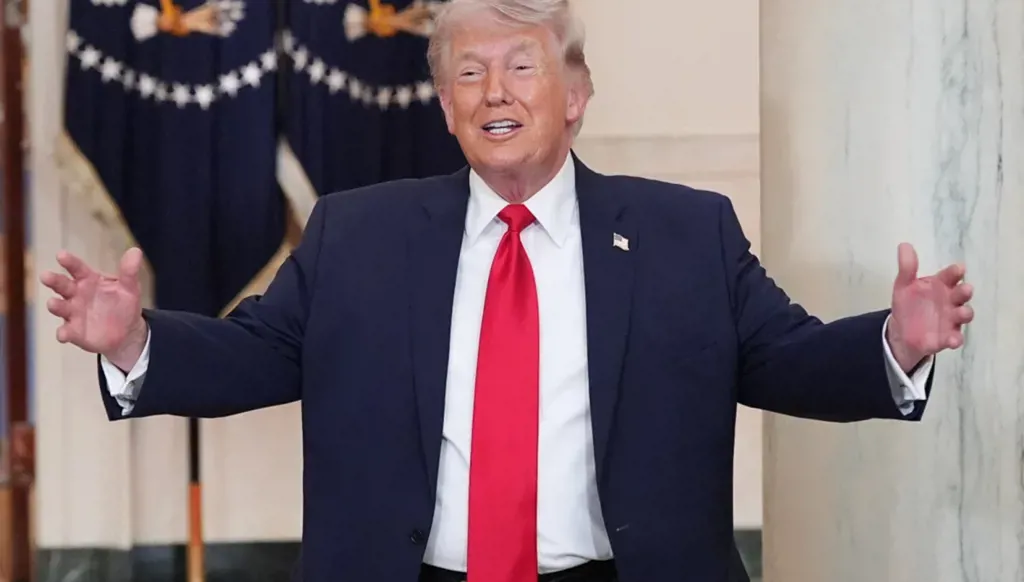
The main danger for Trump does not lie in defeat, but in a “limited” or “incomplete” success. (AFP)
Smaller Bigger

During the Easter lunch at the White House on April 1, Paula White-Cain, Trump’s religious advisor, compared him to Jesus Christ, highlighting the “Savior Lord’s” suffering from “trials,” “betrayal,” and “false accusations.”


In American politics, metaphors rarely remain in the heavens; they quickly descend to the earth—shaped by interests, tested by facts, and ultimately judged by outcomes. When the language of religious salvation is used to describe a president confronting an ongoing international crisis, the concern shifts from rhetoric to destiny.


If Trump’s supporters welcomed his comparison to Jesus Christ, who would politically crucify him if he fails? The answer will likely come not just from his usual adversaries, but from the very camp that put him in power, from the predicament he fashioned with his own hands, and from the storm that consumes its instigator, as it has consumed many before him.


With Iran blatantly and criminally assaulting the Gulf countries daily, Hormuz becomes its major tool.


Trump acted on the logic that Tehran was just steps away from surrender, assuming it couldn’t risk closing its vital artery, Hormuz—but in practice, it nearly did.

Soon, the man realized he had embarked on a war he could not finish. Conflicts that threaten the existence of totalitarian regimes in the Middle East are not resolved by a countdown, but by the logic of survival.


As long as the Iranian regime’s demand is to preserve its vital deterrent tools, pressure serves less to open the door to a settlement than to shut it.


Trust is a rare commodity among ideological regimes in the Middle East. Unless American military coercion yields a swift surrender, it only leads to a prolonged deadlock.


This is where the real predicament begins. The Mullah regime doesn’t need a military victory to derail Trump’s plan; simply raising the costs, prolonging the timeline, and shifting the confrontation to international markets and waterways is enough—causing Trump to stumble ever more.


When Trump says, “whoever needs oil should open the strait,” he strengthens Iran’s position and puts oil‑importing capitals—desperate for supply—in a very weak spot against Iran, which has long sought to assert its dominance over Hormuz.


Then, how can these countries gamble with the role of policeman in the Gulf under the mutual bombing by the US, Israel, and Iran? Moreover, those who are meant to guard and enforce control!


It’s truly a surreal film! It’s hard to believe that Trump is ready to relinquish American influence in the Middle East and delegate its security to an international consensus between China, Japan, Europe, and Iran!


This logic fundamentally contradicts the goal of making “America Great Again”! Will America choose to abandon one of its Middle East policy pillars for the sake of Israel’s security?


Here, the equation turns against its initiator. What begins in Washington as a “pressure on Iran’s artery” policy quickly becomes a crisis framed around “market stability” and “preventing an explosion,” abandoning America’s Gulf role. Hormuz becomes the epicenter, and Trump’s ultimate goals give way to minimal objectives: containment, de-escalation, temporary arrangements, and face-saving exits.


However, following the same crisis logic, ground entanglement occurs gradually. If Trump continues escalating without a reliable negotiation exit, he will find himself drawn into ground involvement. It starts with special forces, then support teams, specialized operations, defensive deployments, and eventually field presence and positioning that exceed his declared objectives. As long as Iran does not surrender, the scope of targets will continue to expand.


Wars are easy on maps but difficult on the ground. This is the trap that American wars in the Middle East have always been known for: promises of resolution end in ground entanglement. A “clean punitive” campaign turns into a field commitment that ignores speeches or elections. Even Trump’s own rhetoric becomes a burden on him.


The man who built much of his legitimacy by mocking his predecessors’ “stupid wars” discovers that unchecked escalation brings him back to the very doorstep he promised his audience he would shut. Open wars drain great nations, wasting their political capital.


At that point, the true avengers will reveal their weapons. They will not be Tehran’s generals or soldiers in Khorramshahr, but rather Trump’s collaborators within America.


A broad current among conservatives views this war not as serving the “America Great Again” project, but as a drain. They argue that Trump betrayed his mandate as a president who promised a firm grip, not a new quagmire. Naturally, his Democratic opponents, the media establishment, and segments of an audience weary of foreign adventures will align with them.


The main danger for Trump doesn’t lie in defeat, but in “imperfect success.” American voters don’t judge a president by maps, but by the bill: the dead, the spending, oil disruptions, unstable markets, and broken promises. In American politics, localized crises often escalate into full-blown domestic battles.


So far, Trump has offered 12 contradictory reasons for this war, set numerous shifting “deadlines,” and issued many vague threats. In doing so, he doesn’t fool his adversaries but confuses his allies and raises the cost of retreat. When a president becomes captive to his own image, he tends to escalate—not because it is the most viable option, but to uphold the gravitas of his words.


Meanwhile, crushed and weakened, Iran spirals toward total ruin under the weight of reckless ideological adventures, sacrificing its people for the “regime’s resilience” and deepening the uncertainty at its core. That too is an old formula for miscalculation.


The current American ground presence seems likely, but it appears to be the quickest path to a domestic crisis. It will never yield a clear American victory, yet it will strike at the very center of Trump’s political equilibrium.


Trump now realizes that the path to war doesn’t run only through the Gulf, but through Washington as well.


When escalation and imperfect victory become strategic, ethical, and electoral burdens, his liberal opponents—and even allies within MAGA—will crucify him on the cross of crisis.


Politics offers no free gifts. Religious hypocrisy alone cannot shape fate. Whoever elevates themselves to the level of salvation also raises the ceiling of their own costs.


As Trump’s allies and generals distance themselves, his opponents grow emboldened, and his supporters retreat into a cocoon, confronting the forces Trump once considered his rear guard. He will move toward slow internal decay.


Then the question won’t be how “Cain” compared him to Christ, but how he ended up hanging on the political cross.

العلامات الدالة

مواضيع ذات صلة

4/4/2026 11:37:00 AM

الأكثر قراءة

الخليج العربي 4/5/2026 12:21:00 PM
السعودية: نُدين الإساءات غير المقبولة للرموز الوطنية للإمارات أثناء الاعتداء على سفارتها 
الخليج العربي 4/5/2026 4:30:00 PM
قرقاش: لا يسعني إلا أن أُحيّي صمود وثبات مملكة البحرين الشقيقة
الخليج العربي 4/5/2026 1:44:00 PM
الاعتداءات تسببت بأضرار مادية جسيمة... ولم تُسجَّل أي إصابات بشرية.