

From isolation to engagement: Europe’s calculated embrace of Al‑Sharaa
The European capitals understood that without the transformation led by Al-Sharaa, Syria today would have been a front fighting alongside Iran, under the guidance of Iranian Revolutionary Guard advisors...


 Messenger
 Whatsapp
 Threads
 Email
Email
 Print
Print
 X
X
 Facebook
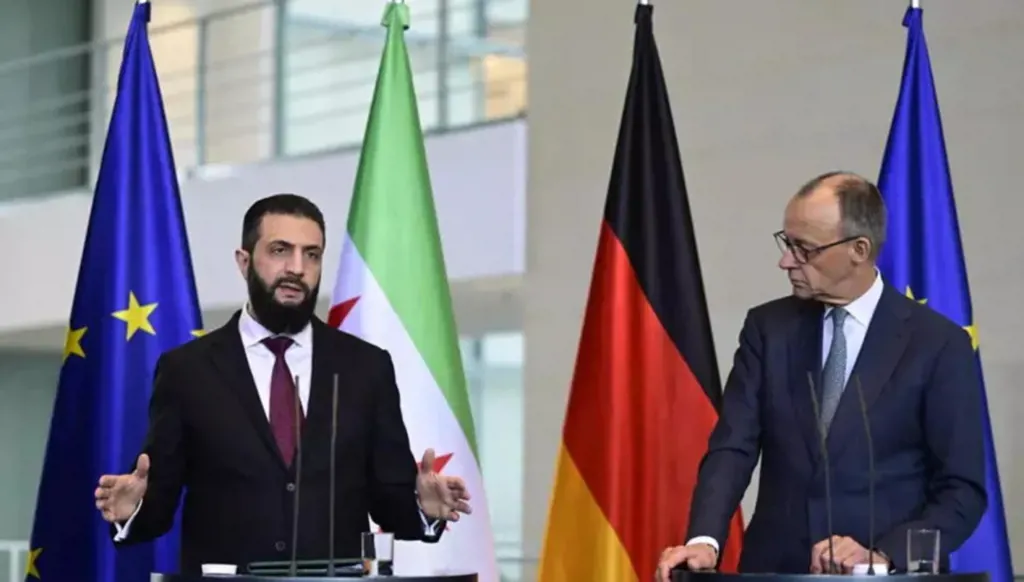


A year and a half ago, no Middle East expert could have imagined that the President of Syria could visit London and Berlin by official invitation. Bashar al-Assad’s regime was suffering from a complete break with all European countries, and its president had become an unwanted figure. A year and a half ago, it would have been unthinkable for a Syria specialist to foresee a new president with a “jihadist” background being hosted by German Chancellor Friedrich Merz and British Prime Minister Keir Starmer.
A few days after Al-Sharaa arrived in Damascus, just hours after Assad fled to Moscow, European and American diplomats rushed to meet him, gauge his character, and explore the forms of support that appeared unconditional. Flags were raised over Western embassies one after another, signaling full endorsement of the changes in Syria and support for maintaining the conditions that allowed it to persist.
Words of reproach, anger, and understanding
Western capitals closely followed the Syrian regime’s stumbles in violent and painful internal incidents. They were slow to apply their usual pressures on these matters, and at times even concealed them. Diplomatic language combined elements of reproach, anger, and understanding. U.S. President Donald Trump welcomed Al-Sharaa to the White House months after French President Emmanuel Macron had received him at the Élysée Palace. Caesar Act sanctions were lifted. Syria returned to the international system, yet the momentum, which had reached its peak, was no longer enough to pull Syria out of its predicament.
These capitals understood that without the transformation led by Al-Sharaa, Syria today would have been a front fighting alongside Iran, under the guidance of Iranian Revolutionary Guard advisors, the Fatimid and Zainabi militias, and other groups loyal to the Iranian Supreme Leader. They also understood that since the start of the current war, Damascus had deployed forces along Syria’s eastern border with Iraq and western border with Lebanon to prevent the conflict from spreading into Syrian territory. They also knew that this military and security effort to protect the borders was challenged by domestic pressures, with the country facing an economic crisis that international momentum could not alleviate.
The cordial support of a friend and ally
During his visit to Berlin and London, Al-Sharaa discovered Europe’s commitment to continue supporting the Syrian experience. Germany and Britain’s view of the Syrian transformation remained unchanged: it is seen as a strategic security interest for the continent and a necessary gateway for resolving the Syrian refugee crisis. At the same time, the Syrian president realized that these two countries, and the West behind them, openly—but always in the spirit of friendship and alliance—expect the new Syria to adopt progressive principles, building a modern state based on justice and the rule of law, safeguarding social stability and minority rights, and providing a legal environment conducive to foreign investment.
It seemed that internal discussions within Britain and Germany demanded accountability for the conditions of support for Syria. Reports emerging from London and Berlin during the Syrian president’s visit reflected a general sentiment calling on Al-Sharaa to introduce changes in the structure of the state, its constitution, political processes, and laws—measures that would remove any hesitation or doubts and encourage financial programs for reconstruction in Syria. Al-Sharaa’s visit was preceded by new sectarian unrest and a UN report on responsibilities for events in Suwayda. Yet circumstances suggested that the world, both near and far, was now attentive to Syria, and Damascus could hear the messages clearly.
Europe needs a strong Syria to maintain the new balance created by Iran’s removal from the Tehran-Beirut corridor equation. It needs security in Syria to prevent waves of terrorism that Europe has experienced in the past. Europe, particularly Germany, wants Syrian refugees—or most of them—to return to their country.
However, Damascus, Berlin, and London understand that the return of refugees requires security, stability, and adequate infrastructure. Meanwhile, European plans to finance this effort still demand urgent answers from Syria, but Damascus responds with considerable vagueness and ambiguity.
It is unclear what Al-Sharaa heard behind the scenes, but he listened carefully and came to view the world from a new perspective: the revolution and its momentum had ended, and the era of the state and its principles had begun.
Disclaimer: The opinions expressed by the writers are their own and do not necessarily represent the views of Annahar.