

October 7, 2023: The day the middle east map was blown apart


 Messenger
 Whatsapp
 Threads
 Email
Email
 Print
Print
 X
X
 Facebook
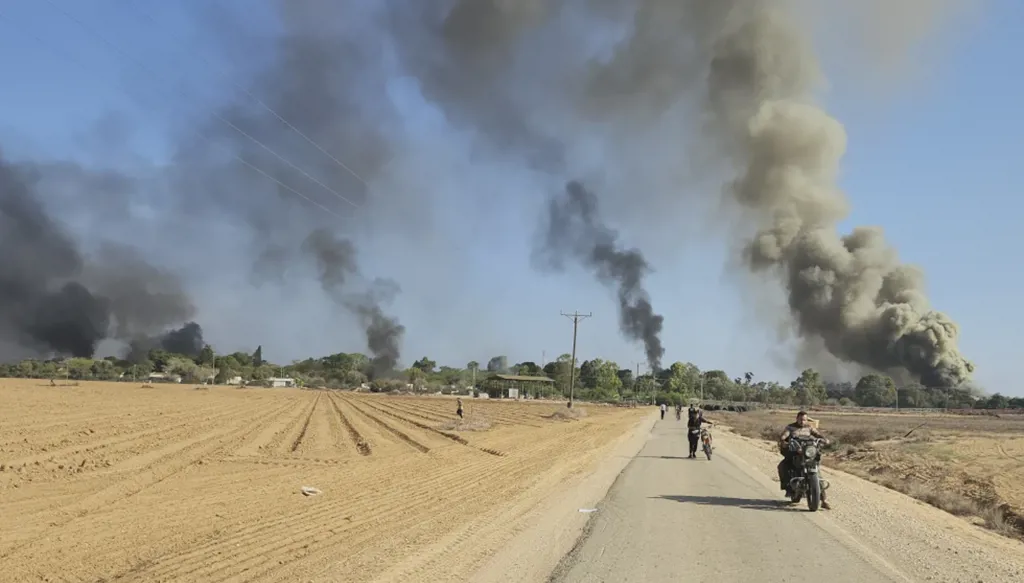


October 7, 2023, stands as one of the most consequential dates in the Middle East in the first quarter of this century. It triggered rapid geopolitical changes across the Middle East and its impact will likely influence regional trajectories well into the future.
When Israeli Prime Minister Benjamin Netanyahu declared: "We want to change the face of the Middle East," the statement reflected a broader realignment already underway. Iranian influence has waned, while Turkey’s regional presence has gained momentum. Meanwhile, major players such as Russia confront an unclear path ahead, and the political map has been redrawn across the Israel-Syria-Lebanon front and within Palestine.
October 7 was the most destructive day in the history of Israel and the Jewish people since the Holocaust. According to Axios, this day marked “the largest massacre of Jews since the Holocaust” and led Israel into “the longest war in its history.” What followed was the most violent in the history of Palestine, with the death toll exceeding 45,000 and the Palestinians losing the Gaza Strip, which was reduced to rubble by Israeli tanks.
The events of October 7, or the so-called “Al-Aqsa Flood,” were the trigger for this change in the Middle East. A surprise operation by Hamas—which Israeli experts say fooled Israeli intelligence, security, and military agencies—paved the way for Netanyahu and the two powerful countries behind him, Israel and the United States, to launch new Middle East projects, starting in Gaza and moving to the West Bank, Lebanon, Syria, Iraq, Yemen, and Iran.
Tahani Mustafa, senior analyst for Palestinian affairs at the International Crisis Group, told An-Nahar that she “sees the issue from two perspectives: everything has changed, and nothing has changed.” In Mustafa’s opinion, divisions among Palestinians “continue and have deepened after the events of October 7, revolving around many issues, including the Palestinian state, governance crises, and the absence of a political horizon.”
A new Middle East without Iran
The new Middle East envisioned by Netanyahu excludes Iran from its landscape, limits its influence, and weakens its power and ability to reach Israel. The Israeli prime minister first aimed to dismantle this axis, aligning the arenas according to his strategy.. He attacked and almost completely destroyed Hamas, weakened Hezbollah, and eliminated the power of the Syrian regime, Iran's strategic ally, which then fell.
The powerful blows Iran received have put it on the defensive. Iran was unable to save Hamas, Hezbollah, or Bashar al-Assad's regime. After losing its front lines and witnessing its allies preoccupied with priorities related to their own national security, Iran realized that the danger could reach within its borders and threaten its regime.
“The Persian crescent is over, and Iran has been forced to retreat within its borders.” journalist and political writer Hanna Saleh observed in his interview with An-Nahar.Mustafa, meanwhile, believes that the Iranian axis has turned out to be a “paper tiger.” The war has shown that Iran “does not have a serious deterrence strategy against Israel, which has demonstrated military superiority in the region, giving it the freedom to do as it pleases.”
Perhaps one of the most important repercussions of the “Al-Aqsa Flood” is the erosion of the idea of Hezbollah as an invincible force –not only in Lebanon, but also in Syria, Iraq, and Yemen. Since the assassinations of its field commanders, followed by the bombing of the “Beavers,” and culminating with the assassination of its powerful secretary-general, Hassan Nasrallahalong with his successor, and his successor's successor–it has been clear that the Persian crescent is heading towards collapse. Hezbollah's own weakness brought down the Syrian regime in less than 13 days, after a 13-year “struggle for survival.”
Turkey filling the void?
The region falls within a triangle of three regional powers: Israel, Iran, and Turkey. Iran's absence from Syria after Assad's fleeing was quickly filled by Turkey's growing presence. Turkish President Recep Tayyip Erdogan was the first to toast Assad's downfall, and his foreign minister, Hakan Fidan, was the first to visit Damascus to meet with the new Syrian leadership.
The special relationship between the new political and military leadership in Syria and Turkey is no secret. This was demonstrated by the visit of Turkey's intelligence chief Ibrahim Kalin, followed by Fidan, who viewed Damascus from the summit of Mount Qasioun in a scene laden with symbolic and political significance, after Assad and his Iranian allies had controlled this summit and extended their influence over the capital.
Changes that brought down Sykes-Picot
The region has also witnessed unprecedented geopolitical changes and the drawing of new boundaries, suggesting the end of the Sykes-Picot borders and those agreed upon after the 1967 war. Israel invaded Syria and reached Quneitra, 25 kilometers from Damascus, and took control of the strategic Mount Hermon. It is unlikely that the invasion will be temporary. Israel also reoccupied the Gaza Strip and began a political process to impose its sovereignty over the West Bank.
Mustafa sees the changes to the maps as a “result” of the repercussions of October 7. In her opinion, Israel took advantage of what happened to achieve its “expansionist goals” and will continue its attempts to “gain what it can, taking advantage of US President-elect Donald Trump's arrival in the White House.”
Saleh recalls Trump’s statement that “Israel is a small space for its inhabitants.” Considering Israel to be the “biggest winner” in light of the changes taking place in the region, he does not rule out further expansion, annexation of the West Bank, and an end to the two-state solution.
Israel and an unprecedented crisis
October 7 and its aftermath had the most serious political and diplomatic impact on Israel, both internally and regionally. Despite open US support, the consequences of the event placed Israel in a delicate diplomatic situation and brought it before international courts. In Mustafa's opinion, Israel is facing “diplomatic disasters and shifts in public opinion,” even though it is “not isolated,” and these events may be the first of their kind.
The events of October 7 rewrote history. Although the Palestinian reality remained unchanged, only deteriorating dramatically and drastically, the international shifts have been the most prominent, reshaping spheres of influence and even redrawing borders. In such a fast-moving and unpredictable landscape, outlining the region’s future has become increasingly difficult.