

.اشترك في نشرتنا الإخبارية لتحصل على أهم و أبرز أخبار اليوم




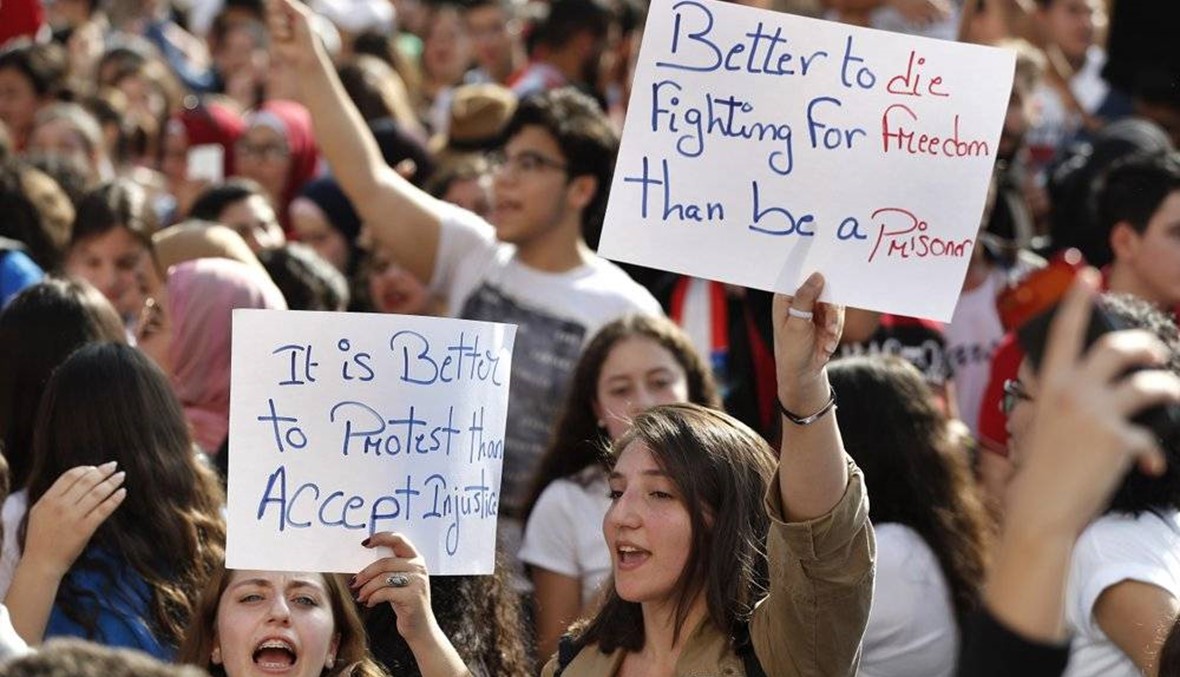


The 17 October Revolution in Lebanon may be a spontaneous movement wanting to remain “fluid” without clear leadership, but youth are clearly at the helm of this mass mobilisation, dubbed the “student revolution” as protests entered their fourth week. Open discussions and debates take place in downtown Beirut on a daily basis discussing a wide range of socioeconomic and political issues in bottom-up citizen-led deliberations. Discussions are participatory, democratic and equal and protests are decentralised and non-violent. Each neighbourhood or group holds its own internal discussions for mobilisations and makes its own decisions.
It is not only the scale of the revolution that is unprecedented, but also its aspirations for change. The 17 October revolution is not just a political intifada but a cultural revolution toward a more inclusive Lebanon, one where youth will no longer passively accept discrimination based on age, sect, gender, socioeconomic background or any other grounds. Equal opportunities are a basic tenet of an inclusive economy and society, and it is precisely this usurpation of equal opportunities that youth were leaving their classrooms to contest on the streets.
The country came to a standstill for the first two weeks of the revolution with leading educational institutions, faculty and students supporting the mobilisation. The University Professors’ Coalition, which brings together professors from private and public universities, actively participated in the mass mobilisation, emphasizing the need to protect the independence of higher educational institutions and particularly the Lebanese University, the only public university. A joint statement by the presidents of the American University of Beirut (AUB) and Saint Joseph University (USJ) urged the Lebanese authorities to “embrace the new spirit … to build a civil state that goes beyond sectarianism and interest-sharing.” The Parents’ Committee in Private Schools fully supported the closure of schools, with the Committee issuing a statement stating that “a degree framed on the wall is useless if its holder is unemployed.”
When schools and universities re-opened their doors during the third and fourth weeks of protests, however, it was students themselves who refused to return to business as usual. Thousands of school and university students from across the country deliberately left the classroom and joined nationwide protests on 6 November. Students from public and private universities self-organized forming the group “October 17 students” the next day to coordinate collective protests and exert pressure on universities not to open before their demands are met. On their banners and in interviews, several students repeated they were “not going [to class] to learn history,” but were “here to write it.” Their position, as summarised in one banner, was simply, “Why have an education if we have no future?”




 واتساب
 يوتيوب
 انستغرام
 نبض
نبض
 ثريدز
ثريدز
 مسنجر
مسنجر
 بريد إلكتروني
 الطباعة
 نسخ الرابط